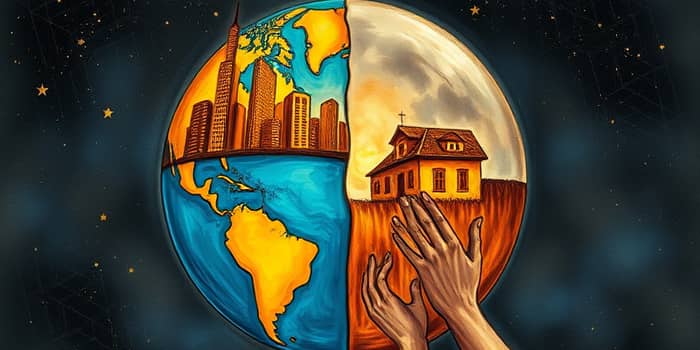
The global economic landscape is marked by a profound and growing chasm that shapes lives and futures. Extreme wealth concentration defines our era in ways that demand urgent attention and action.
This divide isn't just a statistical curiosity; it affects access to education, healthcare, and environmental sustainability. Every day, millions feel the weight of this imbalance in their daily struggles.
Understanding this economic divide is the first step toward fostering a more equitable world. We must confront stark realities to inspire meaningful change and hope.
The Stark Reality of Global Wealth Divide
Recent data reveals a shocking imbalance in how wealth is distributed worldwide. The top 10% controls 75% of all wealth, leaving little for the majority.
At the extreme, the wealthiest individuals hold disproportionate power and resources. The bottom 50% holds just 2% of total global wealth, highlighting immense disparities.
This concentration isn't just about numbers; it translates into real-life hardships and limited opportunities. Top 1% alone controls 37% of global wealth, more than many nations combined.
The implications are vast, affecting everything from political influence to social mobility. We need to grasp these facts to drive conversations about fairness.
- Key statistics show that wealth inequality surpasses income gaps significantly.
- Historical trends indicate a worsening divide over recent decades.
- Regional variations add layers of complexity to this global issue.
Population Distribution and Its Implications
The global adult population is structured into distinct segments based on wealth. Most people belong to the lower or middle tiers, with few at the top.
This distribution shapes economic policies and social programs. Wealth disparities entrench intergenerational impact, making it harder for families to escape poverty.
Understanding who holds wealth helps us target solutions more effectively. It's a crucial step in addressing systemic inequities.
- The bottom 50% includes 2.8 billion adults with minimal assets.
- The middle 40% comprises 2.2 billion people with moderate wealth.
- The top 10% has only 556 million individuals controlling most resources.
Wealth vs. Income: Understanding the Core Difference
Wealth inequality is much larger than income inequality globally. This means assets and capital are concentrated in fewer hands than earnings from work.
Wealth gaps are far larger than income gaps in every region, even in places with lower income disparity. This reflects how capital ownership amplifies economic divides.
Recognizing this difference is key to crafting effective economic policies. It shifts focus from just wages to broader asset distribution.
Regional Disparities: A Closer Look
Wealth inequality varies dramatically across different parts of the world. Some regions face much wider divides than others, influenced by history and policy.
Middle East & North Africa show widest wealth divides, with ratios exceeding 520 to 1. This stark contrast affects millions of lives daily.
In contrast, Europe maintains lower levels of inequality, but challenges persist. Regional disparities are dramatic and complex, requiring tailored approaches.
- North America & Oceania: High wealth inequality with significant economic polarization.
- South & Southeast Asia: Relatively lower but still substantial wealth gaps.
- Sub-Saharan Africa: Combines high income and wealth inequalities, exacerbating poverty.
- Latin America: Similar patterns with deep-rooted economic challenges.
- East Asia: Growing wealth concentration amid rapid development.
Country-Level Insights
The Gini Coefficient measures wealth inequality, with higher values indicating greater disparity. Countries rank differently based on their economic structures and policies.
South Africa has highest inequality with a Gini of 63.0, reflecting deep social divides. In developed nations, levels are lower but still concerning.
Understanding these rankings can inform global efforts to reduce inequality. It highlights where interventions are most urgently needed.
- Highest inequality: South Africa (63.0), Namibia (59.1), Botswana (54.9).
- Upper-middle tier: Colombia (53.9), Brazil (51.6), Zambia (51.5).
- Developed nations: United States (41.8), United Kingdom (32.4), Germany (32.4).
- Lowest inequality: Slovakia (24.1), Slovenia (24.3), Belarus (24.4).
Historical Context and Trends
Over the past centuries, global wealth has become increasingly concentrated. The share of the ultra-rich has accelerated, reshaping economic landscapes.
Top 0.001% share increased from 3.8% to 6.1% by 2025, indicating a trend toward greater inequality. This historical perspective underscores the urgency of action.
While average incomes have risen, distribution remains deeply uneven. Global inequality takes on structural character, affecting long-term stability.
- Wealth share of the rich has grown steadily since the 1990s.
- Globalization has reduced inequality between nations but increased it within them.
- Economic expansion benefits are distributed highly unevenly across populations.
Structural Issues in the Financial System
The global financial system often favors rich countries, perpetuating wealth disparities. Net income transfers flow from poorer to richer nations, exacerbating divides.
Global financial system is rigged in ways that hinder equitable development. This dynamic limits opportunities for billions in lower-income regions.
Addressing these structural issues requires international cooperation and policy reforms. It's a critical step toward a fairer economic order.
- Approximately 1% of global GDP flows annually to richer countries.
- This amount is nearly three times global development aid, highlighting imbalances.
- Intergenerational wealth transfer entrenches inequality across generations.
Environmental and Social Impacts
Wealth concentration has dire consequences for the environment and society. The richest individuals contribute disproportionately to climate change and social strife.
Emissions of richest 1% cause heat deaths, estimated at 1.3 million by century's end. This links economic inequality directly to environmental justice.
Socially, wealth disparities shape life chances and access to resources. Wealth hierarchies exacerbate global challenges, from health to education.
Recognizing these impacts can motivate collective action for sustainability. It ties economic fairness to planetary well-being.
Towards a More Equitable Future
Addressing wealth distribution requires practical steps and inspired commitment. Individuals and communities can play a role in fostering change.
Start by educating yourself and others about these issues. Global economic divide demands collective action to shift narratives and policies.
Support policies that promote fair taxation and wealth redistribution. Advocate for transparent financial systems that benefit all, not just the elite.
Engage in local initiatives that address poverty and inequality. Small actions, when multiplied, can lead to significant transformations.
Remember, understanding the divide is the foundation for building a better world. Hope lies in informed and persistent efforts toward equity.
Together, we can work towards a future where wealth is shared more justly. Let this knowledge empower you to be part of the solution.
References
- https://www.shankariasparliament.com/blogs/pdf/world-inequality-report-2026
- https://worldpopulationreview.com/country-rankings/wealth-inequality-by-country
- https://wir2026.wid.world/insight/global-economic-inequity/
- https://www.oxfam.org/en/press-releases/richest-1-have-blown-through-their-fair-share-carbon-emissions-2026-just-10-days
- https://wid.world/news-article/world-inequality-report-2026-inequality-persist-at-a-very-extreme-level/
- https://qazinform.com/news/75-of-global-wealth-held-by-10-of-the-population-2d9c55
- https://www.visualcapitalist.com/the-global-distribution-of-wealth-shown-in-one-pyramid/
- https://peoplesdispatch.org/2025/12/18/half-of-the-worlds-population-owns-just-2-of-global-wealth-un-report-finds/
- https://socialcapitalpartners.ca/what-the-new-world-inequality-report-tells-us-and-why-it-matters-for-canada/