Every day, we navigate a world filled with choices that shape our lives and happiness.
Imagine deciding between paying rent or buying a new gadget; such moments reveal the deep impact of understanding needs versus wants.
This knowledge is essential for survival and thriving, guiding us toward a balanced and meaningful existence.
By mastering this distinction, you can unlock greater financial freedom and emotional well-being.
Let’s embark on a journey to clarify these concepts and transform your perspective.
The Core Distinction: Needs Versus Wants
Needs are the fundamental requirements for life and basic well-being.
Without them, survival becomes impossible, and thriving is out of reach.
Wants, however, are desires that add pleasure and comfort to our lives.
They enhance experiences but are not vital for existence.
This differentiation forms the bedrock of wise decision-making in daily life.
Recognizing it helps prioritize what truly matters.
Linguistic Insights: How Words Shape Our Understanding
The verb "need" conveys urgency and necessity, such as in "I need water."
It implies a requirement that cannot be ignored without consequences.
In contrast, "want" expresses a craving or wish, like "I want a vacation."
This linguistic nuance highlights the essence of necessity versus desire.
Understanding these terms enriches our communication and self-awareness.
It allows us to articulate our priorities more clearly.
Maslow's Hierarchy: A Framework for Human Needs
Abraham Maslow's theory provides a structured approach to human motivation.
It organizes needs from basic physiological requirements to higher growth aspirations.
This hierarchy serves as a roadmap for human motivation and fulfillment.
It illustrates how our priorities evolve as we meet foundational needs.
- Physiological needs: Air, water, food, shelter, sleep, and clothing.
- Safety needs: Personal security, financial stability, and health protection.
- Love and belonging: Relationships, friendship, and emotional support.
- Esteem needs: Self-respect, achievement, and social recognition.
- Self-actualization: Realizing one's full potential and pursuing passions.
Each level builds upon the previous, guiding personal development.
Fulfilling these needs leads to a more enriched and purposeful life.
Practical Examples: From Survival to Luxury
To make these concepts tangible, consider everyday scenarios.
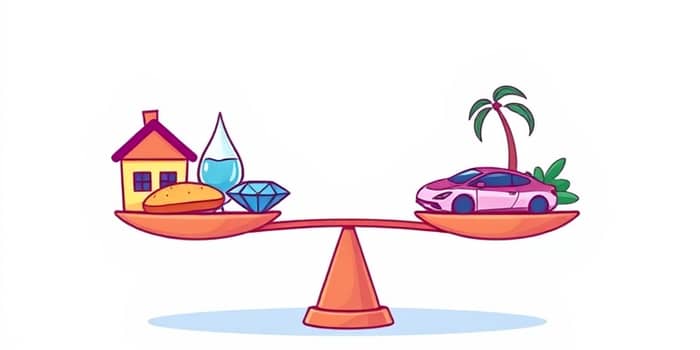
Basic groceries are a need for nourishment, while gourmet food is a want for indulgence.
A car for commuting to work might be a necessity, but a sports car is a luxury desire.
This clarity helps in distinguishing priority in spending habits.
This table visually reinforces the separation between essentials and extras.
It aids in making informed choices during budgeting or shopping.
Gray areas often arise, such as education being a need for growth, but expensive courses a want.
- Basic transportation is a need; luxury models are wants.
- Clothing for protection is a need; designer brands are wants.
- Social interaction is a need; exclusive club memberships are wants.
- Exercise for health is a need; high-end gym equipment is a want.
- Savings for emergencies are a need; impulsive investments are wants.
Identifying these nuances prevents common financial and life pitfalls.
Financial Wisdom: Budgeting with Needs and Wants
Effective budgeting starts by prioritizing needs over wants.
Allocate around 50-60% of your income to essentials like housing and groceries.
This strategy ensures long-term financial security and stability.
Then, use the remainder for wants, while saving for future goals.
- List all expenses and categorize them as needs or wants.
- Cut back on non-essential items first to increase savings.
- Use budgeting apps to track spending and set limits.
- Establish emergency funds to cover unexpected needs.
- Review and adjust your budget monthly to stay aligned with priorities.
This approach minimizes debt and fosters a sense of control over finances.
It empowers you to make choices that align with your values and aspirations.
Teaching Kids: Simple Lessons for Life
Educating children about needs and wants sets a foundation for responsible adulthood.
Use relatable examples and interactive activities to make learning engaging.
This fosters responsible decision-making from a young age.
- Needs are like food and water; without them, we cannot stay healthy.
- Wants are like toys or candy; they are fun but not necessary for survival.
- Play classification games where kids sort items into needs or wants.
- Involve them in family budgeting discussions to build financial literacy.
- Praise wise choices with allowance money to reinforce positive behavior.
These lessons cultivate mindfulness and gratitude in everyday life.
They help children appreciate what they have while understanding limits.
Common Pitfalls: When Wants Masquerade as Needs
One significant challenge is confusing desires for necessities.
For instance, a large house might be justified as shelter, but if it exceeds basic requirements, it becomes a want.
Similarly, expensive clothing can be disguised as a need for professional appearance.
Recognizing these traps maintains a clear perspective on life priorities.
- Ask yourself, "Can I survive or thrive without this item?"
- Consider affordable alternatives that meet the same need.
- Reflect on whether purchases align with long-term goals.
- Avoid societal pressures that inflate wants into perceived needs.
- Practice mindfulness before making impulsive buying decisions.
This awareness reduces stress and promotes contentment with simpler choices.
It encourages a lifestyle focused on fulfillment rather than accumulation.
Balancing for Well-Being: The Path to Fulfillment
Life is not just about meeting basic needs; it is about creating joy and meaning.
While needs ensure our survival, wants add color and happiness to our experiences.
Striking a balance leads to an emotionally rich and satisfying life.
Fulfill needs first to establish a stable foundation.
Then, indulge in wants moderately to enhance daily living.
Over-pursuing wants can lead to dissatisfaction, just as neglecting needs causes hardship.
This equilibrium supports mental health and overall well-being.
In conclusion, understanding the difference between needs and wants is a transformative skill.
It empowers you to make choices that enhance financial health and personal happiness.
Start today by assessing your own priorities and taking steps toward a balanced future.
Remember, this journey is about achieving harmony in life's choices.
References