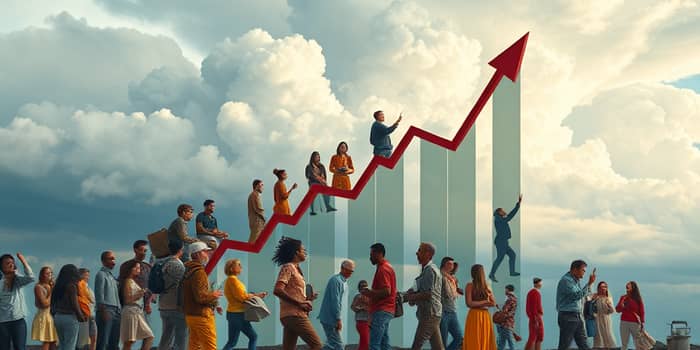
Recessions test our resolve but also present opportunities for growth and innovation. Understanding their roots and remedies empowers individuals, businesses, and policymakers to navigate uncertainty with confidence.
What Is a Recession?
A recession is more than a headline; it is a period of significant decline in economic activity that affects every sector of society. Traditionally defined as two consecutive quarters of negative GDP growth, this rule of thumb overlooks nuances captured by the National Bureau of Economic Research (NBER), which considers real income declines, rising unemployment, and reduced consumer spending.
In Australia, a recession is recognized by sustained weak or negative real GDP growth accompanied by rising joblessness, low household outlays, slumping business investment, and increasing loan defaults. These criteria underscore the multifaceted nature of downturns across different economies.
Key Indicators and Early Warnings
- Gross Domestic Product (GDP) contraction
- Rising unemployment and reduced hours
- Declines in manufacturing, retail sales, and real income
- Inverted yield curve signaling tighter credit conditions
- Conference Board Leading Economic Index downturns
By monitoring these signals, analysts can anticipate seasonal shifts turning into prolonged contractions. For example, an inverted yield curve—where short-term rates exceed long-term rates—preceded every U.S. recession since 1955.
Other leading indicators include weekly unemployment claims, ISM new orders, and manufacturing hours. When these converge toward negative territory, they often foreshadow broader economic stress.
Why Recessions Occur
- Economic shocks: pandemics, natural disasters, geopolitical conflicts
- Loss of consumer confidence snowballizing spending cuts
- High interest rates raising borrowing costs
- Financial instability: credit crunches and banking crises
- Inflation eroding purchasing power and affordability
- Trade disruptions and policy shocks such as tariffs
These triggers often interact. For instance, high inflation may prompt central banks to tighten policy, which then increases borrowing costs and dampens investment. Similarly, a drop in consumer sentiment can lead to layoffs, further reducing spending in a self-reinforcing cycle.
Historical Patterns and Lessons
Since 1948, the United States has experienced 11 recessions, averaging 11 months each. The brief two-month downturn in early 2020, driven by the COVID-19 pandemic, was an outlier in both speed and depth. By contrast, the Great Recession of 2008–2009, triggered by the housing bubble burst and subprime crisis, lasted 18 months and inflicted lasting damage.
Australia’s Q2 2020 GDP drop of 7% highlights how sudden external shocks can overwhelm even resilient economies. Examining these episodes teaches us that no recession is identical; each carries distinct causes and recovery trajectories.
Impact on Economy and Society
Recessions bring job losses, business closures, and tighter credit conditions. Unemployment may spike from lows of 4% to peaks above 8% in severe downturns, straining household budgets and mental health.
Long-term consequences include permanent capacity loss and innovation setbacks, especially when smaller firms fail. Supply chains can fracture, and public debt often rises due to lower tax revenues and increased stimulus spending.
Strategies for Mitigation and Recovery
- Monetary easing and fiscal stimulus to sustain demand
- Targeted interventions preserving consumer confidence
- Diversifying supply chains to reduce shock exposure
- Strengthening social safety nets and unemployment support
Central banks can cut interest rates and deploy quantitative easing to lower borrowing costs. Governments can implement countercyclical spending programs, from infrastructure projects to enhanced unemployment benefits.
Businesses should focus on maintaining liquidity, reviewing debt maturities, and adjusting inventory levels. Diversifying customer bases and revenue streams builds resilience against localized downturns.
2026 Outlook and Practical Advice
As of early 2026, consensus recession odds range from 30% to 40% for the U.S., driven by slowing consumer spending, K-shaped recovery divides, and stubborn inflation near 3%. Baseline forecasts project ~2.2% GDP growth, 4.5% unemployment, and moderate price gains.
To prepare at a personal level, focus on these steps:
- Build an emergency fund covering 6+ months of expenses
- Pay down high-interest debt ahead of potential rate cuts
- Diversify investments across sectors and asset classes
- Enhance skills and certifications to improve job security
Businesses can:
- Conduct stress tests on cash flow and supply chains.
- Negotiate flexible loan terms and line-of-credit facilities.
- Invest selectively in automation and digital capabilities.
Conclusion
Recessions are natural phases in economic cycles. While they bring hardship, they also catalyze innovation and reform. By understanding causes, monitoring indicators, and adopting targeted interventions and prudent planning, societies can cushion impacts and emerge stronger.
Embrace uncertainty as an opportunity to adapt, innovate, and build lasting resilience. The knowledge and strategies outlined here can guide you through downturns and toward sustainable growth.
References
- https://spn.org/what-is-a-recession/
- https://rsmus.com/insights/economics/economic-outlook-for-2026.html
- https://www.invesco.com/us/en/insights/what-is-a-recession.html
- https://www.conference-board.org/topics/us-leading-indicators/
- https://www.rba.gov.au/education/resources/explainers/recession.html
- https://www.youtube.com/watch?v=T7UjQJu7Uio
- https://www.ie.edu/uncover-ie/how-do-recessions-happen-ie-school-of-politics-economics-and-global-affairs/
- https://www.cbo.gov/publication/62105
- https://www.mckinsey.com/featured-insights/mckinsey-explainers/what-is-a-recession
- https://www.brookings.edu/articles/economic-issues-to-watch-in-2026/
- https://www.munich-business-school.de/en/l/business-studies-dictionary/financial-knowledge/recession
- https://www.federalreserve.gov/econres/notes/feds-notes/assessing-recession-risks-with-state-level-data-20260107.html
- https://www.jpmorgan.com/insights/global-research/outlook/market-outlook
- https://fortune.com/2026/03/01/boomer-consumption-investing-labor-jobs-creation-recession/