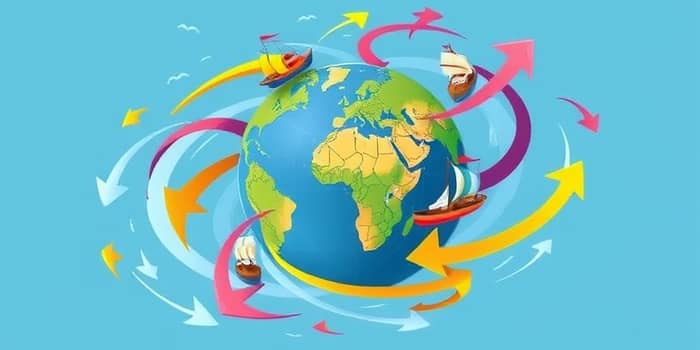
In today’s interconnected world, global trade behaves like powerful winds that guide economies, enterprises, and policies across the seas of opportunity and risk.
By viewing trade flows as metaphorical “trade winds,” we gain fresh perspective on how historical forces, modern disruptions, and forward-looking strategies converge to create prevailing patterns and shifts in the economic currents of nations.
Harnessing the Power of the Metaphor
The metaphor of trade winds captures both the steady breezes of expansion and the sudden gusts of disruption that define global commerce.
Just as mariners once read wind direction and strength to navigate oceans, today’s policymakers and business leaders study trade data, tariff signals, and geopolitical climates to plot their course.
Understanding these shape global economic landscapes empowers decision-makers to anticipate challenges, seize emerging corridors of exchange, and avoid the doldrums of stagnation.
Historical Waves: Lessons from the Past
Globalization has unfolded in distinct epochs, each resembling a successive wave that built on previous momentum before cresting and receding:
- Wave 1 (pre-1914): Driven by steamship and telegraph revolutions, with the UK leading 17.6% of exports, followed by Germany and Belgium.
- Wave 2 (post-WWII to 2007): A thirty-fold growth in trade volumes, U.S. emergence as superpower, and Europe’s recovery punctuated by the removal of wartime barriers.
- Wave 3 (2007-2050): Projections of quadrupled trade values to $68.5 trillion, interspersed with shocks like the 2008 recession and recent geopolitical tensions.
These waves reveal how technological innovations, policy frameworks, and global events act as the winds that accelerate or stall cross-border exchange.
Policymakers can draw practical lessons from each era: invest in infrastructure and connectivity during expansion, and build buffers to withstand storms of protectionism or financial crisis.
Navigating Modern Turbulence
Since 2024, the global trade climate has shown both resilience and fragility. A robust start was followed by slowdowns fueled by tariff spats, supply chain realignments, and policy uncertainty.
Manufacturing PMIs have dipped, import volumes have fluctuated, and advanced economies report rising non-tariff barriers. Yet, services and digital commerce have provided lifelines that sustained growth.
Key drivers shaping today’s winds include:
- Tariffs and tensions across major economies, especially U.S.–China skirmishes and allied tariff measures.
- Supply chain rearrangements as firms diversify sources and nearshore production to mitigate risk.
- Proliferation of free trade agreements, such as RCEP and CPTPP, creating parallel corridors of exchange.
To visualize current growth trajectories, consider the following projections:
This data underscores how even modest changes in policy or geopolitics can shift the winds dramatically, requiring agile responses from states and corporations alike.
Charting a Course Forward: Strategies for Resilience
To thrive amid fluctuating trade winds, stakeholders must combine foresight with practical actions:
- Enhance transparency in supply chains by adopting digital tracking and shared data platforms to reduce delays and build trust.
- Negotiate and upgrade trade agreements with built-in dispute resolution and adaptive tariff schedules.
- Develop regional hubs that can quickly reroute flows in response to blockade or barrier risks.
- Invest in workforce skills and innovation clusters, ensuring that industries can pivot when market winds change.
- Monitor high-frequency indicators like PMIs and shipping indexes to anticipate shifts and act preemptively.
By weaving these elements into economic strategies, nations and businesses can transform risks into opportunities, much like navigators using crosswinds to sail faster toward their destination.
Embracing Future Trade Winds
As we look toward mid-century horizons, trade is expected to resume its upward trajectory, propelled by digitalization, sustainable supply chains, and emerging markets.
Yet, the benefits will only materialize if stakeholders remain vigilant against inward-looking policies and fragmentation threats.
Ultimately, the metaphor of trade winds reminds us that open channels of exchange are the lifeblood of prosperity.
By aligning infrastructure, policy, and innovation, we can ensure that future waves of globalization bring inclusive growth, resilience, and shared success across continents.
In the face of uncertainty, let us steer with confidence, guided by the invisible currents that have, for centuries, shaped the destiny of nations.
References
- https://blogs.worldbank.org/en/voices/global-trade-has-remained-resilient-so-far-but-a-harp-slowdown-is-underway
- https://www.un.org/id/node/238608
- https://www.crowell.com/en/insights/publications/trade-winds-how-global-businesses-are-navigating-trade-tariffs-and-the-uncharted-waters-ahead
- https://www.mckinsey.com/mgi/our-research/geopolitics-and-the-geometry-of-global-trade
- https://www.piie.com/publications/working-papers/2025/global-economic-effects-trumps-2025-tariffs
- https://www.worldbank.org/en/publication/global-economic-prospects
- https://unctad.org/news/mirage-global-economic-resilience
- https://www.trade.gov/trade-winds-resources
- https://www.piie.com/blogs/realtime-economics/2025/global-trade-war-update
- https://www.smu.edu/cox/coxtoday-magazine/2018-10-01-global-trade-winds-in-north-america
- https://courses.lumenlearning.com/suny-microeconomics/chapter/start-up-trade-winds/
- https://academic.oup.com/jcr/article-abstract/27/1/115/1791516