In today's interconnected world, the resurgence of trade wars casts a long shadow over global stability.
These policies trigger profound economic shifts that ripple through every sector and household.
Understanding their impact is key to navigating uncertain financial futures and making informed decisions.
This article explores the mechanisms and consequences, offering practical insights for individuals and businesses alike.
We start by looking back at history to see how tariffs have shaped economies over time.
The Historical Backdrop: Lessons from the Past
Before World War II, tariff shocks were common and often devastating.
From 1869 to 1941, these policies led to increased unemployment and reduced economic activity.
Post-WWII, agreements like GATT helped lower global average tariffs from 10% in 1945 to under 3% by early 2025.
This decline fostered decades of growth and cooperation.
However, recent escalations threaten to reverse this progress.
- Tariff hikes historically correlated with higher unemployment peaks around two years after implementation.
- Uncertainty spikes post-shock, as seen in stock volatility and asset price drops.
- These patterns warn of potential long-term economic stagnation.
Learning from these benchmarks can help us anticipate current risks.
The Recent Surge: US Tariff Escalations in 2025-2026
Since February 2025, the US has enacted rolling tariff increases under new policies.
This has pushed average rates to around 16%, the highest since the 1930s.
It represents a 15% rise in 2025 alone, marking the largest change in the modern era.
Such rapid escalation creates immediate economic pressures.
Consumers and businesses face sudden cost increases that disrupt budgets and planning.
- The increase is driven by political shifts aiming to address trade imbalances.
- Retaliatory measures from other countries further complicate the landscape.
- Legal challenges, such as those under IEEPA, could halve effective rates over time.
This backdrop sets the stage for widespread economic impact.
How Tariffs Work: Mechanisms of Economic Impact
Tariffs primarily raise import costs, which then elevate consumer and business prices.
This leads to reduced exports as trading partners retaliate or shift to cheaper alternatives.
Uncertainty from policy changes depresses demand and investment, slowing economic growth.
The pass-through effect is nearly 100% to US import prices, making tariffs a direct tax.
- Higher import costs translate into inflationary pressures on goods.
- Reduced exports hurt sectors reliant on international markets.
- Uncertainty clouds business confidence, delaying expansions and hiring.
These mechanisms collectively strain economic resilience.
Sectoral Shifts: Winners and Losers in the Trade War
Not all industries feel the impact equally; some sectors decline sharply.
Durable goods manufacturing, mining, and agriculture face significant challenges due to high export exposure.
Sectors with import exposure see hiring drops and reduced activity.
This uneven distribution can lead to regional economic disparities.
- Durable goods manufacturing suffers from reduced global demand.
- Mining and agriculture experience sharp declines in exports.
- Service sectors may be less affected but still face indirect risks.
Understanding these shifts helps in career and investment planning.
Global Ripple Effects: Beyond US Borders
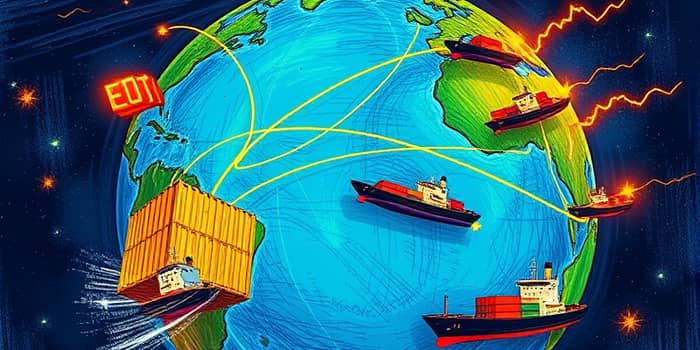
The impact extends globally, with non-USMCA partners like Brazil and India hit hardest.
Mexico and Canada, exempt under USMCA, face fewer direct tariffs but still feel secondary effects.
Investment slowdowns abroad can trigger broader economic downturns.
This interconnectedness means local policies have worldwide consequences.
- Brazil and India see negative growth due to higher US tariffs.
- Global trade balances are driven more by savings and investment gaps than tariffs alone.
- Retaliation from other countries can escalate into full-blown trade wars.
Staying informed about global trends is crucial for risk management.
Uncertainties and Risks: Legal and Policy Challenges
Legal challenges, such as Supreme Court rulings on IEEPA, could alter tariff enforcement.
Exemptions and gaps may reduce effective rates, but uncertainty remains high.
Policy interactions with deportations and Fed independence loss compound risks.
Fiscal deficits, like those from OBBB adding $3.4 trillion over a decade, add complexity.
- Legal uncertainties create volatility in financial markets.
- Combined with other policies, tariffs could trigger a recession.
- Data gaps in models make long-term projections challenging.
Preparing for these uncertainties involves diversifying strategies.
This table summarizes key economic impacts to guide decision-making.
Looking Ahead: Projections and Models
Models like G-Cubed from PIIE project deviations from baseline scenarios, with updates showing worsening conditions.
Historical regressions using 1869-1941 data indicate negative correlations between tariffs and economic activity.
Sectoral analyses highlight import-exposed areas, but uncertainty clouds precise magnitudes.
CBO and Yale estimates provide long-term fiscal modeling, though gaps exist.
- G-Cubed Model shows macro and sectoral results across economies.
- Historical studies reveal tariffs can lower inflation via uncertainty and demand suppression.
- Fed views note tariff-driven inflation stalls, complicating monetary policy.
Using these models can help anticipate future trends.
Counterintuitive Findings and Practical Insights
Contrary to theory, tariffs may lower inflation through uncertainty and demand suppression.
This counterintuitive effect stems from reduced consumer spending and investment.
It highlights the complexity of economic interactions under trade stress.
Practical steps include monitoring price changes and adjusting budgets accordingly.
- Focus on diversifying income sources to mitigate sectoral risks.
- Stay updated on policy changes to anticipate market shifts.
- Consider long-term investments in resilient sectors.
These actions can build financial security in turbulent times.
Conclusion: Navigating the New Economic Reality
Trade wars and tariffs present significant challenges but also opportunities for adaptation.
By understanding historical patterns and recent escalations, individuals and businesses can make proactive choices.
Emphasizing flexibility and resilience is key to thriving in this evolving landscape.
Stay informed, plan ahead, and leverage insights to turn uncertainty into advantage.
The economic impact of tariffs is profound, but with knowledge and strategy, we can navigate it successfully.
References
- https://www.piie.com/blogs/realtime-economics/2025/global-trade-war-update
- https://www.capitalspectator.com/research-review-9-january-2026-tariffs-and-trade-wars/
- https://www.cfr.org/article/trade-tariffs-and-treasuries-hidden-cost-trumps-protectionism
- https://www.frbsf.org/research-and-insights/publications/economic-letter/2026/01/what-can-history-tell-us-about-tariff-shocks/
- https://www.jpmorgan.com/insights/global-research/current-events/us-tariffs