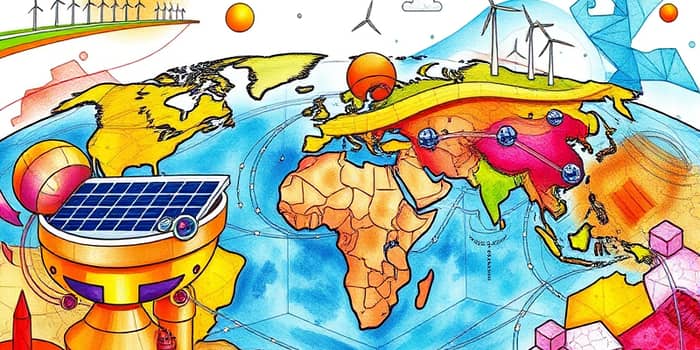
The year 2026 stands as a defining chapter in humanity's quest for a sustainable future. Rapid renewable growth is reshaping our world, offering hope and opportunity amidst challenges.
This shift is not just about technology; it's about reimagining how we power our lives and economies. AI-driven demand surges are testing old boundaries, pushing innovation to new heights.
From geopolitical tensions to grid constraints, every aspect of energy is evolving. Policy shifts toward industrial strategy are fostering resilience and competition.
This article explores the key dynamics of 2026, providing insights to navigate and thrive in this new energy era.
The Renewable Revolution Takes Center Stage
Renewables are poised to become the world's top electricity source by 2026. Overtaking coal with a 36% share, they signal a monumental shift.
Wind and solar alone will reach 20% of global generation. This marks a leap from 15% in 2024, driven by cost reductions and efficiency gains.
The market expansion is staggering. Valued at USD 1.2 trillion in 2025, it's projected to hit USD 1.4 trillion in 2026.
Long-term growth is even more impressive. Reaching up to USD 4.86 trillion by 2033, with a CAGR of 14.7%.
Key segments are leading this charge. Solar dominates with a 46.8% share, thanks to advancements in technology.
- Asia Pacific holds a 39.4% global share by 2035, driven by China and India.
- North America follows with 25.7%, fueled by clean energy initiatives.
- On-grid and greenfield projects account for over 70% of deployment.
China remains a powerhouse, but policy shifts are causing adjustments. Solar additions may drop to 200 GW in 2026 from 300 GW, leading to oversupply.
This growth is underpinned by cost advantages. Over 90% of new renewables are cheaper than fossil fuels.
AI-Driven Demand and Grid Challenges
Artificial intelligence is revolutionizing energy consumption. AI power demand tests grids and accelerates expansion.
This surge necessitates grid modernization. Distributed storage grows to 4.8 GW in 2024, with further increases by 2026.
Grid bottlenecks pose significant risks. Modernization is key for energy security, ensuring reliability amid growth.
- AI load growth requires smart infrastructure investments.
- Storage costs have dropped 2x in two years, enhancing flexibility.
- China leverages excess renewables for green hydrogen production.
These changes highlight the need for adaptive strategies. Embracing innovation can turn challenges into opportunities for resilience.
Geopolitical Tensions and Supply Chain Shifts
Global energy markets are increasingly fragmented. The US-China divide widens with competing policies.
China dominates cleantech exports, leading to oversupply. US interventionist policy targets FEOC rules, affecting trade dynamics.
Industrial policy is prioritizing local content. Subsidies and trade strategies focus on factories and data centers.
- Cleantech spending increases by 30% over the next five years.
- Europe phases out Russian fuels, focusing on resilience.
- Onshoring of critical minerals like lithium becomes essential.
This competitive landscape demands strategic foresight. Execution outweighs ambition in 2026, as nations vie for advantage.
Emerging Technologies and Hard-to-Abate Sectors
New solutions are addressing complex challenges. Sustainable Aviation Fuel consumption doubles to 2 MMt in 2025.
Hydrogen is emerging as a key player. China leads in hydrogen development, using excess renewable power.
Storage technologies are critical for grid flexibility. Battery costs have plummeted 3x in three years.
- SAF potential could reach 42 MMt by 2030, with Asia leading capacity.
- Hydrogen pipelines and exports via ammonia are gaining traction.
- Flexibility solutions are vital for integrating variable renewables.
These innovations offer pathways for decarbonization. Investing in R&D can unlock sustainable growth for all sectors.
Regional Breakdown and Global Impacts
Different regions are navigating unique paths. Asia Pacific builds out rapidly but faces policy slowdowns.
North America benefits from strong policy support. AI demand fuels renewables surge and regulatory frameworks.
Europe focuses on mandates and coal decline. Russian pivot accelerates energy transitions across the continent.
- Global renewables supply 42% of US electricity by 2050, up from 20%.
- Coal declines in China and EU, offset by gains in US and India.
- Grid constraints require coordinated international efforts.
Understanding these dynamics helps stakeholders adapt. Collaboration can mitigate risks and amplify benefits globally.
Risks, Contradictions, and Practical Guidance
The energy transition is fraught with uncertainties. Oversupply from China pressures margins, affecting global markets.
Climate risks necessitate physical and financial adaptation. Disjointed carbon rules create volatility in procurement strategies.
Demand growth outpaces some forecasts, but renewables lead. Embracing flexibility is crucial for navigating contradictions.
- Monitor geopolitical tensions and adjust supply chains accordingly.
- Invest in grid modernization and storage to handle AI demand.
- Leverage policy incentives for renewable projects and emerging tech.
For individuals and businesses, practical steps can make a difference. Adopt energy-efficient practices and support clean innovations.
Stay informed on market trends and policy changes. Engage in community initiatives to foster local resilience.
The future of energy is bright with possibility. By embracing change and innovation, we can build a sustainable world together.
References
- https://www.spglobal.com/energy/en/news-research/special-reports/energy-transition/horizons-top-cleantech-trends-2026
- https://www.researchnester.com/reports/renewable-energy-market/1094
- https://www.deloitte.com/us/en/insights/industry/renewable-energy/renewable-energy-industry-outlook.html
- https://www.carbonbrief.org/iea-renewables-will-be-worlds-top-power-source-by-2026/
- https://www.weforum.org/stories/2025/12/global-energy-2026-growth-resilience-and-competition/
- https://www.ecohz.com/blog/five-renewable-energy-trends-into-2026
- https://rmi.org/the-energy-transition-in-2026-10-trends-to-watch/
- https://www.grandviewresearch.com/industry-analysis/renewable-energy-market
- https://www.rbccm.com/en/story/story.page?dcr=templatedata%2Farticle%2Fstory%2Fdata%2F2025%2F12%2Fselective-by-design-2026-global-energy-outlook
- https://www.solarpowereurope.org/insights/outlooks/global-market-outlook-for-solar-power-2025-2029/detail
- https://www.bdo.com/insights/industries/natural-resources/2026-natural-resources-energy-predictions
- https://gridbeyond.com/lp/white-paper-global-energy-trends-2026-caught-in-the-crosswinds/
- https://www.eia.gov/outlooks/steo/