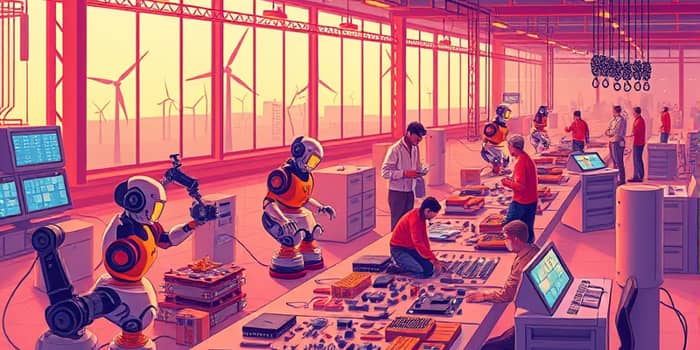
Across the world, a manufacturing renaissance is underway. Once seen as a relic of the past, factories are humming with activity again, powered by new investments, cutting-edge technologies, and strategic policy changes. This revival isn’t just about building products—it’s about rebuilding communities, strengthening supply chains, and securing economic resilience for decades to come.
Economic Contributions and Multipliers
In the third quarter of 2025, U.S. manufacturing added an astounding $2.95 trillion to the economy, representing 9.5% of GDP and marking a steady uptick from earlier in the year. Durable goods output climbed from $1.534 trillion to $1.576 trillion, while nondurable goods rose from $1.325 trillion to $1.375 trillion, signaling broad-based growth across industries.
- Every $1 spent in manufacturing generates $2.64 in total economic impact
- Each manufacturing worker supports 4.8 additional jobs across local communities
- A 1% production change impacts 435,180 jobs and $67.4 billion in GDP
- Foreign direct investment reached $2.416 trillion in 2024, a record high for the sector
Equipment manufacturing alone contributes $316 billion annually to GDP, generates $714 billion in sales/output, and supports 2.3 million jobs, illustrating the outsized role of capital goods in driving broader industrial health.
Reshoring and Supply Chain Shifts
As geopolitical tensions and logistical bottlenecks mount, companies are rethinking where they build and source critical components. Reshoring initiatives accelerated in early 2026, driven by tariffs and trade deal uncertainty and the desire for national defense readiness. Industries from solar panels to electrical transmission systems are racing to secure domestic capacity.
Since 2014, U.S. manufacturing establishments have grown 19%, fueling what experts call a "sluggish renaissance." Yet challenges remain—transport delays, weather disruptions, inventory shortages and unpredictable tariff changes can all derail carefully laid plans. Businesses that invest in visibility and flexibility will be best positioned to weather future storms.
Policy and Economic Drivers for 2026
Lawmakers and regulators are playing starring roles in the manufacturing revival. The One Big Beautiful Bill Act introduces tax and spending measures aimed at lowering operating costs and incentivizing capital investment. At the same time, recent tariff announcements on steel, agriculture and automobiles underscore the continuing tension between protectionism and open markets.
- One Big Beautiful Bill Act lowers costs and spurs investment
- Tariff uncertainty remains top concern for more than 75% of manufacturers
- More than $500 billion committed to semiconductor capacity by mid-2025
- Potential interest rate cuts could reignite capital demand and hiring
- Deregulation and permit reform create both risks and opportunities
North American trade stability is further reinforced by USMCA’s tariff-free auto and parts provisions. As interest rates eventually ease, manufacturers stand ready to accelerate new projects and upgrade facilities.
Technology and Innovation Trends
In 2026, operational agility is the new competitive edge. AI and automation platforms enable real-time decision making, predictive maintenance and rapid reconfiguration of production lines. Industry leaders now plan 20% of budgets on automation, sensors and cloud-based analytics to boost productivity and quality.
Agentic AI solutions are emerging to autonomously navigate trade complexities, optimize logistics and identify cost-saving opportunities. Cybersecurity investments are surging as connected factories become targets of sophisticated threats. The factories of tomorrow will be smart, secure and supremely adaptable.
Workforce and Employment Data
More than 13 million Americans work in manufacturing, spread across over 239,000 facilities. Yet as of November 2025, some 403,000 job openings remained unfilled, reflecting regional labor shortages and skills mismatches. Companies are turning to apprenticeships, partnerships with community colleges and internal training programs to bridge the gap.
Automation isn’t about replacing people—it’s about empowering teams to focus on higher-value tasks. By combining human ingenuity with machine precision, manufacturers can cultivate a more resilient, satisfied workforce.
Challenges and Risks
Despite the bright outlook, headwinds persist. In 2025, rising input costs, declining construction spending and trade unpredictability weighed on output growth. High borrowing rates continue to inflate capital expenses, delaying key expansions.
Looking ahead to 2026, policy shifts and tariff volatility remain top concerns, while cybersecurity threats grow in scale and sophistication. The long-term shift toward a service-based economy has eroded manufacturing’s share of employment over six decades, making sustained job growth an uphill battle.
Opportunities and Strategic Recommendations
Certain sectors—semiconductors, data centers, electric vehicles, autonomous systems and defense infrastructure—stand out as high-growth arenas. By aligning investments with national priorities and emerging technologies, companies can secure lasting advantages.
- Adopt scenario modeling for resilience under diverse economic outcomes
- Invest in automation and analytics to boost competitiveness
- Forge partnerships across supply chains for shared innovation
- Deploy technology for quality and efficiency at every stage
- Develop alternative workforce models to address labor gaps
Manufacturing’s comeback isn’t just about numbers; it’s about hope, opportunity and community revitalization. As global economies realign, this sector’s surge will determine who captures the future of innovation, job creation and shared prosperity.
References
- https://www.bdo.com/insights/industries/manufacturing/2026-manufacturing-industry-predictions
- https://nam.org/mfgdata/facts-about-manufacturing-expanded/
- https://www.deloitte.com/us/en/insights/industry/manufacturing-industrial-products/manufacturing-industry-outlook.html
- https://blog.implan.com/manufacturing-ripple
- https://www.manufacturingdive.com/news/5-trends-watch-2026-tariffs-uncertainty-ai-workforce-chemical-investments/809109/
- https://nam.org/mfgdata/
- https://rsmus.com/insights/industries/manufacturing/top-manufacturing-trends.html
- https://www.aem.org/advocacy/aem-economic-impact-report
- https://www.grantthornton.com/insights/articles/manufacturing/2026/2026-manufacturing-policy-risks-opportunities
- https://www.stlouisfed.org/on-the-economy/2025/aug/sluggish-renaissance-us-manufacturing
- https://cmrris.com/manufacturing-industry-trends-to-watch-in-2026/
- https://www.upjohn.org/research-highlights/understanding-decline-manufacturing-employment
- https://www.weforum.org/videos/5-trends-that-are-set-to-transform-factories-in-2026-88cd396965/
- https://www.nist.gov/el/applied-economics-office/manufacturing/manufacturing-economy/total-us-manufacturing
- https://www.citrincooperman.com/In-Focus-Resource-Center/2026-Economic-Outlook-for-Manufacturers-and-Distributors