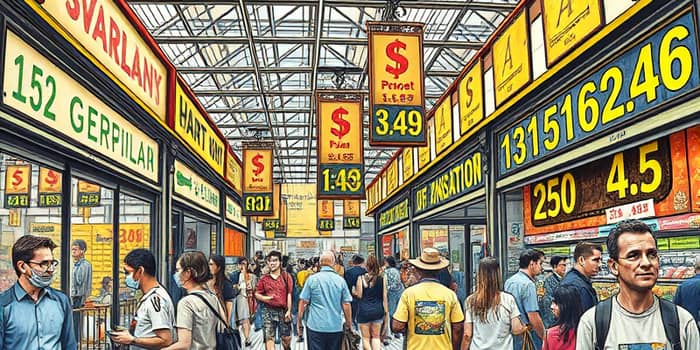
In every purchase, from morning coffee to monthly rent, prices weave through our lives like an invisible tide. This tide—rising in inflation, falling in deflation—shapes our choices, dreams, and financial security.
Whether you’re a small business owner setting prices or a household planning next month’s grocery budget, understanding these forces can transform uncertainty into opportunity.
Defining Inflation, Deflation, and Disinflation
Inflation occurs when the general level of prices for goods and services rises over time, eroding the value of each monetary unit. Conversely, deflation represents the sustained decrease in overall prices of goods and services. While deflation increases the real value of money, it often signals reduced spending, rising unemployment, and economic contraction.
Between these extremes lies disinflation: a slowdown in the pace of price increases. It is the slowing yet positive price growth that indicates an economy cooling without slipping into price declines.
Measuring Price Changes: Indices and Formulas
Governments and analysts rely on comprehensive price indexes across categories to track how prices evolve over time. The Consumer Price Index (CPI) measures a basket of approximately 80,000 goods and services, while headline CPI captures broad swings and core CPI excludes food and energy to remove volatility.
The GDP deflator, also known as the implicit price deflator, compares nominal GDP—valued at current prices—with real GDP—valued at constant base-year prices. This provides a broad measure of average price changes across all domestically produced goods and services, including investment and government spending but excluding imports.
For instance, Texas's nominal GDP rose from $1.577 trillion in the first quarter of 2015 to $2.111 trillion by late 2023. When applying the GDP deflator reindexed to 2015=100, the real output growth appears more moderate, revealing the difference between price-driven growth and true expansion.
Wholesale producers track the Producer Price Index (PPI) as an early indicator: a jump in PPI often presages consumer inflation. Meanwhile, the Personal Consumption Expenditures (PCE) index accounts for consumers switching between products—like trading down from red meat to chicken—making it a preferred gauge for many policymakers.
- Consumer Price Index (CPI): Tracks urban consumer costs, headline vs. core measures.
- GDP Deflator: Ratio of nominal to real GDP, broad coverage of domestic prices.
- Producer Price Index (PPI): Wholesale-level insights, leading indicator for CPI.
- Personal Consumption Expenditures (PCE): Reflects consumer behavior and shifting baskets.
To calculate an inflation rate, subtract the previous period's index value from the current period's, divide by the previous value, and multiply by 100. Positive results indicate inflation; negative results signal deflation. Converting nominal amounts into real terms by dividing by the price index (in decimal form) allows comparisons over time free from price distortions, avoiding the erosion of purchasing power.
The Human Impact: Stories from Past to Present
Behind every percentage point of inflation or deflation lie real families and businesses making decisions. During the Great Depression, deflation reached double-digit annual declines, pushing consumers to postpone purchases indefinitely in hopes of lower prices. This behavior deepened the economic slump, as dwindling demand led companies to cut jobs and output.
Japan's experience in the 1990s and early 2000s illustrates a prolonged battle with deflation. With interest rates near zero, traditional monetary policy ran out of ammunition, ushering in a “lost decade” of stagnant growth. While consumers enjoyed lower prices, debt burdens grew heavier in real terms, dampening investment and innovation.
More recently, after the 2020 global pandemic triggered supply chain disruptions, inflation soared in many economies. Countries like the United States saw CPI peak at over 9% in June 2022, prompting central banks to tighten financial conditions. By mid-2024, inflation moderated to around 3%, an example of measured disinflation through policy action.
Consider a local café adjusting to these swings: when coffee bean prices spike due to supply shortages, the owner faces a choice: absorb costs, shrinking margins, or pass increases to customers and risk lower foot traffic. These daily choices underscore how price dynamics ripple through society.
On a personal level, inflation can erode retirement savings if returns fail to keep pace with rising prices. Conversely, deflation can inflate debt obligations, making mortgages and loans more expensive in real terms. Recognizing these outcomes is the first step toward resilience.
Policy Responses and Practical Strategies
Central banks around the world target inflation near two percent, using tools like interest rate adjustments, open market operations, and quantitative easing (QE). When inflation exceeds targets, raising the policy rate can temper demand by making borrowing more expensive. Conversely, cutting rates or purchasing assets injects liquidity to stimulate spending and investment when inflation falls too low or deflation looms.
History offers lessons in the power of decisive action. In the early 1980s, Federal Reserve chair Paul Volcker raised the federal funds rate above 20% to rein in double-digit inflation. The move triggered a severe recession but ultimately curbed runaway price growth. By comparison, quelling entrenched deflation—as seen in Japan—often proves more challenging, requiring both monetary and fiscal interventions.
Fiscal policy complements these efforts by adjusting government spending and taxation. During economic downturns, stimulus measures can boost consumption and investment, while spending cuts may help cool overheated economies.
Yet individuals and businesses are not powerless observers. Armed with knowledge and proactive measures, you can navigate economic uncertainty. Below are practical steps to adapt your personal finances and operations:
- Build an emergency fund with three to six months of essential expenses to cushion against price spikes or income shocks.
- Lock in fixed-rate debt when rates are historically low, protecting yourself from future hikes and volatile interest costs.
- Diversify investments into inflation-hedged assets such as real estate, commodities, or Treasury Inflation-Protected Securities (TIPS).
- Continuously review and adjust budgets, prioritizing core expenditures while reducing discretionary outlays.
- Enhance your skills and productivity through education or technology upgrades, strengthening earning potential in varying economic climates.
By tracking monthly CPI releases, PPI trends, and PCE revisions, you can anticipate shifts and adjust your plan. Tools such as budgeting apps, professional forecasts, and expert commentary serve as valuable early-warning systems, allowing you to move before the tide turns severe.
Across boardrooms, classrooms, and kitchen tables alike, one truth holds: knowledge is the anchor in a sea of price fluctuations. By understanding the mechanics and consequences of inflation, deflation, and disinflation, you transform abstract numbers into actionable insights.
When you view the economy not as an unpredictable force but as a system governed by measurable indicators and responsive policies, you gain the power to strategize effectively. Through navigating economic uncertainty with confidence, you can safeguard your finances, support your community, and seize opportunities amid change.
In the ever-rolling tide of prices—sometimes cresting in inflation, sometimes receding in deflation—you hold the compass. Let the price pulse guide your decisions toward resilience, growth, and lasting prosperity.
References
- https://databank.worldbank.org/metadataglossary/world-development-indicators/series/NY.GDP.DEFL.KD.ZG
- https://robinhood.com/us/en/learn/articles/2YtFMtDmNGOHr6sgRBLvu/what-is-deflation/
- https://www.moomoo.com/us/learn/detail-inflation-and-deflation-117764-241217096
- https://www.dallasfed.org/research/basics/nominal
- https://www.khanacademy.org/economics-finance-domain/ap-macroeconomics/economic-iondicators-and-the-business-cycle/price-indices-and-inflation/a/lesson-summary-price-indices-and-inflation
- https://www.bea.gov/resources/learning-center/what-to-know-prices-inflation
- https://rwbwealth.com/inflation-vs-deflation-what-do-these-mean/
- https://www.stlouisfed.org/open-vault/2023/august/explaining-inflation-disinflation-deflation
- https://www.schwab.com/learn/story/inflation-deflation-and-stagflation-explained
- https://www.tierneyeducation.com/resources/blog/inflation-deflation-disinflation
- https://www.rba.gov.au/education/resources/explainers/inflation-and-its-measurement.html
- https://www.iforex.eu/blog/what-do-inflation-and-deflation-mean