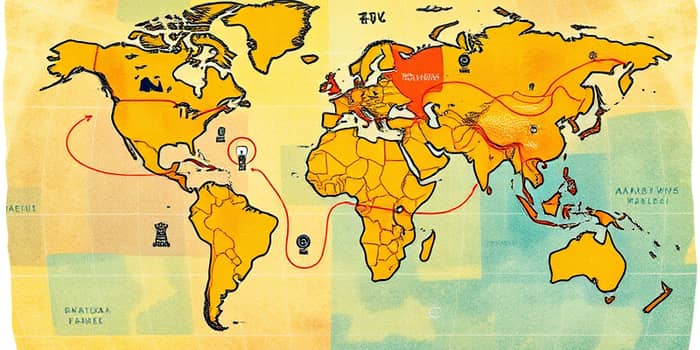
In an era where headlines chronicle diplomatic standoffs and shifting alliances, financial markets often feel the tremors long before peace accords emerge.
Political risks are no longer distant debates; they translate into waves of uncertainty and volatility that ripple across every asset class and supply chain.
Geopolitical Conflicts and Market Turbulence
Major flashpoints—from the Russia-Ukraine conflict to tensions in the Middle East—remind investors how swiftly political moves can ignite price shocks.
When sanctions targeted Russia after 2022, oil prices spiked, European equities fell dramatically, and the ruble plunged nearly 40 percent in weeks.
Similarly, renewed Iran tensions drove oil and gold prices up more than 19 percent between December and February, illustrating the persistent driver of uncertainty via sanctions that global traders dread.
Even dramatic operations like the U.S. strike in Venezuela on January 3 created only short-lived market ripples, underscoring how some events register as headlines yet spark minimal long-term disruption.
The Mechanics of Economic Sanctions
Sanctions have evolved into powerful instruments that can cripple economies without a shot fired. They work through finance controls, trade bans, and energy restrictions.
- Targeted finance measures: asset freezes, SWIFT exclusions, bond bans
- Trade embargoes: export controls on technology and key commodities
- Energy constraints: halting pipeline projects, restricting oil shipments
In Russia’s case, halting Nord Stream 2, freezing central bank reserves, and imposing secondary bond sanctions inflicted deep currency weakness and forced capital controls.
Yet global chains felt the squeeze too—wheat, corn, nickel, and palladium markets saw volatility surge as sanctions spread.
Critics debate their long-term effectiveness, noting unilateral efforts risk collateral damage to allies and may fail to alter entrenched behavior.
Trade Policies, Tariffs, and Global Fragmentation
Beyond sanctions, trade policy shifts reshape investment flows and supply-chain designs.
From Trump-era tariffs on semiconductors to looming 2026 tariff reviews, uncertainty around trade rules has become a constant headwind for corporations seeking stability.
Emerging fragmentation sees blocks forming around technology, energy, and raw materials, forcing firms to consider onshoring or diversifying suppliers.
- Semiconductor tariffs threaten AI supply chains.
- Energy decoupling reshapes OPEC’s market power.
- Immigration and fiscal debates add further policy risk.
Despite these challenges, global trade growth remains resilient, projecting 2.6 percent expansion in 2026, though below historical norms.
Navigating 2026: Economic and Market Outlook
As we look ahead, four overarching themes stand out: growth, inflation, market reactions, and debt dynamics. Each interacts with politics in complex ways.
This landscape demands investors balance optimism about AI and emerging markets against persistent policy uncertainties that can reverse trends overnight.
Investor Strategies in an Uncertain Era
Faced with these crosswinds, successful portfolios often share core attributes:
- Diversification across regions and asset classes
- Hedging strategies for commodity and currency risks
- Focus on companies with strong balance sheets and pricing power
Long-term fundamentals—earnings growth, consumer demand, technological innovation—remain the bedrock for weathering short-term shocks.
Yet investors must also stay nimble, ready to rotate into safe havens or thematic sectors when geopolitical tensions flare.
Conclusion: Resilience Amid Uncertainty
Politics will always cast a shadow over world markets. Sanctions, tariffs, and flashpoints test the resolve of investors and policymakers alike.
But history shows markets adapt, fundamentals prevail, and new opportunities emerge in the aftermath of turmoil.
By understanding the levers of power and building resilient strategies, stakeholders can navigate the turbulence and position themselves for the next wave of growth.
In the intricate dance between nations and markets, those who balance vigilance with optimism will find the greatest rewards.
References
- https://www.usbank.com/investing/financial-perspectives/market-news/russia-ukraine-global-market.html
- https://www.deloitte.com/us/en/insights/topics/economy/global-economic-impact-of-sanctions-on-russia.html
- https://www.mercer.com/insights/investments/market-outlook-and-trends/economic-and-market-outlook/
- https://cepr.org/voxeu/columns/international-trade-and-macroeconomic-dynamics-sanctions
- https://www.brookings.edu/articles/economic-issues-to-watch-in-2026/
- https://www.brookings.edu/articles/can-sanctions-change-the-course-of-conflict/
- https://www.morganstanley.com/insights/articles/investor-guide-political-trends-2026
- https://www.piie.com/commentary/testimonies/evidence-costs-and-benefits-economic-sanctions
- https://unctad.org/news/10-trends-shaping-global-trade-2026
- https://www.congress.gov/crs-product/IF12092
- https://kpmg.com/us/en/articles/2026/global-trade-outlook-2026.html
- https://now.tufts.edu/2024/07/08/are-economic-sanctions-effective-foreign-policy-tools
- https://www.stimson.org/2026/top-ten-global-risks-for-2026/
- https://digitalcommons.odu.edu/cgi/viewcontent.cgi?article=1076&context=politicalscience_geography_pubs
- https://www.jpmorgan.com/insights/global-research/outlook/market-outlook