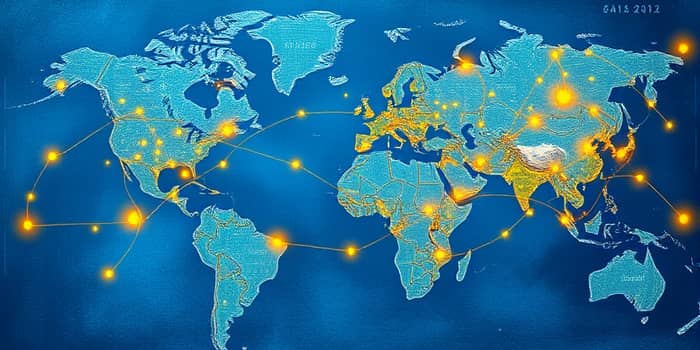
Our modern world is woven together by money, markets, and trust. When a shock hits one corner of the globe, it can ripple through banking systems, capital markets, and trade corridors, often at the speed of fear. Understanding these chains of contagion is not just an academic exercise; it is a vital step toward systemic resilience and shared responsibility.
Understanding Contagion Versus Globalization
Financial globalization refers to the long-term trend of integration, where capital moves freely across borders and markets grow more interconnected. Contagion, by contrast, is the sudden spike in correlations during stress episodes that goes beyond economic fundamentals. In other words, globalization sets the stage, while panic writes the script when crises unfold.
Historical evidence shows that the impact of a crisis depends not only on baseline integration but also on market psychology, leverage, and opacity in financial instruments. Recognizing this helps policymakers and institutions design safeguards to dampen shocks and limit panic-driven contagion.
Waves of Financial Globalization
Since the late 19th century, the world has experienced distinct phases of financial integration. Each wave carried its own lessons on crisis transmission and the limits of policy responses:
- Classical Gold Standard Era (1880–1914): Moderate stock integration yet sharp correlation spikes in crises.
- Bretton Woods Period (1946–1971): Capital controls kept markets segmented and contagion contained.
- Post-Bretton Woods Peak (1972–Present): Highest ever integration but surprisingly muted spillovers in many stress events.
These patterns remind us that more integration does not always equal more severe contagion. Policy design, market structure, and transparency play decisive roles.
Lessons from the 2007–2009 Financial Meltdown
The 2007–2009 Global Financial Crisis (GFC) started as a US housing downturn but quickly escalated into a worldwide calamity. A combustible mix of exotic instruments, overleveraged banks, and unprecedented cross-border capital flows turned a subprime shock into a banking panic.
A concise timeline underscores the crisis’s rapid progression:
Beyond dates and numbers, the crisis taught vital lessons for global policymakers about the perils of excessive leverage, opaque derivatives, and poor risk management.
Europe faced bank runs in Iceland, bailouts in Germany, and deep recessions in the UK, while Asia saw growth stall, Japan’s Nikkei plunged by 10%, and emerging markets endured abrupt capital withdrawals. These global impacts remind us that no region is immune and that dizzying speed of contagion can overwhelm even the most prepared economies.
Mechanisms of Transmission
Crisis spillovers operate through multiple channels. When one institution fails or markets panic, others suffer in turn:
- De-leveraging by banks reduces credit availability globally.
- Fire sales of assets depress prices, causing valuation losses elsewhere.
- Frozen interbank lending disrupts short-term funding across borders.
- Confidence erosion leads investors to withdraw from emerging and developed markets alike.
Recognizing these transmission paths allows governments and regulators to act swiftly, inject liquidity, and shore up confidence before turmoil spreads.
Other Historical Crises: A Comparative Glance
The Asian Financial Crisis of 1997–1998 exemplifies how region-specific vulnerabilities can trigger regional collapses with global echoes. Excessive local borrowing in foreign currencies, crony lending, and abrupt capital flight led to sharp currency devaluations and bank failures in Thailand, Indonesia, and beyond.
Across different eras, five recurring themes emerge: excessive leverage, poorly regulated credit markets, opacity in financial innovations, moral hazard from bailouts, and slow policy responses. By identifying these common threads, we can develop targeted reforms to block contagion channels at their source.
Building Resilience for Tomorrow
What practical steps can stakeholders take today to guard against the next wave of crisis contagion? Collective vigilance and robust policy frameworks are key. By committing to transparency and good governance, market participants and regulators can transform the global financial architecture.
We have seen glimmers of success: during the GFC, coordinated rate cuts by the Federal Reserve, Bank of England, and ECB, along with IMF liquidity facilities, helped stem the panic. Such examples underscore the power of global policy coordination to restore confidence swiftly.
Three pillars of resilience stand out:
- Strengthen surveillance of cross-border exposures and systemic risk.
- Enhance capital and liquidity buffers for banks and non-bank financial institutions.
- Promote international coordination on macroprudential policies and crisis response.
These measures, combined with ongoing stress testing, data sharing, and public-private dialogue, can help the world withstand shocks with minimal spillovers.
Embracing Shared Responsibility
No country is an island in today’s financial seas. Crises traverse oceans and time zones, impacting savers, investors, and families everywhere. Yet, history also shows us that timely interventions, time-tested policy responses, and global solidarity can arrest the worst of contagion and set the stage for recovery.
Individual savers and investors also bear responsibility. Diversified portfolios, prudent risk assessments, and awareness of cross-border exposures can shield personal finances from unexpected tremors. Education and transparency empower every participant to contribute to a more stable system.
Conclusion: Toward a More Secure Future
The interconnectedness of global financial crises is both a challenge and an opportunity. While integration can magnify risks, it also fosters cooperation and shared solutions. Armed with the lessons of the past—from gold standards to mortgage meltdowns—we can chart a course toward stability and shared prosperity.
Ultimately, our resilience rests on collective action, global policy coordination, and an unwavering commitment to learning. In doing so, we honor the sacrifices of those who weathered past storms and pave a safer path for generations to come.
References
- https://cepr.org/voxeu/columns/globalisation-and-financial-contagion-history
- https://en.wikipedia.org/wiki/2008_financial_crisis
- https://libraryguides.law.pace.edu/financialcrisis
- https://www.cfr.org/timelines/us-financial-crisis
- https://www.rba.gov.au/education/resources/explainers/the-global-financial-crisis.html
- https://www.newyorkfed.org/research/global_economy/policyresponses.html
- https://www.fdic.gov/media/18636
- https://fraser.stlouisfed.org/timeline/financial-crisis
- https://elischolar.library.yale.edu/cgi/viewcontent.cgi?article=12772&context=ypfs-documents
- https://education.cfr.org/learn/reading/global-consequences-financial-contagion
- https://www.youtube.com/watch?v=HPwzr1ueFZM