In an interconnected world, trade agreements act as both bridges and battlegrounds, shaping the flow of goods, services, and investments. From the postwar era that witnessed two-thirds of international trade tariff-free to today’s complex mosaic of bilateral and regional pacts, global commerce has undergone a profound transformation. As policymakers and businesses navigate rising tariffs, evolving technical regulations, and geopolitical tensions, understanding the dynamics at play is essential for fostering inclusive and sustainable growth and unlocking new opportunities.
Historical Evolution of Multilateral Trade
After World War II, the General Agreement on Tariffs and Trade evolved into the WTO, significantly reducing barriers and setting the stage for unprecedented expansion. By 2000, a fivefold increase in global GDP had been driven in part by burgeoning cross-border exchanges and the liberalization of markets. Multilateral negotiations created a rules-based system that promoted predictability and encouraged the integration of emerging economies into the global fold.
However, the early 21st century saw rising frustrations with slow dispute resolution and the inability to address non-tariff barriers. As a result, nations increasingly sought regional and bilateral frameworks, ushering in a new era of selective collaboration. Between 2000 and 2015, the global trade landscape shifted, with talks adapting to include digital trade, environmental safeguards, and deeper regulatory cooperation.
Recent Trends and Tariff Dynamics (2024-2026)
Since 2024, average US tariffs climbed sharply, from just 2.0% to 15.4% by late 2025, reflecting an emphasis on manufacturing competitiveness and strategic autonomy. At the same time, technical regulations now cover two-thirds of traded goods, creating both challenges and avenues for negotiation. The mounting complexity has introduced record-setting trade policy uncertainty, though concerted dialogue has at times cooled tensions.
Despite rising barriers, regional trade agreements (RTAs) flourished: seven new RTAs entered into force in 2024, and overall regional pacts increased by 30% between 2017 and 2025. Concurrently, nearly 18,000 discriminatory measures, including sanitary regulations and licensing procedures, were imposed since 2020, underscoring the importance of robust compliance mechanisms.
Projections for global trade growth reflect this nuanced reality. Frontloading of orders before tariff hikes fueled a 3.4% expansion in 2024, but growth slowed to 1.8% in 2025 and is expected to rebound to 2.7% in 2026, assuming policy easing. Even so, forecasts remain 0.8 percentage points below earlier estimates, illustrating the lingering impact of protectionist trends.
Key Agreements Shaping Global Commerce
A series of landmark accords have defined the contours of modern trade. The Comprehensive and Progressive Agreement for Trans-Pacific Partnership (CPTPP), with its $15.8 trillion GDP coverage, now includes the UK and considers new applicants such as China and South Korea. Agreements like the US-UK pact and EU deals with Chile and New Zealand advance regulatory alignment and market access, while sector-specific treaties target technology, energy, and finance.
- CPTPP: Textile and seafood exports up 56% for Vietnam, enhanced market linkages.
- US-UK: Streamlined tariffs and non-tariff barrier reductions in key sectors.
- AfCFTA: Guided Trade Initiative boosting intra-Africa commerce with new members.
- EU-Kenya & China-Serbia: Goods-only agreements fostering regional integration.
Reshaping Supply Chains and Investment Flows
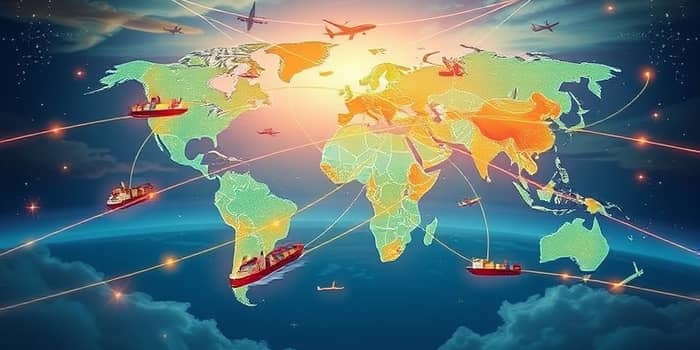
Geopolitical shifts and policy priorities have prompted companies to reconsider long-established supply chains. Analysts estimate that up to one-third of the $14 trillion in goods trade could reroute over the next decade. Foreign direct investment patterns illustrate this trend: FDI into the United States has doubled, while flows to China have declined by 65% from the 2015–2019 period to mid-2025.
Firms are rewiring global supply chains through diversification and nearshoring strategies. Automotive giants like Nissan expanded Mexican production by 9%, and Panasonic relocated assembly from China to Vietnam under the CPTPP framework. Such moves not only mitigate tariff exposure but also capitalize on regional talent pools and emerging market growth.
Sector-Specific Impacts
Manufacturing bears the brunt of tariff volatility, yet it also gains from targeted agreements worth billions in incremental trade. Productivity enhancements arise as resources shift toward efficient producers, though workforce transitions demand comprehensive safety nets and retraining programs.
The services sector has surged, growing 9% in 2025 to represent 27% of global commerce. Digital trade rules and liberalized investment provisions in new deals promise further expansion. Meanwhile, agriculture and food systems rely on stable access to inputs like fertilizers, highlighting the need for open markets and climate-resilient partnerships.
Energy and technology industries are split between winners and losers as critical minerals pacts and clean-tech memoranda shape competitive landscapes. Profit margins and market shares can fluctuate dramatically based on policy signals and bilateral commitments.
Business Strategies and Policy Considerations
In this evolving environment, enterprises and policymakers must embrace agility. Companies can unlock resilience through dual-sourcing and scenario planning, aligning supply networks with shifting regulatory regimes and consumer demands. Governments, in turn, must calibrate trade-offs between strategic objectives and the benefits of open commerce.
- Realign supply chains to tap into emerging markets and secure inputs.
- Implement proactive compliance systems for complex regulatory landscapes.
- Engage in multilateral forums to shape balanced, fair trade rules.
- Invest in workforce development to accompany industrial transitions.
- Preserve special treatment measures for vulnerable economies.
Looking Ahead: Balancing Growth and Fairness
While trade has historically driven freedom and prosperity, gains have not always been evenly shared. Advanced economies accounted for 70% of new restrictions since 2022, even as many developing nations proved resilient when linked to diverse partners. Ensuring that the fruits of globalization reach all communities requires policies that combine ambition with inclusivity.
As the global economy moves forward, stakeholders must foster cooperation that transcends individual interests. By embracing innovation, prioritizing sustainability, and supporting robust dispute resolution, the international community can chart a path toward inclusive and sustainable prosperity that benefits businesses and citizens alike.
References
- https://www.mckinsey.com/capabilities/geopolitics/our-insights/beyond-the-headlines-how-trade-agreements-are-reshaping-business
- https://blogs.worldbank.org/en/voices/global-trade-has-remained-resilient-so-far-but-a-harp-slowdown-is-underway
- https://unctad.org/publication/global-trade-update-january-2026-top-trends-redefining-global-trade-2026
- https://ourworldindata.org/trade-and-globalization
- https://news.gatech.edu/news/2025/03/11/trade-agreements-keep-global-economies-stable
- https://www.globaltrademag.com/long-term-investing-in-global-markets-how-trade-policy-and-supply-chains-influence-returns/
- https://www.cato.org/publications/how-trade-agreements-have-enhanced-freedom-prosperity-americans
- https://www.imf.org/en/publications/fandd/issues/2023/06/growing-threats-to-global-trade-goldberg-reed