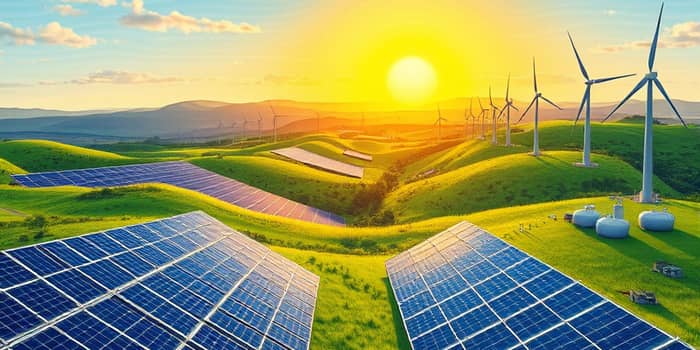
In recent years, the global energy landscape has undergone a seismic shift. Fueled by a combination of technological breakthroughs, ambitious policies, and shifting geopolitics, investment in clean energy has reached unprecedented levels.
This surge—often called the “green gold rush”—promises to reshape economies, spur innovation, and accelerate the transition to a low-carbon future.
The Changing Face of Global Energy Investment
Record-breaking capital flows into renewables, grids, storage, low-emissions fuels, and efficiency measures are redefining energy markets. By 2025, total investment in clean energy technologies is expected to hit about $2.2 trillion globally, with standalone clean energy tech spending reaching $670 billion.
For the first time, investment in renewables, storage, green hydrogen, and carbon capture will match or exceed upstream oil and gas spending, estimated at roughly $640 billion. This rebalancing highlights a decisive pivot toward sustainable solutions, even in traditionally fossil-fuel-led economies.
By the end of 2024, clean power sources—renewables plus nuclear—surpassed 40% of global electricity generation, driven in large part by solar. A staggering 620 GW of new solar and wind capacity came online in 2024 alone, equating to the combined power systems of India, Pakistan, and Bangladesh.
Key Drivers Fueling the Green Gold Rush
Understanding the momentum behind these figures requires exploring the intertwined drivers on both the supply and demand sides.
- Policy and industrial strategy: Governments and corporations alike have woven decarbonization commitments into core strategies. Local air quality and health considerations bolster social license, while industrial policies aim to fortify energy security and foster domestic manufacturing.
- Demand-side transitions: Rapid electrification of transportation, buildings, and industry, coupled with exponential growth in data centers and AI computing, has driven power demand upward. Datacenter operators now account for about 35% of corporate clean energy procurement, pioneering advanced contracting models that pair solar, wind, and storage.
- Technological innovation: Advances in PV module manufacturing, battery storage, and long-duration energy systems have driven down costs and opened new frontiers for decentralized energy solutions.
These forces are not operating in isolation. Trade tensions, fluctuating incentives, and reshoring efforts have created both disruptions and opportunities. As incentives evolve, regions are vying to become new hubs for solar, batteries, and electrolyzer production.
Leading Technologies and Investment Flows
While solar PV continues to attract the lion’s share of funding—forecast to comprise about half of all cleantech investment in 2025—other technologies are rapidly securing their place.
Energy storage systems are entering a golden era. Battery energy storage capacity is set to surpass pumped hydro by 2025, while installations of long-duration storage are expected to double, offering resilience and flexibility to high-renewables grids.
The wind sector—both onshore and offshore—added substantially to the 620 GW deployed in 2024. Onshore wind remains the more cost-competitive segment, but offshore wind’s potential to balance solar-heavy systems keeps it firmly in investors’ sights.
Beyond intermittent sources, clean firm power—nuclear, hydro, and geothermal—continues to expand. These sources, paired with storage, ensure reliability and crucial capacity value, smoothing the path to higher renewables penetration.
Moreover, nascent technologies like green hydrogen and carbon capture, utilization, and storage (CCUS) are garnering strategic investment, particularly for hard-to-abate industries and heavy transport. As part of the $2.2 trillion clean energy spend, these low-emissions fuels signal a broadening of the sustainable toolkit.
Geopolitical Shifts and Regional Opportunities
Geography is playing an ever-more prominent role in the green gold rush. China, long the dominant force in PV and battery manufacturing, is projected to see its global share of PV module production decline from over 80% today to around 65% by 2030.
Meanwhile, regions such as the Middle East and North Africa are emerging as new manufacturing hubs, supported by anti-dumping measures and attractive policy frameworks.
In the United States and Europe, reshoring efforts backed by incentives aim to secure supply chains for critical components, even as policy shifts introduce volatility.
On the demand side, North American data centers are poised to deliver 175 TWh of incremental clean power procurement by 2030, representing roughly 60% of the global increase. European centers contribute about 25%, while Asia-Pacific lags due to grid constraints and project siting challenges.
Charting the Path Forward
Looking ahead, the race to 2030 will hinge on maintaining and amplifying global momentum. Key priorities include:
- Enhancing grid flexibility through targeted storage deployments and transmission investment.
- Strengthening supply chain resilience by diversifying manufacturing and fostering strategic partnerships.
- Deepening decarbonization policies that align economic incentives with net-zero objectives.
In McKinsey’s “Continued Momentum” scenario, fossil fuel demand plateaus by 2030–2035, and gas plus variable renewables dominate new power supply additions. However, coal’s persistence in certain markets underscores the need for continued vigilance and targeted interventions.
At its core, the green gold rush is more than a surge of capital—it represents a fundamental transformation in how we produce, distribute, and consume energy. By championing innovation and collaboration, stakeholders can ensure that this wave of investment delivers enduring benefits: cleaner air, robust economies, and a resilient planet.
As we stand at this pivotal juncture, the choices we make today will echo for decades. The green gold rush beckons us not only to seize opportunity, but to build a future where sustainable energy powers prosperity for all.
References
- https://www.mckinsey.com/industries/energy-and-materials/our-insights/global-energy-perspective
- https://www.weforum.org/stories/2025/09/the-top-5-energy-technology-trends-of-2025/
- https://www.wtwco.com/en-us/insights/2025/07/renewable-energy-market-review-2025
- https://bcse.org/2025-sustainable-energy-in-america-factbook/
- https://www.irena.org/Publications/2025/Jul/Renewable-energy-statistics-2025
- https://ember-energy.org/latest-insights/global-electricity-review-2025/
- https://www.eia.gov/outlooks/aeo/