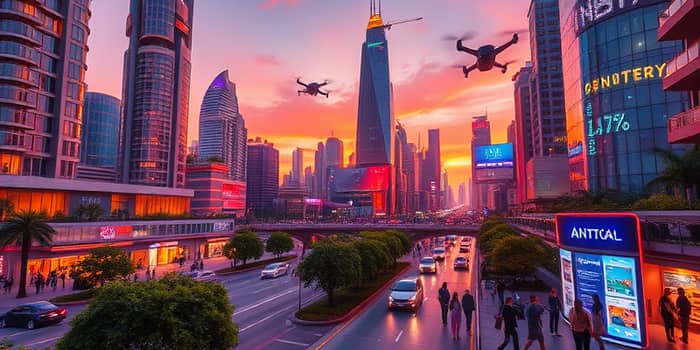
As the world accelerates toward a future where more than two-thirds of humanity will call cities home, investors, policymakers, and communities face both challenges and opportunities of unprecedented scale. This article explores how smart city investments can shape sustainable urban futures and offers practical guidance for stakeholders eager to be part of this transformative wave.
Understanding Urbanization and Its Momentum
Urban centers today absorb over 57.7% of the global population, a figure set to surpass 58% by 2025. This rapid urban population growth is most pronounced in Asia and Africa, which will account for 90% of future expansion. Historically, the shift from agrarian villages to bustling metropolises has been a hallmark of economic development. Between 1950 and 2021, world population soared from 751 million to 7.87 billion, with urban dwellers rising from one-third to over half.
By 2050, an estimated 68% of people will live in cities, representing an increase of approximately 2.5 billion urban residents. This demographic wave demands innovations that can transform urban living quality while ensuring resilience, sustainability, and inclusivity.
Smart Cities Market: A Boom on the Horizon
The global smart cities market was valued at USD 952.13 billion in 2025, with projections soaring to USD 1,445.6 billion by 2030 at a robust CAGR of 15.6%. Alternative forecasts estimate the market could exceed USD 3.7–5.2 trillion by 2030, driven by municipal investments in AI dashboards, sensor networks, and data analytics.
Major governments have mobilized funds to fuel this transformation:
- US Infrastructure Investment and Jobs Act: USD 65 billion for smart grid and EV charging infrastructure
- EU Green Recovery Funds: €750 billion for digital and sustainable urban projects
- China Smart City Program: USD 1.4 trillion invested since 2012
This surge in public support aligns with a rise in private capital: over 4,900 funding rounds, 3,300+ active investors, and 1,800+ startups are shaping a new era of urban innovation.
Top Investment Sectors and Opportunities
From energy to mobility, several sectors stand out for investors seeking both impact and returns:
- Smart Energy & Virtual Power Plants: A USD 300+ billion market in 2025, led by platforms managing gigawatts of capacity across millions of homes.
- Smart Mobility & Transit Technology: Growing from USD 167 billion in 2025 to USD 250.56 billion by 2030, with AI-powered enforcement and autonomous corridors.
- 5G & Connected Infrastructure: Valued at USD 16–43.5 billion in 2025, enabling ultra-low latency applications for safety and efficiency.
- AI-Powered Waste & Recycling: Addressing a USD 2.1 trillion waste market, robotics solutions are sorting billions of items and reducing landfill strain.
Each sector offers a chance to catalyze economic development and growth while addressing pressing urban challenges.
Enabling Technologies Driving Change
At the core of smart cities lie five converging technological forces:
- Artificial Intelligence: Optimizing transit, security analytics, and energy demand response.
- 5G Networks: Creating the backbone for real-time urban data flows.
- Internet of Things (IoT): Connecting sensors and devices in a market set to exceed USD 650 billion by 2026.
- Cloud-Based Security: Securing infrastructure from power grids to autonomous corridors.
- Data Analytics & Sustainability Integration: Ensuring that environmental goals guide every technology deployment.
These technologies enable cities to become adaptive, efficient, and responsive, truly embodying aligning technology with sustainable development goals.
Actionable Steps for Stakeholders
To harness this momentum, different actors must play coordinated roles:
For Investors: Conduct rigorous due diligence on startups and funds, prioritize partnerships with governments, and look for scalable solutions. Consider thematic funds focused on energy, mobility, or waste management to embrace data-driven decision-making practices.
For City Planners and Policymakers: Pilot small-scale smart projects, establish clear data governance frameworks, and invite community input. Emphasize transparency and interoperability to ensure that technology serves everyone.
For Communities and NGOs: Advocate for inclusive designs, demand accountability in spending, and participate in citizen science initiatives. Local engagement can empower communities and transform urban spaces into human-centric environments.
Conclusion
The global urbanization trend presents an extraordinary chance to reinvent how we live, work, and connect. By investing wisely in smart city infrastructure and partnering across sectors, stakeholders can build resilient, sustainable, and inclusive urban landscapes. Now is the time to act—seize these opportunities to shape the cities of tomorrow and leave a lasting, positive legacy.
References
- https://tradingeconomics.com/world/urban-population-percent-of-total-wb-data.html
- https://business20channel.tv/top-10-smart-cities-investment-opportunities-in-2026-21-02-2026
- https://worldpopulationreview.com/country-rankings/most-urbanized-countries
- https://www.shapingtomorrow.com/home/alert/4165100-Smart-City-Futures
- https://tradingeconomics.com/world/urban-population-growth-annual-percent-wb-data.html
- https://www.marketsandmarkets.com/Market-Reports/smart-cities-market-542.html
- https://www.statista.com/statistics/270860/urbanization-by-continent/
- https://www.fortunebusinessinsights.com/industry-reports/smart-cities-market-100610
- https://population.un.org/wup/
- https://infrastructuretransparency.org/2025/10/31/world-cities-day-25/
- https://statisticstimes.com/demographics/countries-by-urban-population.php
- https://www.oecd.org/en/publications/smart-city-data-governance_e57ce301-en.html
- https://www.worldometers.info/demographics/world-demographics/
- https://www.smartcitiesdive.com/news/2026-cities-predictions-ai-infrastructure-cybersecurity-public-safety-transportation/808944/
- https://kingcenter.stanford.edu/news/future-urban