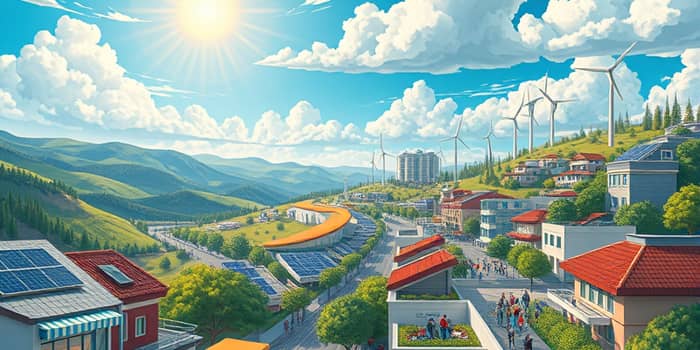
The world stands at a pivotal moment as economies shift toward low-carbon pathways. Investments in sustainable infrastructure, clean technologies, and resilient adaptation are unlocking new opportunities for growth, equity, and environmental stewardship.
Market Size & Growth Trajectory
Over the past decade, the global green economy has surged past a $5 trillion valuation. Between 2025 and 2030, projections estimate an additional $2 trillion infusion into sustainable markets, driving unprecedented growth and innovation.
In 2025, global sustainable energy investment reached $2.3 trillion—an 8 percent jump from 2024. Two-thirds of all energy spending now flows into clean options, marking a decisive shift away from fossil fuels.
Regional Leadership & Investment Distribution
Investment patterns reveal clear leaders and emerging challengers. China, the United States, Europe, and India have ramped up capital deployment, while many developing regions still seek greater access to finance.
This distribution underscores both progress and imbalance: low-income countries, home to 40 percent of the global population, receive only 7 percent of clean energy capital.
- China’s leadership in solar, wind, and battery manufacturing drives cost reductions worldwide.
- The U.S. commissioned 54 GW of new utility-scale generation and storage in 2025.
- Europe deployed record grid expansion funding, led by Germany and the U.K.
Technology Sector Breakthroughs & Cost Reductions
Over the last fifteen years, innovation has cut solar photovoltaic costs by 90 percent and offshore wind by 50 percent. In 2025, renewables accounted for 61 percent of new capacity additions globally.
- Solar & Wind: Utility-scale solar led with 27 GW of new alternating current capacity.
- Lithium Batteries: U.S. operating storage capacity reached 37.4 GW, up 32 percent year-to-date.
- Electric Vehicles: China achieved price parity with combustion vehicles, spurring global EV growth.
Advances in cost-competitive technologies now available are transforming power markets, enabling flexible hybrid solutions and accelerating the shift to decentralized energy systems.
Emissions Reduction Potential
More than half of global greenhouse gas emissions (55 percent) can be addressed using currently available, cost-effective solutions. An additional 20 percent is within reach at modest premiums, especially with supportive policies.
Key sectors like transportation and energy remain top priorities, but emerging solutions in carbon capture, sustainable agriculture, and circular economy models are gaining momentum.
Adaptation & Resilience
As climate risks intensify, investments in adaptation have become essential. Today, adaptation solutions now account for over 20 percent of total climate-related spending, reaching $1.1 trillion annually.
From resilient infrastructure and flood defenses to drought-resistant crops and advanced climate forecasting, these measures not only protect communities—they drive new markets and job creation.
Grid & Infrastructure Investment
To integrate growing renewable capacity, grid investment must exceed $410 billion annually. In 2025, global spending on transmission and distribution grew steadily but still falls short of targets needed for full decarbonization.
Emerging projects in hydrogen distribution, smart microgrids, and cross-border interconnections promise to enhance reliability and unlock further clean energy deployment.
Market Dynamics & Challenges
Supply chain shifts are realigning the cleantech landscape, with much of the new investment flowing toward Asia. Meanwhile, coal demand retreats only gradually, and geopolitical tensions may affect component sourcing.
The transition also faces regulatory hurdles. In the U.S., new foreign entity sourcing rules could reshape solar and battery additions, while consumer willingness to pay higher prices for green products shows early signs of softening.
The Road Ahead
Despite challenges, the story of the global green transition is one of hope, innovation, and collective action. Companies with green revenues are outpacing traditional sectors, and seven in ten people globally now put environmental health ahead of short-term growth.
By aligning policy, finance, and technology with the goal of net-zero emissions, we can create new economic opportunities for all and safeguard the planet for future generations. The time to invest in sustainable futures is now—together, we can build a world where prosperity and ecology advance hand in hand.
References
- https://www.bcg.com/press/2december2025-green-economy-path-7-trillion-2030
- https://bcse.org/market-trends/top-six-trends/
- https://www.spglobal.com/sustainable1/en/insights/2026-sustainability-trends
- https://www.weforum.org/stories/2025/12/global-energy-2026-growth-resilience-and-competition/
- https://www.policycenter.ma/publications/what-2025-2026-tells-us-about-future-global-energy
- https://www.spglobal.com/energy/en/news-research/special-reports/energy-transition/horizons-top-cleantech-trends-2026
- https://www.greeneconomycoalition.org/news-and-resources/the-global-green-shift-public-support-holds-strong-but-economic-realities-bite
- https://www.wri.org/insights/state-clean-energy-charted
- https://about.bnef.com/insights/finance/energy-transition-investment-trends/
- https://www.deloitte.com/us/en/insights/industry/renewable-energy/renewable-energy-industry-outlook.html
- https://www.weforum.org/stories/2026/01/green-transition-affect-labour-markets-around-world/
- https://bcse.org/2025-sustainable-energy-in-america-factbook/
- https://www.wri.org/insights/stories-to-watch-climate-economy-2026
- https://www.privatebank.bankofamerica.com/articles/renewable-energy-investments.html
- https://www.guinnessgi.com/commentaries/sustainable-energy