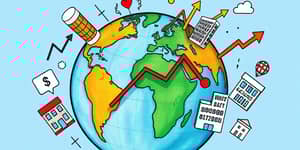
In a world of economic flux, the global consumer stands as a beacon of resilience and change, shaping markets and guiding savvy investment strategies.
Understanding these dynamics is crucial for navigating the complexities of modern finance.
Consumer spending has proven resilient despite headwinds, offering a roadmap for future growth.
The Economic Landscape: Growth and Disparities
Global economic forecasts paint a picture of cautious optimism.
Goldman Sachs Research expects sturdy global growth of 2.8% in 2026, outpacing consensus.
This growth is not uniform, with the U.S. likely to outperform substantially.
More modest projections suggest moderate expansion, setting the stage for strategic investments.
- Global GDP growth forecasts range from 1.8% to 2.8% in 2026.
- The U.S. is anticipated to lead in economic performance.
- Europe and China face unique challenges in consumer engagement.
Consumer Spending: A Tale of Resilience
Across regions, consumer spending shows remarkable adaptability.
It grew by 3% recently, reflecting household strength even under tight credit conditions.
This resilience is a key driver for investment confidence.
Regional variations highlight diverse opportunities.
- In the U.S., consumer spending is forecast to grow by 2.9% in 2026.
- Europe expects household consumption to rise similarly, but with high savings rates.
- China struggles to lift spending, though high-end goods show improvement.
The K-Shaped Economy: Diverging Fortunes
Income inequality creates a stark divide in consumer behavior.
The top third of higher-income households drive more than half of spending.
This gap influences market trends and investment focus.
Lower-income groups face constraints, with a quarter of U.S. households living paycheck to paycheck.
- Upper-income consumers continue to spend robustly without significant acceleration.
- Middle- and lower-income households rely on labor market income, with purchasing power constrained by inflation.
- Tariffs may squeeze budgets further in early 2026.
Savings and Spending Preferences
Households are accumulating record levels of savings, with a rate near 19%.
This high savings rate indicates cautious optimism and future spending potential.
Spending preferences are shifting towards experiential purchases.
Consumers prioritize cruises, concerts, and sporting events across income levels.
- Online retail channels outperform in-store, with TikTok Shop gaining traction.
- Housing and durables remain interest-sensitive, with mortgage rates expected to dip below 6%.
- Home purchase volumes are projected to grow about 3% in 2026.
Labor Market and Policy Drivers
The labor market remains stable, supporting consumer spending expectations.
Unemployment is expected to peak at 4.7% in Q2 2026 before easing.
Real wage gains further bolster household confidence.
Monetary and fiscal policies play a critical role in shaping the economic environment.
- The Fed is on an easing path with 75 basis points in additional policy cuts.
- Fiscal policy is expected to be more expansionary, boosting consumption growth.
- Policy uncertainty is decreasing, which supports spending.
Inflation and Its Impact
Inflation is a key factor influencing consumer behavior.
It is expected to be flat in 2026 versus 2025, with tariff-related pressures peaking early.
This moderates household purchasing decisions and investment risks.
AI: The New Growth Engine
Artificial intelligence is transforming economies and investment landscapes.
Business investment in AI remains strong, adding approximately 0.4 percentage points to growth.
This represents roughly 20% of total growth in 2026 and 2027.
AI-driven stock market rises bolster spending, especially for wealthier consumers.
- AI investment has reached historic levels, focusing on hardware and software.
- Rate cuts may help offset labor pressures from AI adoption.
- Physical limits like grid capacity create new sector opportunities.
Investment Opportunities in a Changing World
Private investment is expected to pick up modestly after years of decline.
Easing borrowing costs and improved corporate balance sheets will boost this trend.
Emerging markets offer significant potential, with US$40-50 billion entering bond markets in 2026.
Private credit shows signs of growth, though concerns remain contained for now.
- EM high yielders are expected to lead rate cuts, attracting capital.
- Business activity is picking up, supported by healthy banks.
- Geopolitical shifts, like a stronger renminbi, may tighten currency dynamics.
Geopolitical Considerations
Trade and immigration policies add layers of complexity to global consumer trends.
Uncertainties in these areas are expected to fade, improving the economic climate.
External sector improvements and supportive commodity outlooks offer further stability.
Investors must stay agile to navigate these evolving factors.
By understanding these trends, one can make informed decisions that capitalize on resilience and innovation.
The global consumer is not just a market force but a guide to future prosperity.
References
- https://www.deloitte.com/us/en/insights/topics/economy/global-economic-outlook-2026.html
- https://www.privatebank.bankofamerica.com/articles/2026-consumer-outlook.html
- https://www.morganstanley.com/insights/podcasts/thoughts-on-the-market/us-consumer-trends-michelle-weaver-arunima-sinha-simeon-gutman-megan-clapp
- https://www.pinebridge.com/en/insights/investment-strategy-insights-assessing-scenarios-for-our-2026-outlook
- https://www.msci.com/research-and-insights/paper/investment-trends-in-focus-key-themes-for-2026
- https://www.library.hbs.edu/working-knowledge/eight-trends-for-2026-pricing-passion-and-the-risks-ahead
- https://www.goldmansachs.com/insights/outlooks/2026-outlooks
- https://www.jpmorgan.com/insights/global-research/outlook/market-outlook
- https://www.mintel.com/insights/consumer-research/global-consumer-trends/