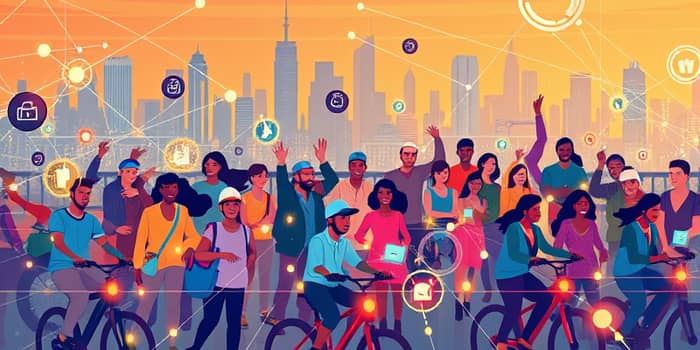
The rise of on-demand work platforms and the shifting expectations of professionals worldwide have given birth to a new era of labor, known as the gig economy. Far beyond informal side hustles, this global phenomenon reshapes how people earn income, balance life, and pursue creative fulfillment.
In this article, we explore the defining characteristics, expansive growth, and profound impact of the gig economy, as well as practical insights to help individuals and businesses thrive in this evolving environment.
Definition and Overview
The gig economy consists of short-term contracts and freelance work facilitated by digital platforms rather than traditional full-time employment. Participants engage in on-demand jobs spanning transportation, delivery, skilled professional services, and creative projects.
Major platforms such as Uber, DoorDash, Upwork, and Fiverr have revolutionized service exchange, enabling task-based arrangements and flexible schedules for millions of independent workers.
These platforms leverage affordable smartphones and high-speed internet to lower barriers to entry, particularly in developing regions where digital adoption is accelerating rapidly.
Market Size and Growth Projections
The global gig economy has experienced remarkable expansion over the past decade. In 2023, its value reached $455.2 billion, with projections indicating a rise to $497.9 billion by 2032 at a 1.9% CAGR.
In the United States alone, freelance earnings contributed $1.27 trillion to the economy in 2023, growing to $1.5 trillion as high-skill freelancers saw earnings climb 18% year-over-year. Globally, online gig work accounted for over 12% of the labor force in 2022, generating $3.8 trillion in revenue.
These figures underscore the steady momentum driving gig work into the mainstream and highlight the need for strategic planning by policymakers and businesses.
Workforce Participation and Demographics
In 2022, there were 59 million independent workers in the U.S., compared with 100 million permanent employees. By 2023, 64 million Americans engaged in some form of freelance work, up from the prior year, and projections estimate 70.4 million by 2025.
Full-time independent workers nearly doubled from 13.6 million in 2020 to 27.7 million in 2024. Generational trends reveal that while millennials and baby boomers dominate this segment, 73% of Gen Z freelancers choose gig work proactively.
Moreover, 4.7 million independent workers earned over $100,000 in 2024, up from 3 million in 2020—a testament to the high-value opportunities available for skilled professionals.
Geographic Distribution
The concentration of gig workers varies across regions and states. Florida leads the U.S. with 22% of its workforce engaged in gig activities, followed by California at 20%, and Texas and Illinois at 18% each.
Metropolitan areas such as Austin, Raleigh, and Denver boast some of the highest remote work percentages, illustrating how urban centers adapt to digital trends.
Emerging markets, particularly in Sub-Saharan Africa, saw job postings rise by 130%, compared with 14% growth in North America, demonstrating the technology-driven expansion of freelance opportunities globally.
High-Paying Gigs and Industries
- Transportation and ride-sharing dominate with billions in revenue from taxi and limousine services.
- Creative professions—artists, writers, designers—generate nearly $18.9 billion.
- Professional consulting roles, such as public relations managers and business consultants, command $50–$100 per hour.
- Specialized skilled trades, including massage therapy, average $27.34 per hour.
These figures highlight the lucrative potential for workers who leverage specialized expertise or unique talents in the gig marketplace.
Benefits and Motivations
Flexibility remains the foremost advantage: 63% of gig workers cite portfolio of clients more reliable than a single employer, and many appreciate the freedom to set their own schedules.
For businesses, gig platforms offer scalability and faster hiring processes, granting access to global talent without the overhead of full-time staff and infrastructure.
- Control over workload and project selection
- Opportunity to diversify income streams
- Work-life balance tailored to individual needs
- Exposure to international clients and markets
According to surveys, 86% of freelancers believe their best days are ahead, driven by optimism about remote collaboration tools and digital connectivity.
Challenges and Barriers
Despite its appeal, gig work carries inherent challenges. Many independent workers struggle with securing affordable healthcare and retirement benefits, as traditional employer-sponsored plans are often inaccessible to them.
A persistent gender wage gap of approximately 30% in the gig economy further underscores inequities that mirror, or even exceed, those found in traditional employment.
Measurement and policy frameworks also lag behind this decentralized sector, making it difficult for labor agencies to track participation accurately and for governments to craft supportive regulations.
Economic and Future Impact
Freelancing now grows three times faster than the traditional workforce, contributing more to GDP than many established industries. As non-employer statistics continue to climb, the need for updated labor policies and social safety nets becomes increasingly urgent.
Looking ahead, the gig economy promises evolving opportunities propelled by automation, artificial intelligence, and expanded digital infrastructure. Stakeholders—workers, businesses, and policymakers—must collaborate to ensure that the benefits of this transformation are harnessed sustainably and equitably.
By embracing the strengths of flexibility, innovation, and global connectivity, we can build a future where independent work is both a pathway to economic resilience and a source of personal fulfillment for millions around the world.
References
- https://financebuzz.com/gig-economy-statistics
- https://www.precisionbusinessinsights.com/market-reports/gig-economy-market
- https://oysterlink.com/spotlight/gig-economy-statistics/
- https://www.talentneuron.com/blog/navigating-the-rising-gig-economy-and-its-impact-on-work
- https://leadingage.org/gig-economy-reveals-important-information-about-the-workforce/
- https://www.naco.org/featured-resources/future-work-rise-gig-economy
- https://www.upwork.com/resources/gig-economy-statistics
- https://www.census.gov/library/stories/2025/07/nes-gig-economy.html
- https://www.integracredit.com/blog/gig-economy-statistics
- https://fortunly.com/statistics/gig-economy-statistics/
- https://guides.loc.gov/gig-economy/statistical-data
- https://www.weforum.org/stories/2025/06/the-gig-economy-ilo-labour-platforms/
- https://www.youtube.com/watch?v=dqmJN5z6Rjc