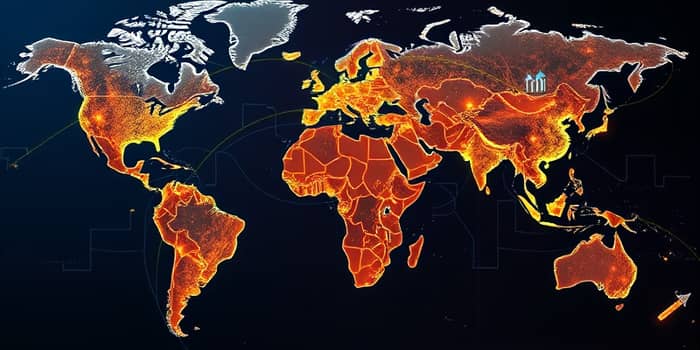
In an era where economic policy intertwines with international relations, the concept of geoeconomics has emerged as a critical lens. It examines the strategic spatial properties of national economies and how states deploy financial tools to achieve political aims. Nowhere is this interplay more pronounced than in the global energy sector, where resource flows and investment decisions shape alliances, rivalries, and the future of our planet.
Defining Geoeconomics
At its core, geoeconomics refers to analytical frameworks that assess how nations leverage economic instruments for strategic advantage. This field blends international economics, geopolitics, and strategy into a unified approach.
Key aspects of this discipline include:
- Control over outbound investment via state-owned enterprises and sovereign wealth funds
- Access to domestic markets, technology transfers, and joint ventures
- Influence over commodity and energy flows through pipelines and shipping lanes
- Global footprint of a country’s currency and financial networks
Increasingly, private capital such as pension funds and institutional investors also play roles alongside traditional state actors, reshaping how economic power is projected abroad.
Energy at the Heart of Geoeconomics
Energy resources occupy a privileged position in geoeconomic strategies because they underpin industrial strength, national security, and diplomatic influence. Control over oil, gas, and emerging clean technologies can translate directly into leverage.
Russia’s history of gas pipeline shutdowns for political gain, such as the 2008 cutoff to Europe, illustrates energy weaponization. Meanwhile, the United States has harnessed its shale revolution to export LNG and oil, strengthening ties with allies and countering adversaries.
China’s Belt and Road Initiative channels massive investments into energy infrastructure across Asia, Africa, and Europe, projecting soft power through power plants, pipelines, and transmission lines. These projects serve both commercial aims and long-term strategic reach.
At the same time, globally integrated markets temper overt coercion, as suppliers must maintain reliability to prevent customers from seeking alternatives. This delicate balance between competition and cooperation underscores the blend of power and profit at the heart of geoeconomics.
Investment Trends in 2025-2026
The global energy transition is accelerating investment flows into clean technologies and resilience measures. After surpassing $3.3 trillion in total energy investments, stakeholders are doubling down on renewables, storage, and efficiency.
Table 1 summarizes key trends in 2025 and projections for 2026:
These figures reveal a record clean energy investment surge that not only outpaces fossil fuels but also reshapes geopolitical alignments. Asia, led by China and India, dominates new capacity additions, while Europe and North America focus on grid modernization and storage expansion.
Major Players and Their Strategies
As the geoeconomic contest intensifies, several actors stand out:
- China: Leading in solar, wind, battery scale-up; deploying cleantech via the Belt and Road Initiative
- United States: Leveraging shale, LNG exports, sanctions, and foreign investment controls
- Russia: Continuing to wield gas exports as a strategic tool in Europe
- Private Capital: Pension funds and institutional investors backing BESS projects and renewable builds
Beyond these, emerging markets in Southeast Asia and Latin America attract multilateral funding for clean grids and alternative fuels like green hydrogen and sustainable aviation fuel.
Emerging Risks and Future Scenarios
The rapid proliferation of AI-driven data centers is driving power demand up by 17% annually, straining existing grids and raising questions about critical infrastructure resilience. Without timely upgrades, blackouts and bottlenecks could undermine economic progress.
Grid modernization requirements pose another hurdle: Europe needs €584 billion in grid upgrades by 2030 to support renewables and electrification. Delay risks stalling global energy transformation goals and amplifying supply vulnerabilities.
Geoeconomic fragmentation—driven by divergent tech standards, supply chain shifts like China+1, and competing debt traps—could lead to volatile trade-offs between security and market access. Companies must navigate a patchwork of regulations and tariffs.
Policy shifts, such as China’s competitive solar bidding and U.S. FEOC rules restricting certain foreign investments, will ripple through investment flows, potentially slowing capacity growth or redirecting capital to new regions.
Charting a Resilient Future
Businesses, governments, and communities must embrace adaptability and foresight to thrive in this dynamic environment. By integrating risk assessments with strategic planning, stakeholders can align investments with long-term resilience goals.
Innovation in financing mechanisms—such as green bonds and public–private partnerships—can unlock capital for remote grids, storage solutions, and emerging clean fuels. Collaboration across sectors will be key to overcoming financing gaps.
Ultimately, the geoeconomics of energy investment offer unprecedented opportunities for growth and collaboration. By understanding core drivers and preparing for volatile market shifts, readers can position themselves at the forefront of the next wave of sustainable prosperity.
References
- https://en.wikipedia.org/wiki/Geoeconomics
- https://energytracker.asia/renewable-energy-investment-opportunities/
- https://www.armyupress.army.mil/Journals/Military-Review/English-Edition-Archives/January-February-2018/Geoeconomics/
- https://www.weforum.org/stories/2025/12/global-energy-2026-growth-resilience-and-competition/
- https://www.chathamhouse.org/2016/12/geoeconomics-explained
- https://press.spglobal.com/2025-12-09-S-P-Global-Energy-Releases-Key-Clean-Energy-Trends-for-2026-as-AI-Growth-and-Geopolitical-Shifts-Reshape-Global-Energy-Markets
- https://www.aacsb.edu/insights/articles/2023/04/geoeconomics-the-force-shaping-todays-business
- https://www.deloitte.com/us/en/insights/industry/renewable-energy/renewable-energy-industry-outlook.html
- https://www.euroamerican.eu/geoeconomics-how-sanctions-and-trade-wars-shape-the-global-order
- https://about.bnef.com/insights/finance/energy-transition-investment-trends/
- https://www.weforum.org/stories/2025/12/navigating-the-new-economy-how-will-geoeconomics-and-technology-define-the-global-landscape-in-2030/
- https://www.womblebonddickinson.com/us/insights/press-release/energy-outlook-2026-global-energy-sector-under-pressure-demand-surges
- https://siepr.stanford.edu/news/power-geoeconomics-make-sense-turbulent-world
- https://www.morganstanley.com/insights/articles/investment-outlook-shaping-markets-2026
- https://smith.queensu.ca/insight/content/What-Is-Geoeconomics.php