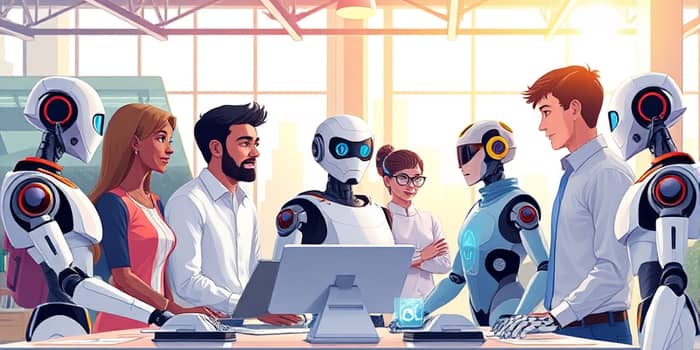
In an age where artificial intelligence, robotics, and process automation reshape industries at unprecedented speed, the future of work holds both challenge and promise. Rather than fear obsolescence, forward-thinking professionals can seize emerging opportunities and prepare to thrive in a transformed labor market.
By understanding the massive scale of automation, embracing roles that will be in high demand, and investing in targeted reskilling, individuals and organizations can unlock growth, productivity, and fulfillment on a global scale.
Embracing AI: From Disruption to Opportunity
Today’s technologies have the potential to automate roughly 57% of U.S. work hours, but realistic adoption scenarios suggest about 27% automation by 2030. Even as 30% of jobs could be fully automated and 60% undergo significant task-level changes, the net global impact points toward growth: automation may displace 92 million jobs but create 170 million new roles, yielding a net gain of 78 million jobs globally.
Far from mere replacement, AI is driving augmentation in 78% of jobs today. Already, more than half of workers use AI tools daily, boosting task throughput by 66% on average. Robotic process automation can deliver up to 200% ROI within its first year, while generative AI could raise labor productivity by 15% in developed markets. These advances create short-term friction—unemployment may tick up during transitions—but ultimately pave the way for unprecedented efficiency and growth.
Sectors Poised for Growth
Not all industries face equal exposure to automation. Sectors that combine human expertise with AI tools will become force multipliers in value creation. Healthcare, for example, stands to gain as machine learning streamlines diagnostics and paperwork, freeing clinicians for direct patient care.
In manufacturing, AI integrated with IoT sensors enables predictive maintenance and real-time process control. Financial services use AI for fraud detection and automated customer service, reducing errors and operational costs. Even creative fields leverage generative tools to accelerate design, content creation, and personalized marketing.
- Nurse Practitioner roles projected to grow 52% by 2033
- Database Architects employment rising 10.8% (2023–33)
- AI & Data Science Specialists in top demand
- Cybersecurity experts with 119% demand increase
As wages in AI-exposed industries rise twice as fast as in others, workers who align with these growth areas will enjoy greater earning potential and stability.
Reskilling for Tomorrow’s Workforce
The scale of the reskilling challenge is immense: 44% of employees will need significant skill upgrades within five years, and 81% require AI-related training to stay current. Companies are investing—69% have active reskilling programs—but success demands more than technology budgets; it requires strategic curriculum design, hands-on practice, and continuous learning cultures.
McKinsey’s Skill Change Index estimates that by 2030, up to one-third of work hours for top skills could be automated. Yet human capacities in creativity, empathy, and negotiation remain irreplaceable. The most in-demand skills will blend technical fluency with interpersonal strengths.
- Machine Learning & AI Development (+142% demand)
- Data Analysis & Interpretation (+128%)
- Emotional Intelligence & Leadership (+87%)
- Creative Problem Solving & Innovation (+76%)
- Cybersecurity & Risk Management (+119%)
Employers and individuals can partner with online academies, industry consortia, and in-house bootcamps to close skill gaps. Microcredentials and project-based assessments ensure learning is relevant and immediately applicable.
Personal Roadmap to Profit
Navigating this transition begins with self-assessment. Identify which tasks in your role are most susceptible to automation, then explore adjacent areas where your domain expertise can shine alongside AI. Set clear goals for acquiring specific certifications or completing hands-on projects.
- Audit your current skill set against future job profiles
- Research industry trends and high-growth occupations
- Enroll in targeted courses or bootcamps
- Join professional communities and AI user groups
- Build a portfolio of AI-augmented work samples
By proactively adapting, you transform automation from a threat into a catalyst for career advancement. Leverage your new skills to take on higher-value projects, command premium compensation, and even spin off side ventures that harness AI capabilities.
Conclusion: Crafting a Collaborative Future
The future of work is not a zero-sum game between humans and machines. Automation and AI will eliminate routine tasks, but they will also unlock our highest human potential. By embracing reskilling, focusing on uniquely human skills, and aligning with growth sectors, professionals can enjoy richer work experiences, higher incomes, and greater job security.
Organizations that foster continuous learning and experiment boldly with automation stand to gain a competitive edge. In this new era of collaboration, those who prepare today will lead tomorrow—capitalizing on change to shape a prosperous and meaningful future of work.
References
- https://www.secondtalent.com/resources/future-of-work-workplace-statistics/
- https://thunderbit.com/blog/automation-statistics-industry-data-insights
- https://www.nu.edu/blog/ai-job-statistics/
- https://www.goldmansachs.com/insights/articles/how-will-ai-affect-the-global-workforce
- https://www.mckinsey.com/mgi/our-research/agents-robots-and-us-skill-partnerships-in-the-age-of-ai
- https://www.bls.gov/opub/mlr/2025/article/incorporating-ai-impacts-in-bls-employment-projections.htm
- https://www.shrm.org/executive-network/insights/research/employment-automated-era-october-2025-en-insights-forum
- https://www.pwc.com/gx/en/services/ai/ai-jobs-barometer.html
- https://www.weforum.org/publications/the-future-of-jobs-report-2025/
- https://www.shrm.org/about/press-room/ai-s-wake-up-call--new-shrm-research-reveals-23-2-million-americ
- https://www.pwc.com/gx/en/issues/workforce/hopes-and-fears.html
- https://budgetlab.yale.edu/research/evaluating-impact-ai-labor-market-current-state-affairs
- https://mitsloan.mit.edu/ideas-made-to-matter/a-new-look-how-automation-changes-value-labor
- https://www.microsoft.com/en-us/worklab/work-trend-index/2025-the-year-the-frontier-firm-is-born