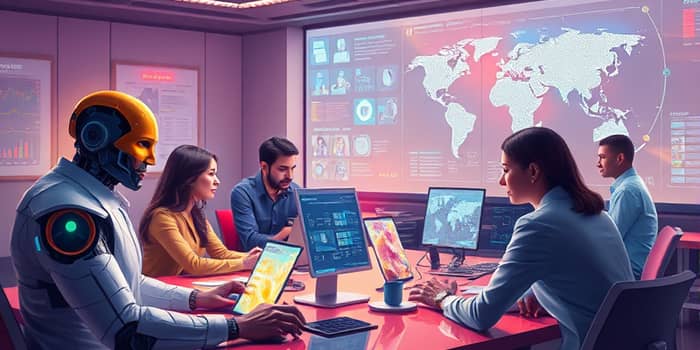
The workplace is evolving at a breathtaking pace, driven by technological leaps and cultural shifts. AI integration and workforce redesign are not just trends but fundamental forces reshaping our professional lives.
By 2026, we stand at the cusp of a new era where human potential meets machine intelligence. Remote and hybrid work persistence has cemented itself as a cornerstone of modern employment, blending flexibility with productivity.
This transformation invites us to rethink what it means to work and thrive. Skills shifts and cultural adaptations will define success, offering a path to more meaningful and resilient careers.
The AI-Powered Workforce: From Tools to Teammates
Artificial intelligence is transitioning from a supportive tool to an active collaborator in the workforce. Human-AI collaboration is poised to unlock efficiencies and innovations across sectors.
Organizations are increasingly tying headcount decisions to AI productivity expectations. This leads to a talent remix via layoffs and restructuring, creating both disruption and new openings.
- Software agents are emerging as a second workforce alongside humans, managing end-to-end workflows rather than isolated tasks.
- By 2026, over 40% of enterprise applications will include task-specific AI agents, up from less than 5% in 2025.
- However, more than 40% of agentic AI projects may be canceled by 2027 due to ROI and governance challenges.
Job roles are being wholesale broken down into tasks assigned to humans or AI. AI contraction and expansion can free over 120 hours per employee annually, with most investments focused on redesigning functions.
This necessitates a shift from traditional job titles to skills-based outcomes. Outcome-based approaches from jobs to skills are becoming critical, with middle managers playing a leveraged role in fluid talent pools.
The Remote Revolution: Stability and Challenges
Remote work has stabilized at levels three times higher than pre-pandemic, offering clear benefits but also presenting coordination hurdles. Personalized hybrid models are emphasized as optimal for balancing focus and well-being.
The following table highlights key remote work statistics for 2026, showcasing its impact and persistence:
These statistics underscore remote work's permanence, yet tools and connectivity require enhancement. Over 40% of hybrid workers feel less connected, highlighting the need for better collaboration solutions.
- Remote work is linked to a 0.1% drop in labor cost growth and a 0.4% drop in office costs per 1% increase in adoption.
- Every 1% increase in remote work corresponds to a 0.08 to 0.09 point rise in total factor productivity.
- This avoids an estimated $600 billion in annual U.S. distraction losses, demonstrating significant economic upside.
Economic Opportunities and the Skills Pivot
The economic implications of these shifts are profound, opening new avenues for growth and innovation. Productivity and cost gains from AI and remote work can drive substantial value, but require strategic adaptation.
A notable trend is the pivot of digital workers to skilled trades, which are less automatable. Soft skills are now more important than ever, with three in five employers emphasizing their value and a 26% growth projected by 2030.
- HR's role is central in this human-machine era, blurring boundaries through AI platforms like Workday and Microsoft Copilot.
- Culture becomes a critical engagement driver, with system-driven approaches focusing on energy and clarity over mere effort.
- Ethical AI boundaries and upskilling for creativity, empathy, and judgment are essential for sustainable growth.
To capitalize on these opportunities, agile strategies must be adopted by both individuals and organizations. Focus on outcome-based performance rather than traditional job roles, and build resilient, inclusive cultures.
- Develop flexible talent pools that incorporate full-time employees, freelancers, and contractors for dynamic project needs.
- Invest in continuous learning to address the 39% of skills expected to be disrupted in the next five years.
- Leverage AI to handle friction-filled tasks, saving employee effort and enhancing overall job satisfaction.
Practical Steps for Thriving in 2026
Embracing the future of work requires proactive and thoughtful actions from everyone involved. Upskilling and reskilling initiatives are no longer optional but imperative for career longevity and organizational success.
For individuals, cultivating a blend of technical and human skills is key to navigating change. Adaptability and lifelong learning will be your greatest assets in a rapidly evolving job market.
- Identify high-demand skills such as critical thinking, emotional intelligence, and digital literacy to stay competitive.
- Seek out training programs or online courses to keep pace with AI-driven changes and emerging technologies.
- Embrace remote work flexibility to improve work-life balance and productivity, but invest in tools to maintain connections.
- Consider pivoting to roles in skilled trades or sectors less susceptible to automation, if aligned with personal interests.
- Build a personal brand that highlights unique human qualities like creativity and empathy, which AI cannot replicate.
For organizations, success hinges on redesigning workflows and fostering a culture of innovation. Implementing human-agent teams effectively can unlock new levels of efficiency and creativity.
- Redesign jobs into tasks that optimize collaboration between humans and AI, avoiding blunt force automation.
- Develop clear policies for remote and hybrid work, prioritizing personalized approaches that suit diverse roles and needs.
- Invest in AI governance to manage risks and ensure ethical use, preventing project cancellations due to ROI issues.
- Create cultures that value energy and clarity, reducing burnout and enhancing engagement in high-pressure environments.
- Expand HR's role to include security against insider threats and management of digital twins for employees.
By taking these steps, we can navigate the uncertainties and harness the vast opportunities of the future workplace. The journey towards a more adaptable and humane work environment is within reach, promising not just economic gains but also greater personal fulfillment.
In conclusion, the future of work in 2026 is a vibrant tapestry of innovation and adaptation. Embrace change with curiosity and courage, and you'll discover that the shifts ahead are not just challenges but gateways to a more dynamic and rewarding professional life.
References
- https://itbrief.asia/story/gartner-maps-nine-ai-driven-work-trends-chros-face-by-2026
- https://www.dayforce.com/blog/10-workforce-trends-for-2026
- https://archieapp.co/blog/remote-work-statistics/
- https://greatleadership.substack.com/p/future-of-work-trends-2026-agent-workforce
- https://www.achievers.com/blog/remote-work-statistics/
- https://www.tmi.org/blogs/the-future-of-work-11-hr-trends-every-chro-must-know-in-2026
- https://www.webwork-tracker.com/blog/remote-work-study-2026
- https://www.prsa.org/article/6-workplace-trends-shaping-2026-jan26
- https://www.strongdm.com/blog/remote-work-statistics
- https://www.fidelityworkplace.com/s/article/workforce-trends
- https://join.virtuallatinos.com/blog/remote-work-statistics/
- https://www.dhrglobal.com/insights/workforce-trends-report-2026/
- https://www.virtualvocations.com/blog/annual-statistical-remote-work-reports/top-100-companies-to-watch-for-fully-remote-jobs-in-2026/
- https://www.binghamton.edu/news/story/6004/remote-work-best-practices-business-new-research
- https://ginitalent.com/remote-work-trends-2026-how-global-teams-are-reshaping-the-future-of-work/