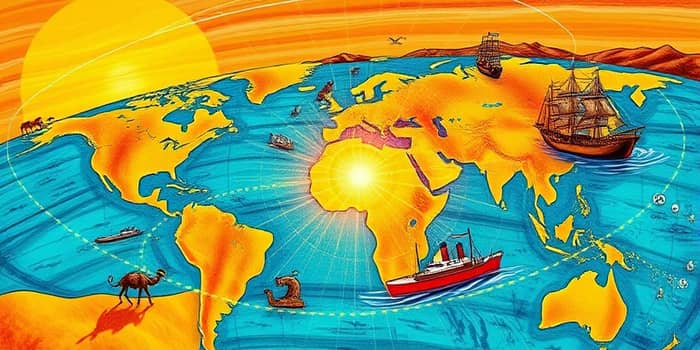
From the dawn of civilization to today’s digital marketplaces, the evolution of trade routes has shaped economies, cultures, and investment opportunities across millennia. By tracing key pathways—land, sea, and cyber—we uncover how each technological leap drove unprecedented capital flow and growth in societies around the globe.
This article explores the major phases of global trade, highlights transformative innovations, and reveals timeless lessons on attracting and deploying investment.
Foundations of Ancient Commerce
Long before modern ports and highways, early societies established formal systems of exchange along river valleys and over deserts. Mesopotamia set a precedent around 4000 BCE, using clay tokens along the Tigris and Euphrates to account for goods. Simultaneously, Egypt leveraged the Nile, Mediterranean, and Red Sea to link Africa with the Middle East.
By 3000 BCE, networks connected the Indus Valley to North Africa. Phoenician mariners (1500 BCE) pushed the limits of shipbuilding, expanding trade across the Mediterranean. Bronze Age civilizations imported tin from Cornwall via France to Greece, fueling the Bronze Age’s metalworking revolution.
The iconic Silk Road emerged around 130 BCE, spanning 4,000 miles from Xi’an to Rome. Caravans carried silk, spices, jade, and porcelain westward, while bringing wool, gold, and silver eastward. This route became a conduit for cultural exchange and brilliant ideas, from papermaking to Buddhism.
Medieval Pathways and Islamic Networks
From the 2nd century BCE to the 14th CE, the Silk Road flourished under Zhang Qian’s expeditions and the commercial savvy of Sogdians, Bactrians, and Khwarazmians. Simultaneously, the Trans-Saharan routes (4th–16th CE peak) linked West Africa’s goldfields to Mediterranean markets via camel caravans of over 1,000 animals.
Across Asia, the Tea Horse Road exchanged Tibetan warhorses for Chinese tea, moving 20,000 horses annually for 8,000 tons of tea during the Song Dynasty. The Islamic Golden Age fostered banking innovations—like the sakk (checks)—and extended Arab trade from Spain to China.
Even as Rome fell, the Byzantine Empire preserved Mediterranean connections. Crusader demand for Eastern goods rekindled European interest, setting the stage for the Age of Exploration.
The Age of Exploration and Mercantilism
The 15th century ushered in Portuguese and Spanish expeditions, with Vasco da Gama rounding Africa to India (1498) and Columbus reaching the Americas (1492). Control of the Spice Route shifted to the Red Sea as Ottoman power grew, redirecting European trade initiatives toward maritime discovery.
Colonial empires exploited a hub-and-spoke mercantilist model: regions exported raw materials to Europe and imported finished goods. Silver from the Americas funded Asian purchases of silk and tea, creating massive bullion flows across oceans and enriching Iberian treasuries throughout the 16th century.
Industrial Revolution to Modern Logistics
The late 18th and 19th centuries witnessed steamships, railroads, and canal engineering. The Suez Canal (1869) reduced Europe–Asia transit by weeks; the Panama Canal (1914) sliced America–Asia routes in half. By the 20th century, containerization slashed shipping costs by over 90% and standardized cargo handling.
Simultaneously, telegraphs morphed into global internet networks, enabling instant transactions and real-time supply chain visibility. Air freight emerged for high-value goods, knitting distant markets ever tighter.
Key Technological Innovations
- Phoenician navigation and hull design (1500 BCE)
- Steam-powered vessels and locomotives (19th CE)
- Suez and Panama Canal engineering feats
- Container shipping standardization (20th CE)
- Digital platforms and blockchain for trade
Investment Opportunities through the Ages
Each era’s breakthrough created fertile ground for investors. Prehistoric token systems laid the groundwork for commercial accounting. Silk Road caravanserais spawned local markets and hospitality services. Maritime discoveries birthed shipyards, insurance, and port infrastructure.
During mercantilism, European powers invested in colonial plantations, mining operations, and naval fleets. The Industrial Revolution’s railways, steamships, and canals attracted vast capital to engineering and manufacturing enterprises. In modern times, logistics firms, container terminals, and digital startups have captured investor attention.
Major Investment Lessons
- Diversify across infrastructure and tech to mitigate geopolitical risk.
- Invest in transportation corridors that shorten transit and reduce costs.
- Back digital platforms enhancing transparency and speed.
- Seek partnerships in emerging markets along new routes.
Contemporary Relevance and Future Outlook
Today's Belt and Road Initiative revives the Silk Road ethos, funding railways, ports, and pipelines across Asia, Africa, and Europe. Digital corridors—fiber-optic cables and satellite networks—extend this vision into cyberspace.
But challenges persist: geopolitical tensions, climate risks, and cybersecurity threats can disrupt even the most robust routes. Investors must balance potential returns with resilience planning.
As history shows, trade routes evolve with each technological wave. From camel caravans to container ships to digital blockchains, connectivity fuels growth. By learning from past innovations and disruptions, modern investors can anticipate the next frontier—be it autonomous shipping, hyperloop corridors, or decentralized trade protocols—and position themselves at the nexus of progress.
References
- https://ndto.com/make-way-the-evolution-of-international-trade-routes/
- https://transportgeography.org/contents/chapter7/globalization-international-trade/global-trade-routes-1400-1800/
- https://study.com/academy/lesson/history-of-trade-origin-timeline-evolution.html
- https://en.wikipedia.org/wiki/Timeline_of_international_trade
- https://www.mentalfloss.com/article/86338/8-trade-routes-shaped-world-history
- https://www.american-trading.com/news/history-of-international-trade
- https://www.youtube.com/watch?v=Q7xp1-VvtZ0
- https://blog.currencycloud.com/the-evolution-of-international-trade-and-modern-day-trade-routes
- https://www.weforum.org/stories/2019/01/how-globalization-4-0-fits-into-the-history-of-globalization/