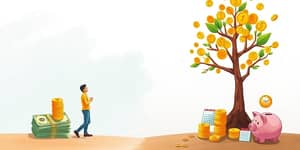
Imagine a single penny doubling every day for a month.
By day 31, it becomes over $10 million, showcasing the incredible power of compounding.
This principle, often dubbed the eighth wonder of the world, turns tiny, consistent inputs into life-changing outcomes across all areas of life.
The Science and Mechanics of Compounding
At its core, compounding is the process where growth generates more growth over time.
In finance, this is known as interest on interest, where earnings are reinvested to accelerate wealth accumulation.
The mathematical foundation is simple yet profound, with future value calculated as (1 + r)^n - 1, where r is the rate and n is the periods.
This formula reveals how small rates can lead to explosive results with enough time.
- With a 5% annual return over 2 years, total growth is 10.25%, with the compounding effect adding an extra 0.25%.
- At 50% annual growth for 2 years, total reaches 125%, demonstrating how higher rates amplify the effect.
- The Rule of 72 is a handy tool: divide 72 by the annual return rate to estimate doubling time, e.g., 10% returns double investment in about 7.2 years.
These examples highlight the exponential nature of compounding, where patience pays off immensely.
Financial Freedom Through Compounding
Compounding is the secret behind many wealth stories, like Warren Buffett's journey from small savings to billions.
Starting early is crucial, as time allows growth to multiply dramatically.
For instance, investing $10,000 at age 31 can yield 15% more wealth than adding $2,000 annually from age 41, despite lower total input.
This underscores the profound impact of early action on long-term results.
Visualizing such scenarios can motivate consistent saving and investing habits.
- Regular saving of $5 daily amounts to $1,825 yearly, which compounded in index funds grows significantly over decades.
- Reinvesting dividends in a diversified portfolio builds wealth steadily for families.
- Avoiding high-interest debt, like 18% credit card balances, prevents negative financial snowballs.
These strategies leverage compounding to secure a stable financial future.
Personal Growth and Daily Habits
Beyond money, compounding transforms personal development through small, daily improvements.
James Clear's "Atomic Habits" emphasizes that 1% daily improvement compounds into mastery over time.
Elon Musk read two books a day as a child, and that knowledge compounded to fuel innovations in multiple industries.
This shows how consistent learning accelerates success in unexpected ways.
- Spending 15 minutes daily on a skill accumulates over 90 hours of practice in a year.
- Improving work productivity by 1% weekly results in being 67% better in a year.
- Cutting 100 calories daily leads to losing 10 pounds in a year, boosting health and energy.
These habits create a ripple effect of positive change, enhancing relationships and overall well-being.
Business and Performance Applications
In business, compounding drives success through marginal gains and feedback loops.
The British Cycling team used the "1% Rule" to transform from mediocrity to dominance with tiny improvements.
By focusing on aerodynamics, sleep, and nutrition, they achieved extraordinary results.
This approach builds sustainable momentum for teams and organizations.
- Implementing daily huddles and weekly metrics creates feedback loops for better execution.
- Focusing on small, consistent wins sustains motivation and drives long-term growth.
- In manufacturing, monthly process improvements compound into quarterly efficiency gains.
These practices show how compounding can elevate performance in any field.
The Risks of Negative Compounding
Compounding isn't always positive; unchecked, small negatives can snowball into major issues.
Credit card debt at 18% interest can grow rapidly if unpaid, leading to financial strain.
Similarly, daily overeating can compound into weight gain, low energy, and poor relationships.
This highlights the danger of ignoring small bad habits over time.
- In investing, funds with negative average alpha can underperform despite occasional wins.
- Global risks, like those in the WEF report, can compound beyond individual threats, creating polycrises.
- Visualizing the cost of daily habits, like $4 coffee over 20 years, reveals missed investment opportunities.
Awareness of these risks helps in making proactive, positive choices.
Practical Steps to Leverage Compounding
To harness compounding in your life, start with simple, consistent actions today.
Focus on building habits that align with long-term goals for maximum impact.
Remember, the key is patience and unwavering consistency through the slow initial phases.
- Begin investing early, even with small amounts, to maximize time in the market.
- Adopt a daily practice of learning or skill-building to accelerate personal growth.
- Track and celebrate small wins in projects to maintain momentum and motivation.
- Avoid high-interest debt and negative habits to prevent compounding drawbacks.
- Set clear, long-term visions to stay committed when results seem distant.
These steps empower you to transform your future through the power of compounding.
Conclusion: Embracing the Compounding Mindset
The compounding effect is a universal force that rewards those who think long-term.
Whether in finance, health, or career, small efforts today lead to extraordinary outcomes tomorrow.
Start now, with whatever resources you have, and let time work its magic.
Embrace the journey, and watch as your consistent actions compound into a life of abundance and fulfillment.
References
- https://wiki.treasurers.org/wiki/Compounding_effect
- https://vocal.media/motivation/the-compound-effect-in-action-real-life-examples-of-small-changes-leading-to-big-results
- https://www.ssb.texas.gov/sites/default/files/uploads/voi/articles/compounding.html
- https://www.plannersearch.org/financial-planning/the-reality-of-compound-returns
- https://www.shortform.com/blog/compound-effect-meaning/
- https://brightadvisers.com/10-examples-of-the-power-of-compounding-for-young-families/
- https://strategyandexecution.com.au/the-compound-effect-in-business/
- https://www.nextlevel.coach/blog/rare-examples-of-the-power-of-compounding-and-why-the-most-successful-people-are-obsessed-with-it
- https://www.fiducientadvisors.com/blog/the-power-of-compounding-how-time-can-be-your-best-investment-ally
- https://www.leaneast.com/compound-effect
- https://hermoney.com/invest/retirement/these-two-examples-illustrate-the-magic-of-compound-interest/
- https://www.broomconsultants.com/the-compounding-effect-how-it-could-boost-or-harm-your-finances/
- https://einvestingforbeginners.com/compound-interest-examples-ashul/