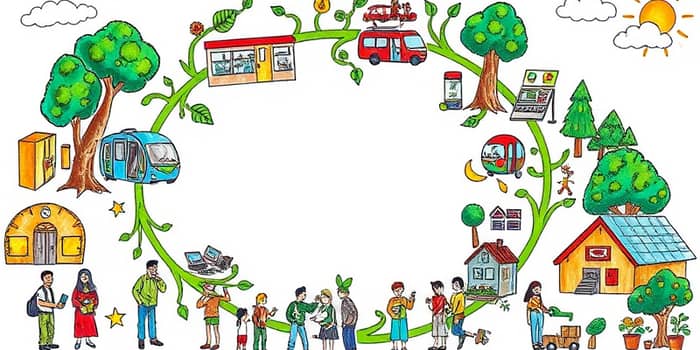
The traditional “take–make–dispose” model is giving way to a transformative vision: a circular economy that prolongs value, reduces waste, and restores nature.
By focusing on keep products and materials in use and emphasizing the return of assets, businesses and communities can unlock tremendous benefits across environmental, economic, and social dimensions.
Core Principles of Circular Economy
The circular economy reimagines production and consumption around three guiding principles:
- Design out waste and pollution by innovating products and processes that generate no harmful byproducts.
- Keep products and materials in use through strategies like reuse, repair, refurbishment, and recycling.
- Regenerate natural systems and biodiversity via practices such as composting, regenerative agriculture, and ecosystem restoration.
This make–use–return logic replaces linear thinking, ensuring materials cycle back into the system rather than ending up in landfills.
Why Circularity Matters Now
With global population projected to reach 9.8 billion by 2050, resource scarcity and environmental stress are intensifying. Nearly 45% of greenhouse gas emissions stem from producing and using goods and food. Circular approaches offer a pathway to reduce these footprints by up to 39%.
Meanwhile, industries such as textiles squander water and throw away usable garments worth $460 billion annually. Embracing reuse and refurbishment can turn these losses into opportunities.
Policy momentum is growing: the European Union anticipates 700,000 new jobs by 2030 through circular initiatives, signaling that sustainable practices are also economically advantageous.
Sustainable Returns on Reusable Assets
Reusable assets—products, components, packaging, and equipment—are at the heart of circular systems. Their extended lifecycles generate returns across three key dimensions.
Environmental Returns
Circular strategies reduce reliance on virgin resources and lower greenhouse gas emissions. For example, reusing building components can cut construction-sector emissions by up to 75% by 2050.
By prioritizing regenerate natural systems and biodiversity, circular models support soil health, biodiversity corridors, and cleaner waterways. This goes beyond minimizing harm to actively restoring ecosystems.
Plastic pollution and e-waste are addressed when single-use items are replaced by durable, repairable alternatives that remain in circulation for years.
Economic Returns
Adopting circular methods leads to significant savings: businesses could avoid $640 billion in material and disposal costs by 2050. This stems from resource efficiency and cost savings achieved through smarter design and material loops.
Innovative models like the circular product-as-a-service leasing model and deposit-return schemes monetize the same tangible good multiple times, creating steady revenue and higher lifetime value.
Moreover, building resilience into supply chains by using recycled inputs reduces exposure to volatile commodity prices and geopolitical risks.
Social Returns
Circular initiatives foster job creation and local development. Repair, refurbishment, and reverse logistics tend to be more labor-intensive and less automated, leading to roughly 7–8 million new global jobs.
By delivering affordable, durable, and repairable products, circular businesses enhance consumer well-being, especially in underserved communities where durable goods lower total ownership costs.
Local repair cafés and community reuse centers also support community empowerment and inclusion, allowing residents to participate directly in sustainable practices and skill-building.
Business Models for Reusable Assets
- Product-as-a-service and leasing subscriptions
- Refurbishment and remanufacturing frameworks
- Deposit-return and takeback logistics for packaging
These models shift focus from selling products to delivering ongoing value, aligning business success with material stewardship.
Practical Steps to Transition
- Map asset lifecycles: identify where materials leak out of your system.
- Design for disassembly: enable easy repair, upgrade, and recycling.
- Engage stakeholders: partner with regulators, communities, and suppliers to build circular loops.
By embedding these steps into strategy, organizations can create practical pathways toward a resilient, regenerative economy.
The circular economy is more than a sustainability buzzword—it is a blueprint for growth that nourishes people and planet alike. Embracing reusable assets and unlocking sustainable returns will define the competitive landscape of tomorrow. Start today by rethinking your products, processes, and partnerships to keep value in circulation, support ecosystems, and inspire positive change.
References
- https://www.wastemanaged.co.uk/our-news/recycling/circular-economy-guide/
- https://www.rts.com/blog/benefits-of-circular-economy/
- https://www.immerse.education/beyond-syllabus/economics/what-is-the-circular-economy-definition-benefits/
- https://www.interlakemecalux.com/blog/circular-economy
- https://www.europarl.europa.eu/topics/en/article/20151201STO05603/circular-economy-definition-importance-and-benefits
- https://www.ube.ac.uk/whats-happening/articles/circular-economy/
- https://www.unepfi.org/pollution-and-circular-economy/circular-economy/
- https://www.weforum.org/stories/2025/09/circular-economy-built-environment-future/
- https://www.ellenmacarthurfoundation.org/topics/circular-economy-introduction/overview