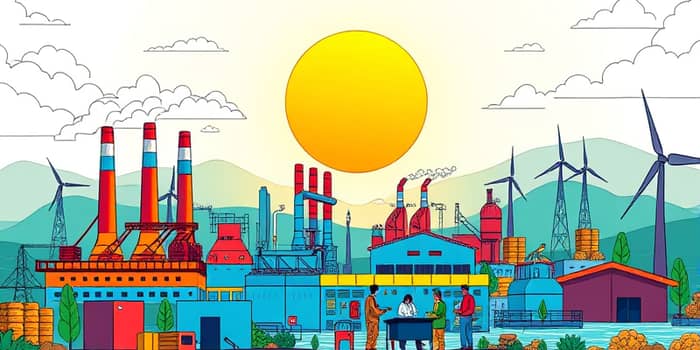
In a world where economic debates often center on consumer spending, supply-side theory shifts the focus to producers as the true architects of growth. By championing innovations in production and reducing obstacles, it promises sustainable expansion that benefits societies at large.
Definition and Core Concept
At its heart, supply-side economics posits that economic growth is driven by increased supply rather than by artificially stimulating demand. The theory traces back to classical thinkers but finds modern expression in policies that aim to remove impediments for businesses and entrepreneurs.
One of its foundational tenets, often paraphrased as Say’s Law, asserts that nothing can be demanded before it is supplied. According to this view, when producers are empowered, they create an abundance of goods and services that naturally attracts consumption.
Historical Origins and Key Figures
The roots of supply-side thought can be found in Adam Smith’s Wealth of Nations and Jean-Baptiste Say’s early 19th-century writings. Say’s observation that “supply creates its own demand” laid a conceptual groundwork that later evolved through scholarly debate.
In the 20th century, the concept was refined by economists such as Arthur Laffer, whose famous curve illustrated how optimal tax rates maximize government revenue by balancing rates with a broader economic base. Jude Wanniski and Robert Mundell further developed these ideas, which gained prominence under President Ronald Reagan in the 1980s.
Reaganomics, characterized by substantial tax cuts and sweeping deregulation, exemplified supply-side policies on a national stage. Supporters credit the period with strong job growth and investment, while critics point to rising deficits and income inequality.
The Three Pillars of Supply-Side Policy
Modern supply-side strategies rest on three interrelated pillars that target different aspects of economic activity. Together, they form a cohesive framework to liberate production and stimulate long-term prosperity.
- Tax Policy: Cutting marginal tax rates to incentivize work, saving, investment, and risk-taking.
- Regulatory Policy: Rolling back unnecessary rules, quotas, and subsidies that restrict labor and capital flows.
- Monetary Policy Critique: Arguing that central bank interventions often misallocate resources and that stable supply conditions drive healthy markets.
Each pillar addresses a key barrier to production. By lowering taxes, reducing red tape, and questioning monetary overreach, supply-side economists seek to unleash entrepreneurial energy.
Key Principles and Policy Measures
Building on its three foundational pillars, supply-side economics advocates a suite of policies designed to maximize efficiency:
- Tax Cuts for Businesses and High Earners: Encouraging investment by improving after-tax returns.
- Deregulation Across Industries: Allowing firms to innovate and scale without bureaucratic delays.
- Incentives for Labor and Capital: Enhancing flexibility in hiring, wages, and financing to match market demand.
- Emphasis on Free Markets: Believing that minimal government interference unleashes competitive strengths.
Through these measures, proponents argue that a virtuous cycle emerges: lower costs spur production, abundant supply lowers prices, and consumers respond with increased purchases.
Theoretical Framework: Aggregate Supply and Demand
Traditional Keynesian models illustrate equilibrium where aggregate demand (AD) intersects with upward-sloping aggregate supply (AS). In this view, fiscal stimulus or monetary easing shifts demand to stabilize output and employment.
Supply-side economists, however, visualize AS as a nearly vertical line at full productive capacity. Removing supply constraints shifts this line rightward, leading to higher output without fueling inflation. This perspective emphasizes that production capacity shapes long-term growth more than transient demand shocks.
Comparing Supply-Side and Demand-Side Approaches
This comparison highlights fundamental philosophical differences regarding the path to sustainable growth.
Evidence and Examples
The 1980s U.S. economy under President Reagan offers a vivid case study. Tax reductions under the Economic Recovery Tax Act of 1981 aimed to broaden the tax base. Deregulation swept through sectors from finance to telecommunications.
Proponents point to robust GDP growth, falling unemployment rates, and surging private investment. Critics, however, warn of ballooning deficits and question whether benefits reached all income groups equally.
Outside the U.S., various nations have adopted supply-side reforms with mixed results. Eastern European economies, for instance, saw rapid industrial transformation post-communism by privatizing state assets and slashing trade barriers.
Empirical studies on the Laffer Curve suggest that tax rate reductions below a certain threshold can indeed increase total revenues by spurring growth in taxable activities. However, pinpointing the exact revenue-maximizing rate remains a subject of debate.
Criticisms and Challenges
Despite its appeal, supply-side economics faces noteworthy critiques:
- Deficit Risks and Fiscal Sustainability: Large tax cuts can outpace revenue growth, leading to higher debt.
- Income Inequality Concerns: Benefits may accrue disproportionately to top earners.
- Market Failures and Externalities: Unregulated industries can harm public goods like the environment.
A balanced approach may include sunset clauses on deregulation measures and targeted support for displaced workers, maintaining momentum while guarding against excesses.
Modern Relevance and Future Outlook
In the 21st century, governments grapple with issues from digital transformation to climate change. Supply-side tools remain relevant as policy-makers seek to kindle innovation in renewable energy, biotechnology, and infrastructure.
Advocates argue that streamlined regulations and well-calibrated tax incentives can accelerate green technologies, creating new industries and jobs. Skeptics insist that strategic demand-side investments, such as public R&D funding, complement supply liberalization.
In emerging markets, adapting supply-side frameworks to local contexts has shown promise. For instance, targeted tax holidays for tech startups in Southeast Asia have accelerated digital innovation, though they require robust governance to prevent abuse.
As the global economy evolves, a nuanced approach may blend supply and demand strategies, ensuring that productivity gains translate into shared prosperity.
Conclusion
Supply-side economics offers a compelling vision: by removing barriers to production and investment, societies unlock the creativity and drive of their most dynamic actors. While challenges remain, the core message endures—empowering producers can spark durable growth and widespread opportunity.
Whether one embraces pure supply-side reforms or opts for a balanced fiscal framework, recognizing the pivotal role of supply in economic performance is essential. In the quest for growth, it is often those who make and build who light the way forward.
References
- https://corporatefinanceinstitute.com/resources/economics/supply-side-economics/
- https://fee.org/articles/a-walk-on-the-supply-side/
- https://rv-times.com/2023/08/08/what-is-supply-side-economics-definition-history/
- https://www.annenbergclassroom.org/glossary_term/supply-side-economics/
- https://fiveable.me/key-terms/principles-macroeconomics/supply-side-economics
- https://study.com/learn/lesson/demand-side-vs-supply-side-economics-theories-differences.html
- https://www.britannica.com/money/supply-side-economics
- https://www.econlib.org/library/Enc/SupplySideEconomics.html