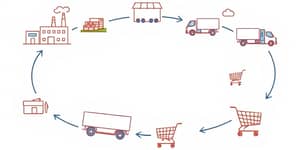
In our daily lives, we rarely think about the intricate networks that bring goods to our doors.
Yet, geopolitical fragmentation and tariffs are silently inflating prices from electronics to groceries.
This unseen force touches every aspect of the economy, affecting your wallet in profound ways.
Understanding these dynamics is key to making smarter financial decisions.
The Hidden Forces Behind Your Shopping Cart
Supply chain disruptions are no longer distant events confined to business reports.
They directly influence affordability and economic stability for households worldwide.
Economic turbulence and consumer spending slowdowns create ripple effects that reach your home.
From rising debt to job market shifts, these factors compound daily expenses.
By grasping these connections, you can better anticipate changes in your cost of living.
2026: A Year of Transformation and Risk
The coming year promises significant shifts in global supply chains.
Key trends will redefine how businesses operate and consumers spend.
Here are the major risks and opportunities to watch:
- Geopolitical fragmentation and tariffs heighten volatility, complicating long-term planning for companies.
- Economic turbulence leads to consumer spending deceleration and affordability challenges.
- Cost optimization becomes a top priority as rising expenses force network consolidation.
- Workforce shifts require new skills, driven by aging leadership and automation needs.
- Infrastructure and weather disruptions cause multibillion-dollar failures, impacting 63% of firms in 2025.
- Uncertainty as the new norm makes scenario planning essential for resilience.
These elements intertwine to shape the everyday economy in tangible ways.
Preparing for them can mitigate personal financial strain.
The Numbers Don't Lie: A Table of Impacts
Quantifiable data reveals the stark reality of supply chain effects.
This table summarizes key statistics that highlight economic burdens and opportunities.
These figures underscore the urgency for both businesses and individuals to adapt.
Inflation adding $1,200 extra spend annually is a wake-up call for budget planning.
Harnessing Technology for a Smoother Flow
Innovation offers powerful tools to combat supply chain challenges.
Technology adoption is transforming efficiency and reducing costs dramatically.
Consider these quantified benefits from AI and digitalization:
- AI drives a 15% logistics cost drop and 35% inventory reduction for companies.
- Digital tools achieve 65% service efficiency gains and 20% lower operating costs.
- Multi-shoring is adopted by 50% of firms by 2026, boosting supply reliability by 10 percentage points.
- Sustainability efforts reduce labor costs by 70% and influence consumer buying habits.
AI driving 15% logistics cost drop exemplifies the tangible returns on tech investment.
Embracing these solutions can lead to significant savings and improved service.
For consumers, this means more stable prices and better product availability.
What You Can Do: Practical Steps for Everyone
Navigating supply chain impacts requires proactive strategies at all levels.
Here are actionable tips for businesses and individuals to stay ahead.
For businesses, focus on resilience and cost management:
- Test suppliers for debt and refinancing risks to avoid disruptions.
- Diversify logistics corridors and communicate tariff costs transparently to customers.
- Invest in digital nerve centers and dual sourcing for enhanced agility.
- Use AI for scenario planning to anticipate and mitigate potential failures.
For consumers, adapt spending habits and stay informed:
- Monitor price trends in exposed categories like electronics and household goods.
- Prioritize eco-products despite perceptions of higher costs, as remote work boosts sustainability buying.
- Adjust budgets to account for potential $1,200 annual extra spend from inflation.
- Support businesses that practice transparent supply chain management.
Daily disruption cost averaging $1.5 million highlights the need for swift action.
By implementing these steps, you can reduce personal financial vulnerability.
Building Resilience for the Future
The future of supply chains hinges on anticipation and adaptation.
Uncertainty is here to stay, making proactive measures non-negotiable.
Key strategies include near-shoring and focusing on cash efficiency metrics.
KPIs for 2026 should emphasize resilience over mere speed or volume.
Revenue hits affecting 94% of companies show the widespread nature of disruptions.
Embrace a mindset of continuous learning and flexibility.
This approach not only safeguards businesses but also stabilizes the broader economy.
For households, it means a more predictable cost of living and better financial security.
Together, we can turn challenges into opportunities for growth and innovation.
References
- https://www.supplychaindive.com/news/supply-chain-trends-risks-2026-retail-manufacturing/808797/
- https://procurementtactics.com/supply-chain-statistics/
- https://www.library.hbs.edu/working-knowledge/eight-trends-for-2026-pricing-passion-and-the-risks-ahead
- https://igps.net/supply-chain-kpis-to-measure-in-2026/
- https://www.supplychainbrain.com/articles/43011-supply-chain-uncertainty-likely-here-to-stay-in-2026
- https://www.everstream.ai/articles/are-you-prepared-for-the-supply-chain-disruptions-of-2026/
- https://www.globaltrademag.com/top-10-supply-chain-and-logistics-technology-trends-for-2026/