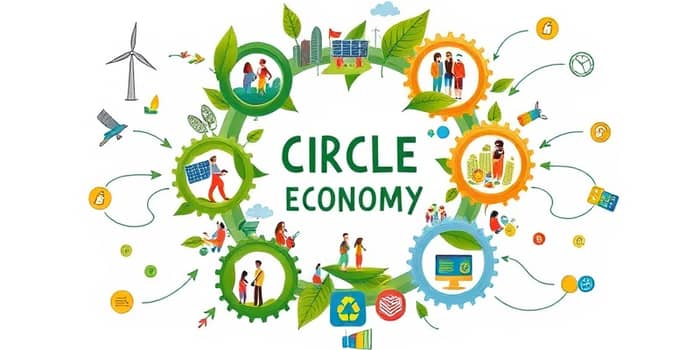
As global populations and economies expand, traditional resource consumption poses existential threats. We must fundamentally rethink how we produce, consume, and finance economic activity to secure a resilient future.
The Circular Economy Foundation
The concept of a circular economy hinges on designing out waste and keeping materials in use. Unlike the linear "take-make-dispose" model, circular systems extend product value through repair, reuse, and recycling.
One of the most transformative business approaches is the product-as-a-service model. Instead of ownership, consumers pay for utility. This shift aligns incentives: manufacturers maintain and upgrade assets, while users enjoy access without burdens of disposal.
Beyond service models, value retention activities—repair, refurbishment, remanufacturing—unlock new revenue streams. Yet many companies score zero on these practices. Embracing them reduces waste while driving profitability.
Regulatory Catalysts
Policy frameworks are steering industries toward resource efficiency. The upcoming EU Circular Economy Act aims to elevate Europe’s leadership by 2030, mandating measurable improvements in product design and materials recovery.
Extended Producer Responsibility (EPR) schemes are proliferating worldwide, shifting end-of-life obligations onto manufacturers. Key regional milestones include:
- EU Textiles EPR: Member states must transpose legislation by June 2027, with full operation by April 2028.
- North America: Maine and Oregon finalize fee structures; California’s SB 54 targets a 25% reduction in plastic packaging by 2032.
- Latin America: Uruguay’s Deposit Return System for beverage containers; Colombia and Mexico enforcing stricter packaging waste rules.
Moreover, the EU Carbon Border Adjustment Mechanism (CBAM), effective January 2026, imposes carbon-based charges on imports of cement, steel, aluminum, and other energy-intensive goods. This creates urgency for transition finance in developing economies, accelerating the shift to low-carbon production.
Financing Innovation
Mobilizing capital is essential to scale sustainable models. The Tropical Forests Forever Facility (TFFF) launched at COP30 aims to raise $100 billion through green bond issuances combined with $25 billion in philanthropic capital. At least 20% of net proceeds will empower Indigenous Peoples and local communities.
Climate tech investments continue to surge: $56 billion flowed into clean energy, battery storage, and sustainable mobility during the first nine months of 2025, surpassing prior annual totals. Initiatives like Partnering for Green Growth (P4G) provide grants and technical assistance to early-stage ventures in EMDCs.
- BRICS collaboration on green bond markets and joint investment vehicles.
- Private sector adaptation financing via resilience bonds and infrastructure funds.
- Interoperable sustainable finance taxonomies reducing transaction costs.
This blended finance approach unlocks new flows of capital, aligning returns with impact and bridging the gap between public mandates and private interests.
Just Transition & Social Impact
A just transition ensures that workers and communities are not left behind in the shift from fossil fuels. In April 2026, Colombia will host the first global conference on Just Transition, co-organized with the Netherlands. This landmark gathering will spotlight strategies to avoid stranded assets and support economic diversification.
Brazil’s domestic Transition Away from Fossil Fuels (TAFF) initiative is forging a national roadmap, to be tabled at COP31. By pairing retraining programs with green infrastructure projects, Brazil aspires to safeguard livelihoods while reducing emissions.
Supply Chain Transformation
Global competitiveness increasingly hinges on resource circularity. Recycling critical minerals such as nickel, cobalt, and lithium can cut greenhouse gas emissions by around 80% compared to virgin extraction. Governments and industries must collaborate on national end-of-life collection systems and investment in advanced recycling/refining facilities.
Emerging technologies—digital sensors, blockchain-enabled tracking, and digital product passports—enhance material traceability and ensure accountability. By integrating these tools, enterprises can measure and verify sustainable practices across complex supply chains.
Implementation & Technology
Successful adoption demands clear metrics and behavioral alignment. Regulators are moving from voluntary disclosure to measurable performance expectations, requiring companies to report not just recycled content but also the percentage of products reused or remanufactured.
Advances in agri-tech and food tech—precision farming, AI-driven supply chain analytics, and alternative proteins—embed circular principles at the source. Water-resilient agriculture and sustainable packaging solutions further reduce ecological footprints, creating synergies between food systems and material circularity.
Future Outlook
Between 2026 and 2028, several milestones will shape the trajectory of resource reimagining:
- Full enforcement of EU Circular Economy Act and textile EPR across member states.
- Expansion of CBAM coverage to additional sectors and geographies.
- Launch of national digital product passport requirements in major markets.
- Scaling of blended finance platforms targeting biodiversity, adaptation, and transition projects.
Despite challenges—technology gaps, policy alignment, and capital constraints—the momentum toward sustainable economic models is irreversible. By integrating circular design, robust regulatory frameworks, innovative finance, and inclusive social strategies, we can unlock multiple dividends: resilient supply chains, decarbonized industries, and thriving communities.
Now is the time for visionary leadership. Organizations that embed behavioral and economic integration will not only mitigate risk but also gain competitive advantage. Resource reimagining is not a peripheral initiative—it is the foundation for long-term prosperity.
Together, we can transform global markets into engines of regeneration. The path forward demands collaboration across sectors and borders. By embracing sustainable economic models today, we ensure a healthier planet and a more equitable future for generations to come.
References
- https://www.wri.org/technical-perspectives/6-opportunities-sustainable-finance-2026
- https://www.verdantix.com/client-portal/blog/is-2026-the-year-circularity-finally-breaks-through
- https://www.ecomondo.com/en/news-detail/sustainability-what-will-2026-look-like?newsId=6240303
- https://www.statista.com/statistics/1337519/circular-economy-market-revenue/
- https://www.thegreenshot.io/uncategorized/economic-sustainability-development/
- https://www.nsaction.us/post/looking-ahead-to-2026-making-a-circular-economy-work-in-and-for-america
- https://www.diyinvestor.net/five-themes-that-will-shape-sustainable-investing-in-2026/
- https://rev-log.com/global-epr-circular-economy-trends-2025-2026/
- https://www.indeed-innovation.com/circularity-index-2026/
- https://www.lombardodier.com/insights/2026/january/5-must-watch-sustainable-investing.html
- https://www.startus-insights.com/innovators-guide/circular-economy-report-key-insights/
- https://www.schroders.com/en/nordics/professional/insights/2026-sustainable-investment-outlook-7-key-trends-for-north-america-in-the-year-ahead/
- https://www.weforum.org/stories/2026/01/circular-economy-clean-energy-supply-chain-critical-minerals/
- https://greenmoney.com/five-sustainable-finance-predictions-for-2026/