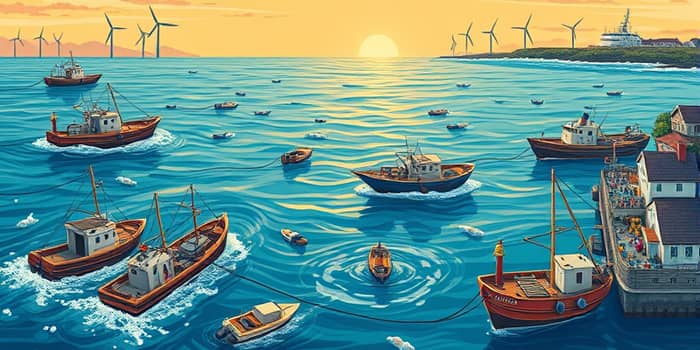
The global ocean is a vast frontier of commerce, culture, and conservation, supporting billions of lives. From coastal villages to international shipping lanes, marine systems underpin food, energy, and trade.
Unlocking this potential responsibly requires rigorous frameworks and shared visions. Below, we explore definitions, scale, sectoral insights, governance, and emerging trends shaping a resilient ocean economy.
Defining Marine Economies
The concept of the ocean economy covers all economic activities that use the ocean, including living resources, offshore minerals, shipbuilding, transport, tourism, utilities, and research infrastructure.
By contrast, the blue economy stresses sustainable use, restoration and stewardship of resources to balance growth with ecosystem health. Tools like ecosystem services valuation and natural capital accounting help quantify both market value and the crucial benefits nature provides.
Global Scale and Macroeconomic Importance
In 2023, global ocean trade in goods and services reached $2.2 trillion, roughly 7% of international commerce. Services—ranging from shipping to tourism—totaled $1.3 trillion, while goods accounted for $900 billion.
The ocean economy contributes about 3–4% of global GDP, according to OECD data. It doubled in real terms from $1.3 trillion in gross value added in 1995 to $2.6 trillion in 2020, and it is projected to quadruple by 2050, outpacing overall economic growth.
More than 100 million jobs are directly linked to marine sectors, with approximately 600 million people worldwide depending on fisheries, aquaculture, transport, and tourism for their livelihoods. Healthy oceans are thus integral to poverty reduction and food security.
Small island developing states and coastal communities are particularly vulnerable to both economic shocks and climate change. Equitable strategies must address regional disparities and build resilience to sea-level rise, storms, and resource depletion.
Case Study: United States Marine Economy
The United States exemplifies a mature marine economy. In 2023, marine sectors generated $826.6 billion in gross output and contributed $511.0 billion—about 1.8%—to national GDP, marking growth of 2.9% in value added and 3.5% in sales year-on-year.
Employment reached 2.6 million jobs with an average salary of $85,000. High-value segments include information services ($155,000), mining ($151,000), and coastal utilities ($141,000), reflecting strong technical and energy components.
Regional innovation hubs, such as offshore wind development in the Northeast and research clusters in the Gulf of Mexico, showcase how states can leverage natural endowments and research capacity to diversify marine activities.
This diversified portfolio illustrates how established economies integrate strategic sectors to build resilience, promote innovation, and cushion against market volatility.
Key Sectors of the Ocean Economy
Traditional industries continue to dominate the marine landscape, but sustainability pressures demand evolution. Effective management seeks to decoupling growth from degradation and pollution through science, policy, and community engagement.
- Fisheries and aquaculture: Core sources of protein for billions. Overfishing and habitat loss are pressing challenges, remediated through catch limits, rights-based management, and certification.
- Shipping and transport: The backbone of global trade. Innovations in fuel efficiency, cleaner fuels, and port resilience address climate targets and operational risks.
- Offshore oil, gas and minerals: Historically lucrative but facing a shift toward renewables. Debate over deep-sea mining highlights the balance between resource demand and ecological protection.
- Coastal tourism: Generates over $700 billion annually, driving local economies. Nature-based and community-led models mitigate overtourism and foster stewardship.
Emerging and High-Potential Sectors
New frontiers promise to reshape the marine economy. From energy to biotech, innovation unlocks value while minimizing environmental footprints.
Offshore wind, tidal, wave, and floating solar energy are expanding rapidly. Strategic siting, grid integration, and supply chain development are critical to scaling these industries responsibly.
Blue biotechnology and marine pharmaceuticals harness genetic resources for novel drugs, biomaterials, and industrial enzymes, offering high-value opportunities that align with conservation goals.
Digital ocean services—marine mapping, monitoring platforms, and AI-driven forecasting—enhance decision-making, optimize shipping routes, and support precision marine farming.
Desalination and coastal utilities address freshwater scarcity and urban demands. Advances in energy-efficient membranes and renewable power integration reduce environmental impacts and operational costs.
Balancing Growth and Conservation
Effective governance is the linchpin of a sustainable ocean economy. International frameworks like UNCLOS, regional fisheries management organizations, and marine protected area networks establish rules and safeguards.
National ocean economy satellite accounts inform policy by measuring gross output, employment, investment, and trade, while integrated ocean management aligns sectoral plans with ecological limits.
- Integrated coastal and marine spatial planning
- Rights-based resource management
- Ecosystem-based approach to conservation
Financing and Technology for a Sustainable Future
Bridging funding gaps requires innovative instruments: blue bonds, blended public-private partnerships, and payments for ecosystem services channel capital toward restoration and low-impact infrastructure.
Advances in precision aquaculture and marine monitoring technologies, such as sensor networks and automated data analytics, improve yield forecasting, reduce waste, and lower environmental footprints.
Case studies—satellite surveillance to combat illegal fishing in West Africa, blockchain traceability for sustainable seafood, and AI-driven climate models—demonstrate technology’s transformative potential.
Ensuring Equity and Inclusive Development
Sustainable growth must be fair. Marine policies should empower small-scale fishers, women, and indigenous peoples, ensuring they have access to resources, markets, and decision-making forums.
By promoting just transition for coastal communities and workers and delivering benefits to small-scale fishers and entrepreneurs, stakeholders can foster social cohesion, reduce poverty, and build long-term support for conservation efforts.
Future Projections and Scenarios
Looking ahead, the ocean economy could quadruple by 2050 under current trends. Realizing this potential hinges on aligning growth with climate and biodiversity targets to avoid systemic risks.
Climate change introduces uncertainty: shifting fish stocks, sea-level rise, and extreme weather events challenge infrastructure and supply chains. Adaptive strategies and resilient design are imperative.
Scenario planning, multi-stakeholder collaborations, and dynamic policies enable governments and businesses to navigate uncertainty and seize emerging opportunities responsibly.
Charting a Path Forward
The ocean’s promise is immense, but so are its vulnerabilities. By integrating rigorous science, inclusive governance, and strategic finance, we can tap marine resources sustainably, ensuring economic prosperity and ecological health.
Collective action—from local fishers to multinational corporations and national governments—is essential. Together, we can steward the blue economy to benefit current and future generations, safeguarding the ocean’s bounty and beauty.
References
- https://unctad.org/publication/global-trade-update-june-2025-sustainable-ocean-economy
- https://coast.noaa.gov/states/fast-facts/marine-economy.html
- https://unctad.org/news/rising-tide-growing-risks-ocean-economy-faces-pressure-and-fragmentation
- https://www.bea.gov/data/special-topics/marine-economy
- https://www.weforum.org/stories/2025/10/how-the-ocean-economy-can-catalyze-sustainable-growth/
- https://unctad.org/news/fast-growing-trillion-dollar-ocean-economy-goes-beyond-fishing-and-shipping
- https://www.polarismarketresearch.com/industry-analysis/ocean-economy-market
- https://www.worldbank.org/en/topic/oceans-fisheries-and-coastal-economies
- https://www.oceanaccounts.org/valuing-the-ocean-economy-lessons-from-earlier-adopters/
- https://www.oceaneconomics.org/NOEP/Market/ocean/OESsearch.aspx
- https://www.oecd.org/en/blogs/2025/09/why-ocean-economy-productivity-is-declining-and-what-policymakers-can-do-about-it.html
- https://www.oecd.org/en/publications/2025/03/the-ocean-economy-to-2050_e3f6a132.html
- https://earth.org/the-ocean-economy-is-poised-for-a-sustainable-shift-so-is-its-workforce/
- https://oceanpanel.org/publication/ocean-employment/
- https://www.wri.org/insights/opportunities-ocean-action-2025
- https://www.bea.gov/news/2025/marine-economy-satellite-account-2023