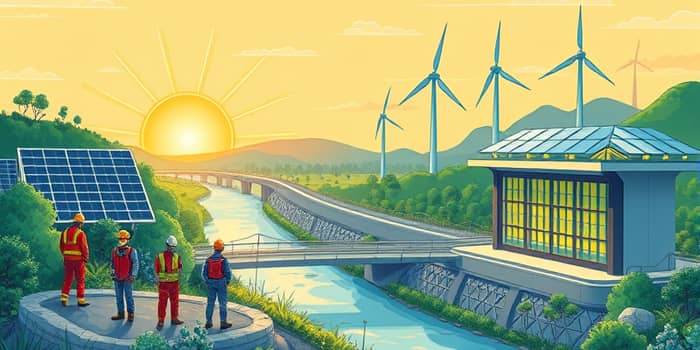
In an era defined by rapid urbanization, climate challenges, and digital transformation, the call for robust infrastructure investment has never been louder. Leaders worldwide grapple with soaring demands for resilient transport, reliable energy, and seamless connectivity. The gap between ambition and action, however, remains a formidable barrier.
Understanding the Global Financing Gap
As the world charts its course to 2040, it confronts a massive global financing shortfall estimated at an astonishing $15 trillion by 2040. Current projections foresee nearly $79 trillion in investments, yet the reality demands closer to $94 trillion, leaving nations scrambling to bridge an ever-widening chasm.
This shortfall extends beyond raw capital. The yearly Sustainable Development Goals financing gap in the poorest nations soars to $4.3 trillion, with renewable energy alone requiring $2.2 trillion annually. Europe alone needs over €12 trillion by mid-century, including €3.6 trillion dedicated to building retrofits. Clearly, the stage is set for transformative strategies.
Bridging the gap requires annual investments equating to at least 3.8% of global GDP, or about $3.3 trillion yearly from 2016 to 2030. Cumulatively, this represents nearly $49 trillion. These capital flows are not just numbers: they fuel economic expansion, reduce inequality, and underpin climate resilience across continents.
Market Outlook for 2026
Despite persistent headwinds, the infrastructure sector enters 2026 underpinned by renewed stability with easing inflation and supportive fiscal measures. Growth may be measured, but the momentum is undeniable. 2025 witnessed a record-breaking surge in fundraising, topping $250 billion for the first time since 2015—a remarkable leap from $99 billion in 2024.
Private capital is racing in, with $200 billion raised by September 2025 and nearly $474 billion actively sought. Secondaries markets matured with a record $30 billion in transactions. Meanwhile, debt strategies are attracting attention as investors seek stable, inflation-protected returns.
Investor sentiment is particularly strong in the energy transition, with mandates tripling to $3 billion in 2025, and in digital infrastructure, evidenced by the record 604 data centers completed in 2024. The debt segment is poised for growth as high rates underpin predictable cash flows, making infrastructure a safe haven amid volatility.
Key Drivers and Global Megatrends
Identify the forces shaping infrastructure investment and align your strategy across multiple dimensions.
- Geopolitical competition and domestic resilience: Initiatives like China’s Belt and Road and the G7’s PGII underscore the need for secure, sovereign infrastructure networks.
- Climate action and energy transition: Expanding renewables, storage, and carbon capture is essential to reach net-zero targets, while extreme weather demands upgraded defenses.
- Digitalization and AI-driven demand: Data centers, smart grids, and AI compute power drive unprecedented connectivity and efficiency requirements.
- Urbanization and demographic shifts: Emerging markets need transport, water, and sanitation systems to support expanding cities; mature regions focus on retrofits.
These megatrends intersect, creating compounded demand for cross-sectoral infrastructure investment solutions. For instance, urban expansion intensifies climate risks while heightening digital service requirements, demanding integrated planning and financing mechanisms.
Regional Highlights
Infrastructure needs vary regionally, reflecting economic priorities and policy frameworks. The following table outlines key requirements and notable trends across four major markets:
In Europe, the Green Deal and national renovation wave champion decarbonization at unprecedented scale. The US benefits from the Infrastructure Act, boosting broadband and clean energy. In India, digitizing 625,000 villages exemplifies progress, while Sub-Saharan Africa explores blended finance to unlock private capital.
Strategies for Impactful Investment
To transform ambition into tangible progress, investors and policymakers can adopt visionary approaches that balance risk, return, and impact.
Innovative financing instruments, such as green bonds and sustainability-linked loans, can bridge the risk-return gap. Blended finance structures—combining public grants with private equity—mobilize capital where traditional investors hesitate.
- Prioritize resilient assets in renewable power, storage, and data centers, which offer long-term inflation-protected investment returns.
- Leverage public-private partnerships to align interests, share risks, and access innovation in project delivery.
- Drive operational excellence through commercial enhancements, roll-up strategies, and technology integration.
- Advocate for streamlined permitting and policy stability to accelerate deployment and reduce costs.
Emerging managers, seeking $11 billion for value-add funds, represent a growing force in uncovering high-yielding opportunities in underpenetrated markets.
Challenges and Risk Mitigation
Even the most promising projects face obstacles. High interest rates and refinancing demands can strain returns. Political shifts, trade disruptions, and investment controls layer uncertainty. Skilled labor shortages and cost overruns can delay or derail critical work.
Mitigation begins with rigorous due diligence, diversified funding structures, and flexible contract terms. Building strong local partnerships and investing in workforce development will also help navigate complex regulatory and geographic landscapes.
Additional risks stem from evolving ESG standards, currency fluctuations, and community engagement requirements. Early stakeholder alignment and transparent governance frameworks are critical for project success. Adopting technology for real-time monitoring further reduces operational risks.
Looking Ahead: Building a Sustainable Future
The scale of the challenge is daunting, but the potential rewards are profound. Infrastructure is not merely steel and concrete; it is the foundation of resilient communities and thriving economies and a livable planet.
For investors, governments, and civil society, the call to action is clear: commit to strategic, long-term investment and embrace the partnerships that will drive meaningful change. Together, we can build roads, bridges, grids, and networks that power prosperity and equity.
Over the next decade, integrating AI-driven analytics, blockchain-based supply chain tracking, and climate risk modeling will be essential. By embracing innovation and forging collaborative networks, stakeholders can ensure that infrastructure investments deliver not only financial returns but also lasting social and environmental benefits.
References
- https://www.dws.com/insights/research/infrastructure/infrastructure-strategic-outlook-2026/
- https://unctad.org/publication/international-investment-sustainable-infrastructure-role-public-private-partnerships
- https://www.bcg.com/publications/2026/infrastructure-investments-in-an-uncertain-world
- https://www.ubp.com/en/news-insights/newsroom/the-evolution-of-infrastructure-opportunities-and-challenges
- https://www.bny.com/investments/us/en/intermediary/articles/equities/6-for-2026-outlook-global-infrastructure.html
- https://www.nuveen.com/en-us/insights/fixed-income/global-infrastructure-listed-securities-offer-opportunities
- https://giia.net/insights/how-record-setting-year-infrastructure-fundraising-shaping-market-2026
- https://academic.oup.com/ooih/article/doi/10.1093/ooih/ouae006/7766081
- https://www.withintelligence.com/insights/infrastructure-outlook-2026/
- https://www.mckinsey.com/industries/infrastructure/our-insights/the-infrastructure-moment
- https://outlook.gihub.org
- https://www.gihub.org/infrastructure-monitor/
- https://www.clearbridge.com/blogs/2025/infrastructure-outlook-ai-decarbonization-and-policy-tailwinds-in-2026
- https://www.kearney.com/service/operations-performance/article/overcoming-barriers-to-infrastructure-investment-in-developing-markets
- https://www.spglobal.com/ratings/en/regulatory/article/global-infrastructure-seven-trends-to-watch-in-2026-s101666059