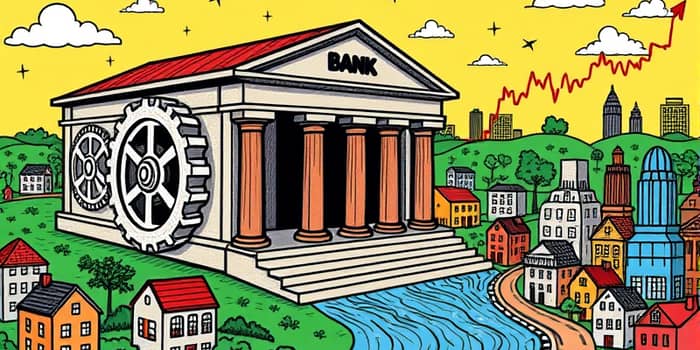
Interest rates are often described as the economy's throttle, a powerful lever that central banks adjust to steer growth and stability.
This macroeconomic tool influences everything from your mortgage payments to global trade, making it a cornerstone of financial health.
When rates change, they ripple through consumer spending, which drives approximately 70% of GDP in developed nations.
Understanding these shifts can empower you to make better financial decisions and navigate economic uncertainties with confidence.
Introduction to Interest Rates as a Macroeconomic Tool
At their core, interest rates represent the cost of borrowing money, set by central banks like the Federal Reserve or the European Central Bank.
These institutions use benchmark rates, such as the federal funds rate, to target specific economic goals like inflation control and sustainable growth.
By lowering rates, they encourage borrowing and investment, while hiking them cools down overheating economies.
This delicate balancing act ensures that economies do not spiral into recession or uncontrolled inflation.
For instance, during the COVID-19 pandemic, rate cuts were implemented to support activity and prevent collapse.
Why Interest Rates Change: Central Bank Mechanisms and Triggers
Central banks adjust interest rates based on key indicators like inflation and economic growth.
Inflation control is a primary trigger; when prices rise too fast, as seen with 7% CPI in early 2022, rates are increased to reduce spending.
Conversely, during slowdowns, rate cuts stimulate the economy by making credit cheaper and more accessible.
They employ various tools to enact these changes, each with specific roles in monetary policy.
- Open market operations involve buying or selling securities to adjust money supply and liquidity.
- The discount rate is the interest charged on loans from central banks to commercial banks, signaling policy direction.
- Administered rates, such as interest on reserve balances, set ceilings for overnight borrowing rates.
- The target federal funds rate range is the primary tool for easing or tightening monetary conditions.
As of May 20, 2025, the U.S. effective benchmark rate stood at 4.33%, reflecting a steady approach amid global uncertainties.
This transmission starts with official rates affecting money-market rates, then trickling down to bank lending and deposit rates.
Transmission Channels: How Changes Ripple Through the Economy
When interest rates change, their effects spread through multiple channels, impacting various aspects of the economy.
The table below summarizes these key transmission channels and their effects.
These channels illustrate how a single rate adjustment can have far-reaching consequences.
Impacts on Key Sectors and Behaviors
Different sectors of the economy respond uniquely to interest rate changes, influencing daily life and long-term planning.
Housing and durables are among the most sensitive, with lower rates driving demand through cheaper mortgages.
Higher rates, however, increase payments and slow sales, affecting homeownership and renovation trends.
Consumer confidence often falls with rate hikes, leading to reduced discretionary spending in areas like retail and travel.
This shift highlights the contrast between essential and non-essential industries, where the latter suffer more during tightening cycles.
- Non-essential industries, such as leisure and entertainment, face greater downturns with rate hikes.
- Essential sectors, like healthcare and utilities, remain more stable regardless of rate fluctuations.
Saving patterns also evolve; higher deposit rates encourage saving, benefiting savers and retirees.
Conversely, lower rates can hurt those relying on interest income, prompting a search for alternative investments.
Commodities, including oil and gold, see price increases with rate drops, as cheaper financing boosts demand.
For example, a 100 basis point drop in real rates can raise commodity prices by about 3.5%, peaking within four months.
Effects on Financial Markets
Financial markets react swiftly to interest rate changes, influencing investment strategies and portfolio values.
Stocks often sell off with rate hikes due to higher discounting of future earnings and reduced corporate investment.
In contrast, rate cuts boost stock prices by lifting earnings expectations and encouraging capital inflows.
Bonds have an inverse relationship with rates; when rates rise, bond prices fall, but new issues yield more.
Lower rates cause bond prices to rise, making existing high-coupon bonds more valuable in the market.
- Currency markets see appreciation with higher rates, as higher yields attract foreign capital.
- Lower rates weaken the currency, aiding exports but increasing the cost of imports.
The yield curve, which plots interest rates across different maturities, can steepen if markets anticipate hikes due to inflation fears.
This dynamic affects everything from government debt to corporate borrowing costs, shaping economic outlooks.
Trade-Offs, Risks, and Broader Context
Interest rate policies involve significant trade-offs and risks, requiring careful consideration by policymakers and individuals alike.
Borrowers generally benefit from rate cuts, with cheaper loans for homes and businesses, while savers gain from hikes through better returns.
Small businesses and startups are particularly vulnerable to rate increases, as they rely heavily on accessible credit.
Cyclical effects can create feedback loops; for instance, investment spurred by low rates leads to job growth and further spending.
However, prolonged low rates risk asset bubbles, as investors search for yield in riskier ventures.
- Historical examples include Fed hikes in 2022 to combat inflation and pandemic-era cuts for stimulus.
- Limitations exist, as rates are not the sole driver; geopolitics and sector-specific factors also play crucial roles.
For example, in the 2025 cycle, rate cuts did not trigger a boom, highlighting the complexity of economic interactions.
It's important to recognize that interest rates interact with other economic variables, making predictions challenging.
- Winners include exporters during rate cuts and importers during hikes, depending on currency effects.
- Losers often comprise industries tied to discretionary spending, which suffer in tightening environments.
By understanding these nuances, you can better prepare for economic shifts and protect your financial well-being.
Embracing this knowledge empowers you to adapt, whether you're investing, saving, or planning for the future.
References
- https://www.rosenbergresearch.com/2025/05/23/the-impact-of-interest-rates-on-the-economy/
- https://privatebank.jpmorgan.com/nam/en/insights/markets-and-investing/how-will-the-rate-cutting-cycle-impact-economic-activity-and-market-returns
- https://www.pimco.com/us/en/resources/education/bonds-102-understanding-how-interest-rates-affect-bond-performance
- https://www.northstarccu.com/blog?blog_id=171
- https://www.ecb.europa.eu/mopo/intro/transmission/html/index.en.html
- https://site.financialmodelingprep.com/education/financial-analysis/The-Impact-of-Interest-Rates-on-the-Economy-and-Financial-Markets-A-Comprehensive-Analysis
- https://www.stlouisfed.org/in-plain-english/the-fed-implements-monetary-policy
- https://www.imf.org/en/publications/fandd/issues/series/back-to-basics/monetary-policy
- https://www.federalreserve.gov/aboutthefed/fedexplained/monetary-policy.htm
- https://www.federalreserve.gov/faqs/why-do-interest-rates-matter.htm
- https://www.bmt.com/news-insights-events/understanding-interest-rates-in-the-u-s-and-how-they-affect-deposits-lending-and-mortgages/
- https://online.tamucc.edu/degrees/business/mba/finance/why-is-there-such-a-focus-on-interest-rates/
- https://www.discover.com/online-banking/banking-topics/how-does-the-federal-reserve-interest-rate-affect-me/
- https://bettermoneyhabits.bankofamerica.com/en/personal-banking/what-affects-interest-rates