Interest rates touch every corner of our financial lives, from the homes we dream of owning to the savings we build for tomorrow. Understanding their mechanics empowers you to make informed choices and seize opportunities.
Understanding Interest Rates and Their Components
At its core, an interest rate is the cost of borrowing money, expressed as a percentage of the amount borrowed. Lenders charge it, and borrowers pay it over time. Key components include:
- Principal: The original sum borrowed.
- Simple Interest: Calculated solely on the principal.
- Annual Percentage Rate (APR): Reflects the yearly total cost of borrowing, including fees.
- Annual Percentage Yield (APY): Accounts for compound interest frequency, showing true returns.
For example, borrowing $100 at 5% simple interest for three years costs $15 total ($100 × 5% × 3). By contrast, a savings account with 5% APY compounds more frequently, yielding slightly more growth.
The Federal Reserve: Steering the Economic Ship
The Federal Reserve sets the federal funds rate, guiding short-term rates across the banking system. When the Fed lowers this target, it reduces borrowing costs for consumers, encouraging spending and investment. When it raises rates, it curbs inflationary pressures by making loans more expensive.
These adjustments are known as:
- Easing: Lower rates to stimulate a sluggish economy.
- Tightening: Raise rates to cool an overheated expansion.
Through its monetary policy decisions, the Fed performs a delicate balancing act between fostering growth and containing inflation.
The Interest Rate Throttle: Impact on the Economy
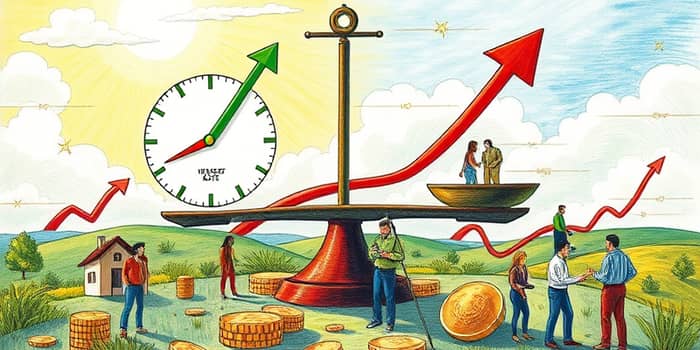
Interest rate moves serve as a macro-economic throttle, accelerating or decelerating activity. When rates fall, borrowing becomes more attractive, fueling spending on homes, autos, and business expansion. When rates climb, borrowing tightens, tamping down excess demand.
Historical data reveals that even a one-percentage-point shift can significantly sway national output, underscoring the Fed’s potent influence.
Consumer Behavior: Spending, Saving, and Borrowing
Consumers respond quickly to rate swings. Lower rates mean more people qualify for loans and face reduced monthly payments, effectively boosting their discretionary income. Conversely, higher rates can lead to tightened budgets and postponed purchases.
- When rates drop, credit card use often rises, and auto financing thrives.
- When rates rise, major purchases like appliances and home renovations tend to decline.
Understanding your own borrowing power—and knowing when to act—can save thousands in interest over time and keep your budget resilient.
Housing Market: Where Dreams Meet Dollars
Mortgage rates are the most visible example of interest rate shifts for many families. A 30-year mortgage at 6.50% on a $300,000 loan yields monthly payments of $1,896.20. Adding $6,000 in fees pushes the APR to 6.72%, translating into tens of thousands more over three decades.
Current rates (February 2026) have fallen to around 6.16%, marking a three-year low despite strong employment figures. Buyers who lock in these rates today could secure substantial savings in the long run.
Business and Investment: Growth Under Different Rates
For businesses, interest rates shape growth strategies. Low rates make financing capital expenditures and expansion projects more feasible, boosting productivity and employment. Higher rates force firms to reassess budgets, delay new initiatives, and conserve cash.
Startups and small businesses—which often rely on bank loans—are particularly sensitive to these shifts. Strategic planning during low-rate periods can catalyze innovation and establish a competitive edge.
Savers, Investors, and the Road Ahead
Savers have endured historically low yields, with national average savings account rates near 0.46% as of late 2025. Certificate of Deposit (CD) rates, however, reflect an inverted yield curve: three-month CDs at 4.50%-5.00% APY, six-month CDs at 4.75%-5.25%, and one-year CDs at 5.00%-5.40%.
Higher rates may lure depositors back to fixed-income products, while risk-averse investors might shift from equities into Treasuries or high-grade corporate bonds. Balancing your portfolio across asset classes helps mitigate volatility and harness potential gains.
Charting the Future: 2026 Outlook and Strategies
The path of interest rates in 2026 remains uncertain, influenced by labor market trends, inflation data, and global events. Consensus on rate cuts is unsettled, prompting consumers and businesses to develop adaptive strategies.
Key considerations include fixed vs. floating-rate decisions. Locking in a three-year fixed rate can hedge against future increases, while floating rates may benefit those anticipating cuts. Risk management tools—such as rate caps, swaps, or laddered debt structures—offer additional protection.
Finding Balance in a Shifting Landscape
Interest rates may feel like distant economic abstractions, but they directly shape the choices we make—buying homes, investing savings, and growing businesses. By cultivating a clear understanding of rate mechanics and staying alert to Fed decisions, you can transform uncertainty into opportunity.
Embrace these practical steps:
- Monitor rate trends and economic indicators regularly.
- Diversify borrowing and investment tools to hedge risk.
- Seek guidance from financial professionals when navigating complex decisions.
With knowledge as your compass, you can navigate the currents of interest rate changes, harness their power, and chart a course toward financial resilience and growth.
References
- https://www.youtube.com/watch?v=xvCn_LxwN9Y
- https://dechtmanwealth.com/insights/blog/how-interest-rates-impact-the-economy
- https://www.guidestone.org/Resources/Education/Articles/Investments/Understanding-Interest-Rates
- https://www.rosenbergresearch.com/2025/05/23/the-impact-of-interest-rates-on-the-economy/
- https://www.federalreserve.gov/aboutthefed/fedexplained/monetary-policy.htm
- https://www.bankschaumburg.com/articles/2022/09/fed-interest-rate-changes-how-does-this-impact-your-personal-finances.html
- https://www.amerisave.com/learn/apy-vs-interest-rate-the-savers-guide-to-maximizing-your-money
- https://online.tamucc.edu/degrees/business/mba/finance/why-is-there-such-a-focus-on-interest-rates/
- https://www.masterclass.com/articles/what-are-interest-rates
- https://www.bmt.com/news-insights-events/understanding-interest-rates-in-the-u-s-and-how-they-affect-deposits-lending-and-mortgages/
- https://www.bankrate.com/mortgages/analysis/mortgage-rates-february-11-2026/
- https://www.usbank.com/financialiq/invest-your-money/investment-strategies/how-do-interest-rates-affect-investments.html
- https://www.invesco.com/us/en/insights/what-is-interest-rate.html
- https://www.youtube.com/watch?v=NM-jPK7ODO8