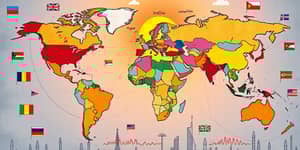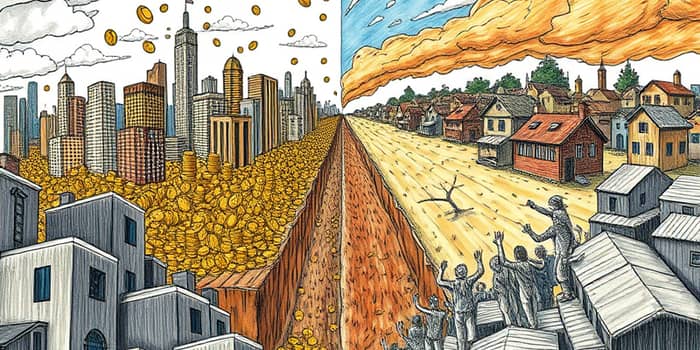
Across every continent, the chasm between great wealth and crushing poverty has never been wider. When the richest ten percent of adults command more than half of all income, and the bottom half struggles to secure single-digit shares, we confront a moral and economic crisis. Yet inequality is not an immutable fate; it arises from choices, structures, and policies that can be reshaped. This article explores the forces driving inequality, illuminates its profound human toll, and charts concrete paths toward a fairer, more inclusive world. By understanding the roots of this divide, we can harness collective will to build systems that serve everyone.
The Stark Realities of Global Inequality
The scale of disparity today is astonishing. The top one percent of the world’s population now pockets over a fifth of global income, while billions subsist on a fraction of that share. In wealth terms, the gap is even more dramatic: a tiny elite holds the vast majority of assets, leaving little for the many. These imbalances undermine social cohesion and threaten long-term prosperity.
- Top 10% receive 53% of global income, while the bottom half capture only 8%
- The richest 1% earn 2.5 times more than the entire bottom 50%
- Top 10% own 75% of global wealth, compared to 2% held by bottom half
- Education spending per child is €200 in Sub-Saharan Africa vs. €9,000 in North America
- Women earn 61% of men’s hourly wages, dropping to 32% when unpaid work is included
Root Causes: Why the Divide Widens
Understanding inequality means tracing its roots through history, policy, and institutional design. Over decades, growth has overwhelmingly favored those with capital over those reliant on wages. Structural barriers deny equal educational and economic opportunities, while global financial systems channel wealth toward already affluent countries and individuals. Political choices—such as regressive tax codes and lax regulation—have compounded these trends, enabling concentrated fortunes to grow ever larger.
- Resilient concentration of capital captures the fastest gains in wealth generation
- Uneven access to education and health fortifies intergenerational disadvantage
- Policy frameworks often favor the wealthy through loopholes, weak labor protections, and tax breaks
The Human Cost of Disparity
When incomes stagnate for the majority, economic mobility grinds to a halt. Middle-class families struggle to save for emergencies, invest in education, or build assets for future generations. The result is diminished productivity, stalled growth, and rising social tensions. Inequality erodes trust in institutions and sows the seeds of conflict.
Beyond economics, stark disparities inflict deep social wounds. Limited access to healthcare and nutrition fuels chronic illness in the poorest communities. Political power concentrates in the hands of a wealthy few, who shape rules to entrench their advantages. At the same time, marginalized groups—particularly women—bear the brunt of unpaid care work and lower wages, perpetuating cycles of vulnerability.
Charting a Path Forward
Reversing these trends requires bold, coordinated action at local, national, and global levels. Policy interventions must focus on raising incomes, redistributing resources, expanding opportunity, and reforming financial structures. Through democratic engagement and data-driven advocacy, citizens and leaders can champion measures that rebuild equitable systems and renew social compact.
Complementing these are health and safety-net expansions—like Medicaid enrollment, child allowances, and nutrition support—that safeguard families from shocks. Infrastructure and renewable energy projects can create millions of jobs, especially in underserved regions, while auto-enrolled retirement savings and affordable housing initiatives build long-term security. Systemic reforms such as stronger financial oversight, elimination of loopholes, and a minimum global wealth tax can curtail the unchecked accumulation of fortunes.
Stories of Hope and Collective Action
Across cities and countries, innovative policies and grassroots movements are proving that change is possible. In New York City, universal pre-K enrollment has narrowed early learning gaps; paid sick leave laws have boosted worker well-being and productivity. In Nordic nations, robust social support and progressive taxation sustain both economic dynamism and low inequality. At the community level, cooperatives and credit unions are fostering asset building for low-income families, while labor unions fight for fair pay and safe working conditions.
These successes are not just statistics; they are testaments to the power of solidarity, civic engagement, and evidence-based policymaking. By sharing best practices and forging cross-border alliances, advocates can amplify their impact and press for global commitments to tackle the concentration of wealth.
Conclusion: A Shared Future Within Reach
Tackling income inequality is among the defining challenges of our era—and also one of the greatest opportunities to reshape our world for the better. With bold policy reforms, collective action, and unwavering commitment to fairness, we can build economies that reward work, invest in human potential, and ensure that prosperity is shared. The choices we make today will echo for generations. Let us choose a path of inclusion, dignity, and hope, forging a future in which every individual has the chance to thrive.
References
- https://www.socialjustice.ie/article/world-inequality-report-2026
- https://www.clasp.org/press-room/news-clips/10-solutions-fight-economic-inequality/
- https://wid.world/news-article/world-inequality-report-2026-inequality-persist-at-a-very-extreme-level/
- https://belonging.berkeley.edu/six-policies-reduce-economic-inequality
- https://wir2026.wid.world/insight/global-economic-inequity/
- https://wir2026.wid.world
- https://www.cssny.org/news/entry/government-policies-can-diminish-income-inequality
- https://inequality.org/facts/global-inequality/
- https://www.un.org/sustainabledevelopment/inequality/
- https://www.oxfam.org.uk/get-involved/campaign-with-oxfam/fight-inequality/oxfams-global-inequality-report/
- https://www.changelabsolutions.org/driver-income-inequality-poverty
- https://www.oxfamamerica.org/explore/issues/economic-justice/extreme-inequality-and-poverty/
- https://www.oxfamamerica.org/explore/issues/economic-justice/inequality-in-the-us/
- https://www.weforum.org/stories/2024/02/inequality-developing-countries-women-oxfam/