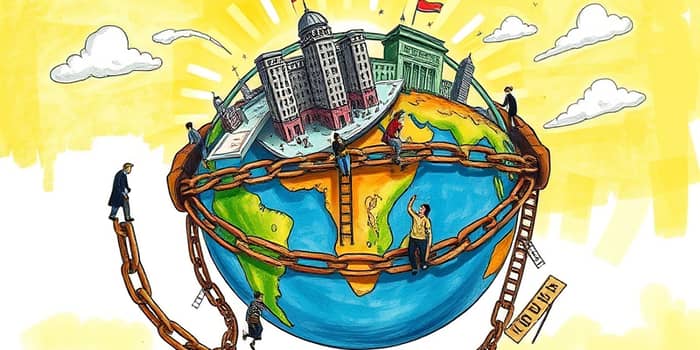
Global debt has reached unprecedented levels, casting a long shadow over economic stability and growth prospects. From public deficits to corporate borrowing, the world’s balance sheets are bulging with obligations that demand careful management and bold solutions.
As nations grapple with the legacy of pandemic spending, rising interest rates, and ambitious stimulus programs, the question becomes: how can we transform this burden into an engine for sustainable prosperity?
Global Debt: Scale and Scope
By the end of last year, total global debt soared past $251 trillion, equivalent to over 235% of world GDP. Public debt alone approached $99.2 trillion, while private debt stood at $151.8 trillion—the lowest ratio since 2015.
However, by Q3 2025, the Institute of International Finance reported a staggering $346 trillion in total debt, or 310% of global GDP, marking a year-to-date increase of $26.4 trillion.
This surge highlights a looming financial storm of debt driven by mature market government borrowing (over $17 trillion) and emerging market issuance (nearly $5.5 trillion).
- Public debt now nears 100% of global GDP, on pace to surpass that mark by 2029.
- Household and corporate borrowing has receded in advanced economies, offset by rising fiscal deficits.
- Emerging markets, notably China, have seen private debt climb to 206% of GDP.
These figures underscore the vast scale of commitments facing governments, firms, and households alike, setting the stage for complex trade-offs between growth and stability.
Diverging Trends Across Economies
While total debt has stabilized at high levels, the distribution between public and private sectors reveals stark contrasts. Advanced economies have witnessed private debt declines alongside surging government liabilities, whereas many emerging markets continue to ramp up corporate and household borrowing.
Across global regions, debt-to-GDP ratios climbing unchecked fuel concerns about long-term sustainability and crowding-out of productive investment.
- Advanced economies (excluding the US) now average 110% total debt-to-GDP, with public debt at 93% globally.
- Emerging markets (ex-China) hover below 56% public debt, yet face rising non-performing loans and liquidity constraints.
- Low-income countries struggle with limited finance, tight monetary conditions, and sovereign-private debt linkages.
China’s private sector, driven by corporate borrowing for infrastructure and strategic investments, stands at record levels despite property sector weakness. In contrast, US private debt has fallen by 4.5 points to 143% of GDP, reflecting deleveraging trends.
Top Countries by Debt Levels
Country-level data provides insight into the members of this high-debt club and illuminates unique risk factors and policy contexts.
Japan’s debt ratio ranks second highest globally, while Lebanon tops at nearly 358%, illustrating the diverse pressures from demographics to fiscal policy.
Risks and Future Projections
As debt accumulates, multiple vulnerabilities emerge. High interest costs squeeze public finances, while crowding-out effects limit private credit availability in key sectors, slowing potential investment.
Global GDP growth, projected at 2.7% in 2026 and 2.9% in 2027, lags historical norms. This growth-debt mismatch raises the specter of stagnation if unchecked.
- Persistent fiscal deficits (averaging 5% of GDP) and rising interest rates heighten refinancing risks.
- Unsustainable US deficits and a weakening dollar signal investor unease and potential market volatility.
- Non-performing loans in emerging markets (e.g., Brazil) and household strain in China pose localized threats.
Absent corrective measures, global public debt could exceed 100% of world GDP by 2029, a post-WWII high with few precedents for safe navigation.
Policy Recommendations for Sustainable Management
Confronting this challenge demands a balanced approach: restrain debt growth without undermining economic vitality. Policymakers should adopt sustainable fiscal adjustments and reforms underpinned by credible, medium-term frameworks.
Key strategies include:
- Implementing transparent budget consolidation plans tied to growth forecasts.
- Optimizing revenue through targeted tax reforms and broadening the base.
- Exploring debt reprofiling or restructuring in vulnerable jurisdictions.
Nations with low borrowing costs, like Germany, can build buffers, while growth-led models, exemplified by India, underscore the power of structural reforms.
Harnessing Growth and Innovation
Debt can fuel transformation if channeled wisely. Investments in private sector resilience and innovation—particularly in clean energy, digital infrastructure, and AI—can amplify productivity and generate new revenue streams.
Non-financial corporate debt, nearing $100 trillion, reflects market confidence in transformative sectors. Public-private partnerships and regulatory support can unlock these resources for public benefit.
Charting a Path Forward
The scale of global indebtedness presents a formidable challenge, but also an inflection point. History teaches that periods of high leverage, when met with decisive action, can catalyze reform and long-term stability.
By fostering transparency, strengthening institutions, and prioritizing growth-friendly policies, the international community can steer away from crisis. Collaboration—across governments, financial institutions, and civil society—will be essential to forge resilient frameworks.
Ultimately, this moment calls for vision and resolve. With strategic planning and collective will, we can transform the burden of debt into a foundation for sustainable prosperity, ensuring economic security for generations to come.
References
- https://www.imf.org/en/blogs/articles/2025/09/17/global-debt-remains-above-235-of-world-gdp
- https://www.infohubfacts.com/finance/top-10-countries-highest-debt-world-bank-2026
- https://www.iif.com/LinkClick.aspx?fileticket=XaPrtyfpqD8%3D&portalid&_cldee=qaIdLvvhcoWqwx4lcAnlZqVK1qwdm4hGn07AkbFQOZUZEL3s5UINkqNtLRpPYskc&recipientid=contact-2c3d922d9468f011bec27ced8d1cd64f-329d09e3688d4926bbe0951c72a3fced&esid=12658f32-07d5-f011-8543-000d3a561e57
- https://worldpopulationreview.com/country-rankings/countries-by-national-debt
- https://www.icgam.com/2026/01/23/2026-macro-and-private-markets-outlook-sustained-resilience/
- https://en.wikipedia.org/wiki/List_of_countries_by_external_debt
- https://thecommonwealth.org/story/blog-100-trillion-and-counting-can-we-tame-global-public-debt
- https://www.imf.org/external/datamapper/GGXWDG_NGDP@WEO/OEMDC/ADVEC/WEOWORLD
- https://www.empower.com/investment-insights/global-debt-problem
- https://www.globalfirepower.com/external-debt-by-country.php
- https://unctad.org/publication/world-economic-situation-and-prospects-2026
- https://tradingeconomics.com/country-list/government-debt-to-gdp
- https://www.oecd.org/en/data/indicators/general-government-debt.html
- https://www.worldeconomics.com/Indicator-Data/Economic-Size/Dept-to-GDP-Ratio.aspx
- https://www.jec.senate.gov/public/index.cfm/republicans/debt-dashboard