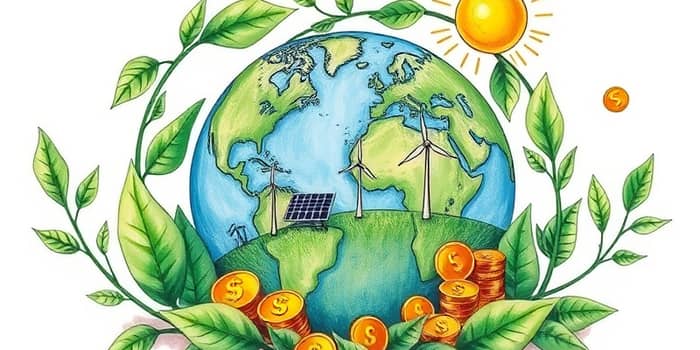
In a world grappling with pressing challenges, from climate change to inequality, a powerful movement is reshaping finance one investment at a time.
Impact investing marries profit with purpose, allowing investors to generate meaningful social and environmental returns alongside financial gains, creating a ripple effect of positive change.
This approach is not just a niche trend; it has evolved into a dynamic global force, driving capital towards solutions that benefit both portfolios and the planet.
As awareness grows and technology advances, more people are discovering how to align their values with their wallets, making impact investing an accessible and compelling choice.
In this article, we explore the rapid growth, key insights, and practical opportunities in impact investing, empowering you to join this transformative journey.
The Explosive Growth of Impact Investing
The market for impact investing has seen rapid expansion from USD 502 billion in 2016 to over USD 1 trillion in recent years, driven by increasing demand for sustainable solutions.
Projections indicate continued robust growth, with estimates varying due to different methodologies and scopes.
For instance, assets under management (AUM) are expected to surge from USD 87.53 billion in 2024 to as high as USD 2.08 trillion by 2030 in some forecasts.
This growth is fueled by a convergence of factors, including sustainability agendas and institutional adoption, making impact investing a mainstream financial strategy.
To illustrate the diversity in projections, here is a table summarizing key market forecasts from various sources:
Discrepancies arise from inclusion criteria, but the overall trend points to significant compound annual growth rates averaging high teens, reflecting strong investor confidence.
This growth is not just about numbers; it represents a shift in how capital is deployed for global good, with profound implications for economies and communities.
Regional Hotspots and Global Dynamics
Impact investing is a global phenomenon, with different regions leading in various aspects.
North America holds the largest market share, accounting for 34.9% globally in 2024, driven by strong institutional participation.
Asia Pacific is the fastest growing region, with countries like India showing remarkable expansion, projected to reach USD 8,916.3 million by 2030.
Europe remains a key player, often cited as the largest overall market, thanks to supportive policies and investor engagement.
Emerging markets are gaining traction, with planned allocation increases in regions such as Sub-Saharan Africa and Southeast Asia.
For example, surveys indicate a 53% increase in allocations to Sub-Saharan Africa over the next five years.
Key regional insights include:
- North America: Dominant in revenue, with the U.S. expected to lead globally by 2030.
- Asia Pacific: High growth fueled by economic development and sustainability initiatives.
- Europe: Established market with strong regulatory frameworks.
- Emerging markets: Rising interest due to untapped potential and social needs.
This geographic diversity highlights opportunities for investors to diversify while making a difference across continents.
Navigating Asset Classes and Investment Segments
Understanding asset classes is crucial for effective impact investing.
Equity dominates the market, representing 56.24% share in 2024, valued at USD 49,228.1 million.
Fixed income is the fastest growing segment, appealing to risk-averse investors seeking stable returns.
Other asset classes include multi-asset and alternatives, each offering unique benefits for impact goals.
Private equity shows a high growth rate of 11.20% CAGR, partly due to better impact measurement tools.
Key sectors driving growth include sustainable agriculture, renewable energy, and education.
For instance, sustainable agriculture is projected to grow at a 9.45% CAGR, addressing food security and environmental sustainability.
Asset class breakdown:
- Equity: Largest share, ideal for long-term growth and ownership in impactful companies.
- Fixed Income: Fastest growing, suitable for income generation with lower volatility.
- Private Equity: High growth potential, often focused on innovative startups and SMEs.
- Retail Access: Growing via digital platforms, enabling individual participation at 10.56% CAGR.
This segmentation helps investors tailor their portfolios to match their financial and impact objectives.
Driving Forces and Emerging Trends
Several factors propel the rise of impact investing, making it more accessible and effective.
Awareness of social and environmental challenges is a primary driver, motivating both individuals and institutions.
Sustainability agendas are increasingly integrated into corporate strategies, pushing capital towards green and social initiatives.
Technological advancements, such as AI, are revolutionizing impact measurement, with 98% of investors embedding AI into their processes.
Key trends for 2026 and beyond include financial materiality, where impact is tied to cash flows and valuations.
AI and geospatial analytics are enhancing data accuracy, addressing previous gaps in measurement.
Other emerging trends focus on geopolitical shifts and institutional infrastructure development.
Drivers of growth:
- Renewable energy transition: A major focus, with investments in climate tech and infrastructure.
- Blended finance: Combining public and private funds to support SMEs and job creation.
- Investor sentiment: 73% of investors are optimistic about the 2026 environment, favoring private markets.
- Retail access: Digital platforms and tokenized funds are democratizing participation.
These trends indicate a maturing market where impact and financial performance are increasingly aligned.
Who's Investing and How to Get Involved
Impact investors come from diverse backgrounds, including institutional players, individuals, and others.
Institutional investors, such as pension funds and endowments, are leading the charge, driven by long-term sustainability goals.
Individual participation is growing rapidly, facilitated by online platforms that simplify entry into impact investments.
Investor sentiment is overwhelmingly positive, with 81% favoring private markets for impact opportunities.
Opportunities abound, with near-term estimates of USD 576.06 billion and future growth potential up to USD 1,312.9 billion.
Social and green bonds, collaborations, and nature-based solutions are popular avenues for investment.
To get started, consider these steps:
- Define your impact goals: Identify social or environmental issues you care about, such as climate change or education.
- Research asset classes: Choose between equity, fixed income, or others based on your risk tolerance and returns.
- Leverage technology: Use digital platforms for easy access and AI tools for impact assessment.
- Diversify geographically: Explore opportunities in fast-growing regions like Asia Pacific or emerging markets.
- Stay informed: Follow surveys and reports, such as the GIIN Impact Investor Survey, for ongoing insights.
This practical approach ensures that your investments are both profitable and purposeful.
Overcoming Challenges and Looking Ahead
Despite its growth, impact investing faces challenges that require attention and innovation.
Geopolitical uncertainties, such as trade tensions, can affect capital flows and project viability.
Data measurement issues persist, with inconsistent sizing and spotty metrics complicating impact assessment.
For example, the closure of USAID programs in 2023 impacted aid budgets, highlighting reliance on public support.
However, solutions are emerging, including improved AI tools for real-time data analysis and standardized frameworks.
The future of impact investing is bright, with continued integration into mainstream finance and expanding global reach.
Key areas for growth include climate tech, circular economy models, and education initiatives.
As more investors embrace this model, we can expect a significant shift towards scalable impact that drives economic and social transformation.
Looking ahead, focus on collaboration and innovation to overcome hurdles and maximize positive outcomes.
Final thoughts: Impact investing is not just a trend; it's a fundamental rethinking of finance's role in society.
By aligning investments with values, we can build a more equitable and sustainable world for generations to come.
References
- https://www.grandviewresearch.com/horizon/outlook/impact-investing-market-size/global
- https://www.technavio.com/report/impact-investing-market-analysis
- https://iixglobal.com/impact-investing-quarterly-q2/
- https://www.researchandmarkets.com/report/responsible-investment
- https://www.otpp.com/en-ca/about-us/news-and-insights/global-perspectives/global-investor-sentiment-2026/
- https://www.mordorintelligence.com/industry-reports/impact-investing-market
- https://trellis.net/article/10-impact-investing-trends-that-will-define-2026/
- https://www.skyquestt.com/report/impact-investing-market
- https://thegiin.org/impact-investor-survey/
- https://www.grandviewresearch.com/industry-analysis/impact-investing-market-report
- https://www.weforum.org/stories/2025/10/measuring-impact-investing/
- https://www.edengreen.com/blog-collection/what-is-impact-investing
- https://www.newprivatemarkets.com/impact-finds-new-centres-of-gravity/
- https://www.sphericalinsights.com/our-insights/impact-investing-market
- https://www.nb.com/en/link?type=article&name=cio-weekly-perspectives-markets-in-2026-full-speed-ahead-with-eyes-wide-open