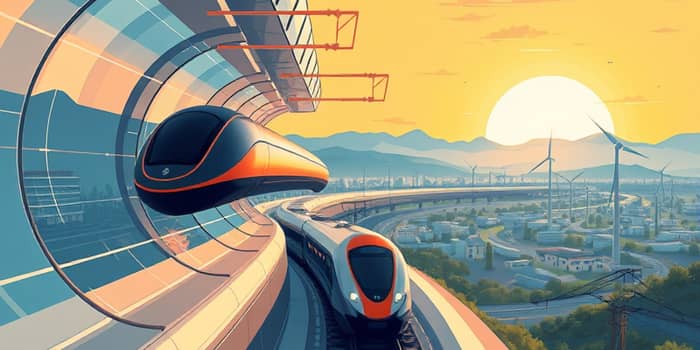
From concept sketches to policy debates, the race to revolutionize passenger and cargo transport has reached a fever pitch. On one side stands the proven might of high-speed rail networks already reshaping intercity travel. Opposing it is the visionary promise of vacuum-tube maglev systems that could slash journey times to minutes. Yet, the ultimate question remains: where will the greatest returns—financial, social, and environmental—be found?
This article takes you on an in-depth journey through the technological foundations, performance metrics, energy and sustainability considerations, economic dynamics, risks, and projected timelines for both Hyperloop and high-speed rail (HSR). We’ll explore how each system stacks up and what investors, communities, and governments should weigh as they wager on the future of transport.
Technological Foundations of Ultra-Fast Travel
Hyperloop, popularized by Elon Musk in 2013, envisions passenger and cargo pods rocketing through low-pressure, near-vacuum tubes at near-supersonic speeds. By combining magnetic levitation or air bearings with electric linear propulsion, Hyperloop pods aim to virtually eliminate friction and aerodynamic drag.
High-speed rail, by contrast, relies on refined steel wheels on rails, advanced aerodynamics, and sophisticated signaling. Defined by speeds above 250 km/h (155 mph), HSR trains like Japan’s Shinkansen have carried millions of passengers safely at up to 320 km/h, showcasing a mature, proven technology that integrates seamlessly with existing rail networks.
Speed, Capacity & Performance
Speed is the headline grabber for both technologies, but practical performance paints a fuller picture.
- Hyperloop: Theoretical ceiling of 1,220 km/h (760 mph), yet Virgin Hyperloop’s 2020 passenger test peaked at only 172 km/h over 500 meters.
- High-Speed Rail: Commercial services routinely achieve 250–350 km/h, with special runs reaching 400 km/h in testing environments.
- Maglev (for context): Demonstrated speeds over 600 km/h on dedicated tracks in limited corridors.
Trip time illustrates the allure: a Hyperloop connecting London and Manchester could shrink the 200-km journey to under 20 minutes—compared to roughly two hours by current rail and under 90 minutes on proposed UK HSR lines.
Energy Efficiency and Sustainability
Transport accounts for a significant slice of global emissions. Both HSR and Hyperloop promise greener footprints than air travel, but their life-cycle impacts differ.
HSR is already powered largely by electricity, increasingly drawn from renewable grids. High-capacity trains spread energy use over thousands of seats, delivering among the lowest carbon per passenger-kilometer of any mode.
Hyperloop’s design further curbs operational energy through vacuum conditions and low rolling friction. Concepts propose solar arrays along tubes to power propulsion. Yet the environmental cost of manufacturing steel-and-concrete tubes, plus continuous vacuum maintenance, remains uncertain until full-scale systems exist.
Economic Dynamics and Returns
Evaluating returns means dissecting capital expenditures, operating costs, and broader economic impacts.
Key drivers of HSR costs include dedicated tracks, viaducts, tunnels, stations, and signaling. However, using standard gauge rails and leveraging existing corridors tempers expenses and accelerates deployment.
By contrast, Hyperloop demands entirely new, airtight tubes over hundreds of kilometers, precise alignment, and bespoke terminals. Industry experts warn that ensuring near-perfect vacuum conditions and structural integrity could inflate costs well above even the priciest HSR projects.
Operating expenses favor neither side conclusively. HSR track maintenance and complex signaling remain substantial, while Hyperloop’s vacuum pumps and safety systems introduce fresh cost centers. Over time, maglev-derived wheel-free designs could lower maintenance, but only if vacuum integrity issues are solved at scale.
The true returns lie beyond ticket revenues. HSR has a track record of boosting regional integration, expanding labor markets, and spurring tourism. Japan’s Shinkansen transformed intercity travel and catalyzed economic corridors across Honshu. In Europe, HSR lines have redistributed growth from capital hubs into mid-size cities.
Hyperloop promises transformative potential too: ultra-fast cargo could reroute time-sensitive freight from air to tube, while commuters could live hundreds of kilometers from their workplaces. Real estate markets might realign around super-connected city clusters. Yet as no commercial Hyperloop line exists, these benefits remain conjectural until demand is proven.
Safety, Risk & Public Acceptance
When speeds climb into supersonic territory, safety takes center stage. HSR benefits from decades of operational experience, with global safety standards, proven emergency protocols, and robust public trust.
Hyperloop must navigate uncharted regulatory landscapes. Tube depressurization, pod evacuation, and tube alignment maintenance pose novel challenges. Public acceptance may hinge on demonstrated reliability and transparent safety certifications, requiring extensive testing and phased rollouts.
Project Timelines and the Road Ahead
High-speed rail expansion is already underway across Asia, Europe, and parts of North America. New corridors in the U.S., India, and Southeast Asia are moving from planning to construction, promising incremental returns in the next decade.
Hyperloop development is more nascent. Pilot routes in the Middle East, Europe, and the U.S. aim for passenger service in the mid-2030s. Investors should expect a paced, milestone-driven progression rather than instant returns. Early freight or short-haul demos may pave the way for full-scale passenger lines.
Ultimately, racing towards returns in transport means picking the best blend of proven performance and bold innovation. High-speed rail offers immediate, scalable impacts on mobility, emissions, and economics. Hyperloop holds the tantalizing prospect of redefining distance itself—but only if its engineering and regulatory hurdles can be surmounted economically.
As stakeholders chart their transport strategies, balancing short- and long-term returns will be crucial. Will the sure returns of HSR underwrite incremental progress? Or will the audacity of Hyperloop capture the capital and public imagination needed to transform travel as we know it? The next chapter in transit history is unfolding now—fasten your seatbelt and choose your lane wisely.
References
- https://www.meegle.com/en_us/topics/hyperloop-technology/hyperloop-vs-high-speed-rail
- https://www.meegle.com/en_us/topics/hyperloop-technology/hyperloop-vs-traditional-rail
- https://www.deployrecruit.com/hyperloop-vs-high-speed-rail
- https://www.hsrail.org/blog/maglev-hyperloop/
- https://northeastmaglev.com/2025/02/26/maglev-vs-hyperloop-whats-the-difference/
- https://www.youtube.com/shorts/wxLn-72mjC0
- https://morson-projects.co.uk/latest_news/hyperloop-or-high-speed-rail-the-uks-transport-future/
- https://uic.org/com/enews/article/uic-high-speed-community-meets-hardt-hyperloop-innovation-in-veendam