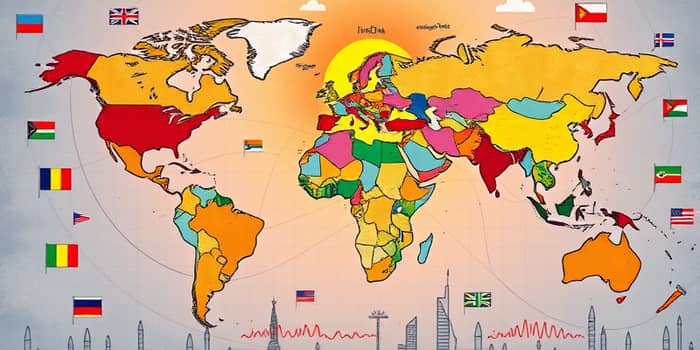
In an age when political fault lines shape financial flows and trade routes, understanding the interplay between global tensions and market dynamics is indispensable. Business leaders and investors must not only recognize the risks but also adopt strategies that transform uncertainty into opportunity. This guide synthesizes major geopolitical risks, economic implications, and actionable steps to foster resilient and forward-thinking leadership.
Mapping High-Impact Geopolitical Risks
Tier I risks—those with both high likelihood and high impact—span the Middle East, Europe, and the Asia-Pacific, driven by longstanding conflicts and rising great-power competition.
- Middle East conflicts and humanitarian crises fueled by contested territories, proxy wars, and nuclear ambitions.
- Tensions between Russia and NATO over Ukraine, combined with potential armed clashes along hybrid warfare fronts.
- Cross-strait crises involving China and Taiwan, North Korean nuclear tests, and India-Pakistan skirmishes in Kashmir.
Beyond these, moderate-to-high impact flashpoints—from sectarian violence in Syria to renewed hostilities in the Caucasus—serve as ever-present reminders that volatility can emerge unpredictably.
Trade Disruptions and Economic Pressures
Inflationary pressures and supply chain disruptions have become the new normal. Tariffs imposed during trade wars often translate into pipeline inflation and rising consumer costs. Firms that stockpiled inventories to hedge against tariffs now face higher ongoing import prices and weakening currencies.
The broader economic fallout includes:
- Capital flow volatility as investors flee traditional safe havens like US Treasuries in favor of gold or emerging-market assets.
- Higher unemployment alongside inflation—an unsettling phenomenon not seen since the 1970s—eroding consumer confidence.
- Supply chain realignments in high-tech manufacturing and AI, where protected industries may emerge as winners.
Looking ahead to 2026, businesses must prepare for sustained uncertainty in trade policy, balancing national security and revenue priorities when assessing market entry or expansion.
The Evolving Sanctions Landscape
Sanctions have expanded in scope and complexity, no longer confined to traditional financial restrictions. Authorities now deploy a suite of tools—from export controls on semiconductors to maritime “shadow fleet” targeting. The global framework is increasingly dynamic, with more intense enforcement and adaptive evasion tactics.
Key elements of this landscape include:
- Coordinated but diverging actions by the US, UK, and EU, posing challenges for multinational compliance teams.
- Counter-sanctions and extraterritorial effects from Russia and China, amplifying the so-called spider effect.
- Integration of sanctions with tariffs, anti-money laundering measures, and foreign investment reviews.
To navigate this environment, organizations must implement robust screening systems, continuous monitoring, and adaptive policies that align with evolving legal obligations.
Strategies for Resilient Business Leadership
Amid intensifying geopolitical tensions, proactive resilience becomes a competitive advantage. Leaders can transform risk into value by adopting the following strategies:
- Diversify supply chains and markets to reduce dependency on any single region or trade route.
- Invest in scenario planning that integrates conflict escalation, climate risks, and regulatory shifts.
- Strengthen compliance frameworks with real-time data analytics and cross-functional collaboration.
By embedding flexibility into operations and capital allocation, companies can quickly pivot when new sanctions, tariffs, or conflicts arise. In addition, building local partnerships and investing in digital traceability can mitigate disruptions.
Embracing Innovation Amid Uncertainty
Geopolitical stress can accelerate technological adoption. Industries at the intersection of AI, cybersecurity, and renewable energy are poised to thrive. Embrace digital transformation not only as a cost-savings measure but as a strategic safeguard against unpredictable market shocks.
Leaders should champion a culture of continuous learning, fostering cross-disciplinary teams that can anticipate shifts in both politics and technology. Such an approach ensures an organization remains agile in the face of systemic change and ready to capitalize on emerging opportunities.
Conclusion: Turning Tension into Opportunity
Global tensions will persist, but so too will the potential for growth and innovation. By understanding the contours of high-impact risks, preparing for economic and regulatory headwinds, and fostering resilient leadership, businesses can navigate this complex era with confidence.
Ultimately, success rests on the ability to transform challenges into catalysts for transformation—unlocking new markets, pioneering breakthrough solutions, and championing sustainable growth in a world defined by dynamic geopolitics.
References
- https://kpmg.com/us/en/articles/2026/global-trade-outlook-2026.html
- https://www.jpmorgan.com/insights/global-research/commodities/oil-prices
- https://www.wellington.com/en-us/institutional/insights/geopolitics-in-2026-risks-and-opportunities-were-watching
- https://www.hklaw.com/en/insights/publications/2026/01/ofac-sanctions-will-intensify-amid-global-tensions-in-2026
- https://www.cfr.org/reports/conflicts-watch-2026
- https://www.pinsentmasons.com/out-law/analysis/spider-effect-sanctions-presents-business-risk-2026
- https://www.stimson.org/2026/top-ten-global-risks-for-2026/
- https://www.moodys.com/web/en/us/kyc/resources/insights/the-global-sanctions-landscape-2026.html
- https://www.eurasiagroup.net/issues/top-risks-2026
- https://www.skadden.com/insights/publications/2025/11/the-sanctions-puzzle
- https://www.gzeromedia.com/podcast/gzero-world-podcast/the-biggest-geopolitical-risks-of-2026-revealed
- https://www.brookings.edu/articles/can-sanctions-change-the-course-of-conflict/
- https://www.weforum.org/publications/global-risks-report-2026/digest/
- https://www.afslaw.com/perspectives/national-security-counsel/top-five-export-controls-and-sanctions-areas-watch-2026
- https://www.lazard.com/research-insights/top-geopolitical-trends-in-2026/