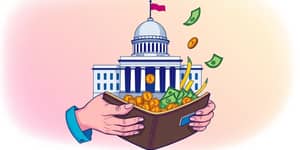
In the ever-evolving world of economics, governments hold a powerful key to national prosperity through fiscal policy.
This strategic tool allows policymakers to directly influence economic activity by adjusting government spending and taxation.
By doing so, they aim to achieve critical goals like price stability and full employment, fostering a resilient and growing economy.
Understanding fiscal policy is essential for anyone interested in how nations navigate financial challenges and secure a brighter future.
What is Fiscal Policy?
Fiscal policy refers to the government's use of revenue collection and expenditure to steer the economy.
It focuses on managing aggregate demand to smooth out business cycles and promote stability.
Unlike monetary policy, which is handled by central banks, fiscal policy is implemented by governmental bodies such as legislatures or finance ministries.
This distinction highlights its direct impact on public finances and economic outcomes.
Core Components of Fiscal Policy
The foundation of fiscal policy rests on three interconnected pillars that shape economic decisions.
- Government spending: Direct purchases of goods and services, such as infrastructure or education, to stimulate demand and growth.
- Taxation: Revenue collected from individuals and organizations, where adjustments influence disposable income and consumption.
- Transfer payments: Payments like subsidies or welfare that act as negative taxes to boost spending without direct exchange.
Spending is further categorized to reflect different budgetary approaches.
- Discretionary spending is set annually by lawmakers for new programs.
- Mandatory spending is fixed by law, often for entitlements like social security.
Even revenue-neutral changes can alter economic incentives and output.
Types of Fiscal Policy
Governments deploy various types of fiscal policy based on economic conditions to achieve desired outcomes.
The balanced budget multiplier ensures that equal adjustments still impact GDP, demonstrating policy's nuanced effects.
Mechanisms and Effects
Fiscal policy operates through key mechanisms that amplify its influence on the economy.
In the aggregate demand-aggregate supply model, spending directly shifts demand, while tax cuts work indirectly via increased consumption.
Multipliers play a crucial role in determining the scale of impact.
- Spending multiplier: Calculated as 1/(1-MPC), where MPC is the marginal propensity to consume.
- Tax multiplier: Typically negative and smaller, equal to -MPC times the spending multiplier.
For instance, with an MPC of 0.8, the spending multiplier is 5, meaning a $2 million increase can close a $10 million output gap.
This illustrates how precise calculations guide effective policy implementation.
Goals and Tools Summary
Fiscal policy targets several overarching objectives to enhance societal well-being.
- Economic growth through injections of money via spending or tax cuts.
- Price stability by curbing inflation with contractionary measures.
- Full employment achieved during downturns with expansionary actions.
- Poverty reduction supported by transfers and public goods provision.
Tools are tailored to address specific economic imbalances, ensuring responsive governance.
- For negative output gaps, expansionary policy with tax cuts and increased spending is recommended.
- For positive gaps, contractionary policy with tax hikes and spending cuts helps stabilize the economy.
This framework empowers policymakers to act decisively in times of need.
Real-World Considerations and Challenges
Implementing fiscal policy involves practical hurdles that can affect its success.
Lags introduce delays that may reduce effectiveness, requiring careful timing.
- Data lag: Time needed to collect accurate economic data like GDP.
- Recognition lag: Identifying when a problem actually exists.
- Decision lag: Political debates and approvals for policy changes.
- Implementation lag: Enacting and rolling out the adjustments.
Automatic stabilizers, such as progressive taxes, provide built-in counter-cyclical support without legislative action.
Deficits and debt are critical concerns in fiscal management.
A deficit occurs annually when spending exceeds revenue, while debt accumulates from past deficits.
Expansionary policies often widen deficits but can be offset with balanced approaches.
Common Misconceptions and Nuances
Clearing up misunderstandings is vital for a deeper appreciation of fiscal policy.
- It does not eliminate business cycles but aims to smooth their volatility.
- Fiscal policy is distinct from monetary policy, with different implementing bodies.
- Balanced budget changes can still impact the economy due to the multiplier effect.
- Revenue-neutral adjustments influence economic incentives and behavior.
- Tax increases might expand the economy if funding growth-enhancing projects like infrastructure.
Grasping these nuances helps citizens and leaders engage more effectively in economic discussions.
Conclusion
Fiscal policy stands as a cornerstone of economic governance, offering pathways to stability and growth.
By mastering government spending, taxation, and managing deficits, societies can navigate uncertainties with confidence.
This knowledge not only informs policy decisions but also inspires collective action toward a prosperous and equitable future.
References
- https://www.poems.com.sg/glossary/financial-terms/fiscal-policy/
- https://socialsci.libretexts.org/Bookshelves/Economics/Introductory_Comprehensive_Economics/Economics_(Boundless)/26:__Fiscal_Policy/26.01:_Introduction_to_Fiscal_Policy
- https://www.reviewecon.com/fiscal-tools
- http://www2.harpercollege.edu/mhealy/eco212/lectures/fiscpol/fp.htm
- https://www.khanacademy.org/economics-finance-domain/ap-macroeconomics/national-income-and-price-determinations/fiscal-policy-ap/a/lesson-summary-fiscal-policy
- https://www.congress.gov/crs-product/IF11253
- https://www.worldbank.org/en/topic/fiscalpolicy