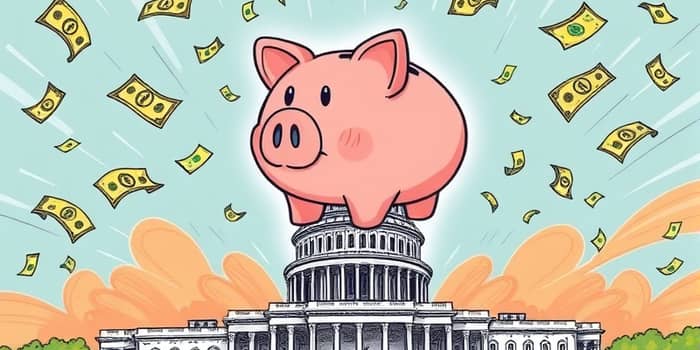
Many of us think of our personal budgets in terms of income, expenses, and savings. Yet, the larger financial world of government spending and revenue choices plays an equally vital role in shaping our daily lives. From the taxes we pay to the interest rates on our mortgages, the federal budget ripples through the economy, ultimately touching every household.
By understanding these connections and applying sound personal finance strategies, we can achieve greater stability—and even thrive—regardless of partisan debates or headline-driven upheavals.
Bridging the Gap: From Capitol Hill to Your Kitchen Table
The federal budget spans billions of dollars across defense, healthcare, infrastructure, and more. It determines tax policies, deficit levels, and program funding that directly impact inflation, employment, and borrowing costs.
When Congress enacts spending bills or extends continuing resolutions, it’s not an abstract exercise: it’s federal budget influences personal finances in very real ways. Consider how borrowing to cover a deficit can drive inflation or how tax adjustments affect take-home pay.
Key Milestones in the FY2026 Budget
The FY2026 U.S. federal budget began October 1, 2025, and has been shaped by shutdowns, continuing resolutions, and negotiated appropriations. Major events include:
- 2025 Shutdown: A partial government closure ended November 12, 2025, with a continuing resolution and three appropriations bills, preserving pay for furloughed workers without mass layoffs.
- September 2025 CR Attempts: Competing proposals to extend healthcare subsidies and rollback Medicaid cuts failed in both chambers, reflecting deep partisan divides.
- January 2026 Package: Enacted bills funded Interior-Environment, Commerce-Justice-Science, and Energy-Water agencies, including NASA and Corps projects.
- Pending Measures: House-passed bills for State, Defense, Transportation, and Health await Senate action, while debates over spending priorities continue.
Justice Department Grantmaking: Funding Shifts Explored
The President’s FY2026 request proposes significant cuts to Justice Department grants—potentially reshaping law enforcement, juvenile programs, and research efforts.
These shifts illustrate how federal priorities translate into local impacts—police hiring, community programs, and data-driven policy all hinge on budget allocations.
The Ripple Effect on Personal Finances
Government borrowing adds roughly $15,000 per household each year, contributing to a national debt that exceeds $260,000 per household. When the Treasury issues bonds to cover deficits, the Federal Reserve may print money, leading to inflation eats away at savings and higher prices for food, housing, and energy.
Moreover, servicing that debt requires interest payments, which can prompt higher taxes or a redirection of funds away from essential federal programs. With Social Security trust funds projected to deplete by 2035, many retirees face the prospect of reduced benefits unless policymakers act.
Higher interest rates, meant to curb inflation, affect mortgages, credit cards, and auto loans, making borrowing more expensive for families already juggling costs.
Putting Fiscal Fitness into Practice
Just as governments track revenues, manage deficits, and reallocate resources, households can apply similar principles at a personal level. By embracing disciplined habits, you can build resilience against economic uncertainty.
- Track every expense: Maintain a monthly spreadsheet or use an app to ensure tracking every dollar spent and identify areas to trim.
- Prioritize high-interest debt: Focus extra payments on credit cards or loans with the highest rates to reduce overall interest costs.
- Build an emergency fund: Aim for three to six months of living expenses to build an emergency savings fund and avoid high-interest borrowing in a crisis.
- Invest for growth: Contribute regularly to retirement accounts or diversified portfolios to outpace inflation over the long term.
- Review and adjust: Revisit your budget quarterly to reallocate resources as goals and circumstances change.
Learning from Government’s Playbook
While the scale differs, governments and households share the core principles of fiscal stewardship. By studying how Congress negotiates spending—and how those decisions reverberate through inflation and taxation—we gain insights into our own financial planning.
For example, when lawmakers face a shutdown, backpay for federal workers demonstrates the importance of maintaining a cash reserve. Similarly, when deficit borrowing spikes, it reminds us of the dangers of relying on credit without a clear repayment plan.
This convergence of public and private finance underscores a timeless lesson: prudent management, transparent tracking, and forward-looking reserves are the keys to long-term stability.
Looking Ahead with Hope and Action
As debates over the FY2026 budget continue—whether extending tax credits, adjusting Medicaid funding, or reallocating disaster relief funds—your household can emerge stronger by implementing disciplined financial practices.
Though we cannot vote directly on every line item in Washington’s ledger, we can control how we allocate our own resources. By combining awareness of macroeconomic forces with personal fiscal fitness, each of us becomes an architect of our financial destiny.
Embrace this moment as an opportunity. Channel the energy of national negotiations into your own budgeting breakthroughs. When government and household finance principles align, we foster resilient communities and secure personal futures.
Together, we can turn the complexity of federal budgets into a blueprint for individual empowerment—one dollar at a time.
References
- https://en.wikipedia.org/wiki/2026_United_States_federal_budget
- https://duncangrp.com/government-budget-vs-your-household-budget/
- https://counciloncj.org/unpacking-the-presidents-2026-budget/
- https://www.heritage.org/budget-and-spending/commentary/the-costly-truth-about-government-spending
- http://strong.house.gov/media/press-releases/house-passes-eighth-fiscal-year-2026-spending-bill
- https://www.wealthenhancement.com/blog/how-to-protect-your-money-from-consequences-of-the-national-debt
- https://www.crfb.org/blogs/appropriations-watch-fy-2026
- https://www.vectrabank.com/personal/community/two-cents-blog/The-Impact-of-Economic-Policies-on-Personal-Finance/
- https://www.govinfo.gov/app/collection/budget/2026
- https://www.pgpf.org/federal-budget-guide/
- https://www.dol.gov/general/budget
- https://www.youtube.com/watch?v=42Kojzq1_kc
- https://www.congress.gov/crs-appropriations-status-table
- https://www.whitehouse.gov/omb/information-resources/budget/the-presidents-fy-2026-discretionary-budget-request/