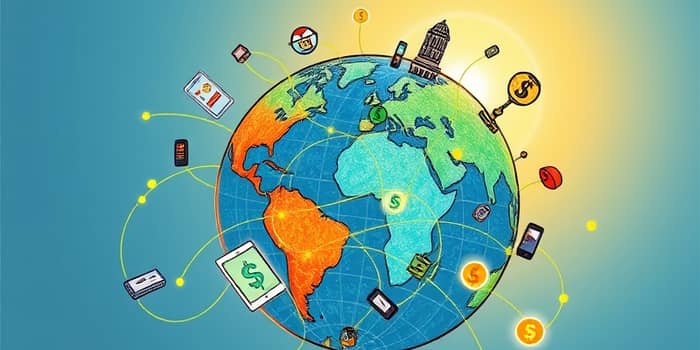
The modern world rests on the constant movement of capital, yet today’s global monetary network faces friction, fragmentation, and vulnerability. As finance expands at record pace, it must evolve toward seamless monetary connectivity that benefits everyone.
Layer 1: The Current Landscape of Financial Flows
Over the past five years, funds intermediated by banks and nonbank providers surged by $122 trillion or 40%, averaging 7.0% annual growth—far outpacing global GDP’s 4.8% expansion. Retail funds rose 6.0% per year, while institutional vehicles climbed 7.7%. Private capital within banking grew even faster at 17.2% annually, highlighting the ascendancy of private credit and equity.
Household and institutional wealth now exceeds 350% of nominal global GDP. In 2024, banks’ revenues after risk costs reached a record $5.5 trillion, with net income of $1.2 trillion. This unprecedented free cash flow to equity fuels shareholder distributions and war chests for technology and mergers.
Yet the macro backdrop shows headwinds. Growth is forecast at 2.6% in 2025–26, below the pre-pandemic 3% trend. Demographic shifts, slowing productivity, high debt burdens, and tighter financial conditions and debt buildup suggest the real economy may struggle to keep pace with financial asset expansion.
Layer 2: Fragmentation and Its Costs
For decades after the end of Bretton Woods, a unified framework supported trade, capital mobility, and stable prices. Today, geopolitical tensions and regulatory divergence are fragmenting that framework, adding cost and risk.
A worst-case analysis by the World Economic Forum and Olivier Wyman warns that persistent fragmentation could shave off $5.7 trillion from global GDP and drive inflation more than 5 percentage points higher.
Manifestations include record tariff rates (US at 17.9% in 2025), capital flow screens in China and the US, and emerging financial blocs. Russia has halved external liabilities since 2022, while China shifts lending toward emerging markets and offshore hubs. Rival reserve currencies threaten to fragment liquidity further.
- Slower cross-border payments and duplicated settlement systems.
- Higher funding costs and volatile exchange rates.
- Weakened global safety nets for emerging economies.
Layer 3: Toward a Resilient and Inclusive Future
Building a seamless monetary architecture demands technology, policy alignment, and shared trust. Innovations like tokenization and central bank digital currencies (CBDCs) promise interoperable digital payment rails that settle instantly across borders.
Enhanced regulatory coordination—completing Basel reforms, global crypto-asset frameworks, and the G20 payment roadmap—can reduce friction. A reinforced global safety net, with expanded IMF resources and regional swap lines, would ensure more equitable crisis support.
- Deploying CBDCs with cross-border interoperability standards.
- Adopting common data and privacy protocols.
- Harnessing fintech to close the “last mile” in underserved regions.
Financial inclusion remains critical. World Bank data show that women, rural residents, and the poor still lag in account ownership. Mobile money and digital lending platforms are bridging the inclusion gap, but harmonized regulation and infrastructure investment are needed to reach the unbanked.
Practical Strategies for Stakeholders
Policymakers should prioritize:
- Regulatory alignment on cross-border payments to lower costs and speed transactions.
- Investing in digital infrastructure that connects national systems securely.
- Strengthening global coordination on financial stability risks and crisis response.
Financial institutions and fintech innovators can:
- Leverage distributed ledger technology for secure, transparent settlements.
- Partner with local agents and mobile networks to expand services in emerging markets.
- Implement risk-management tools that monitor real-time flows and concentration risks.
By working together across sectors and borders, stakeholders can transform a fragmented network into an inclusive and resilient financial ecosystem. Such a system would not only accelerate growth but also spread its benefits equitably.
Conclusion: The stakes could not be higher. A fragmented monetary system risks trillions in lost GDP, higher inflation, and greater instability. Conversely, a seamless framework built on shared standards, cutting-edge technology, and a commitment to inclusion can unlock the full power of global finance. The journey toward that vision starts today—with collective determination, innovative solutions, and unwavering trust in our shared future.
References
- https://www.mckinsey.com/industries/financial-services/our-insights/global-banking-annual-review
- https://www.weforum.org/stories/2025/11/understanding-fragmented-global-financial-system-safeguarding-its-integrity/
- https://www.imf.org/en/news/articles/2025/10/29/pr-25351-imf-releases-the-2025-financial-access-survey-results
- https://www.imf.org/en/publications/gfsr/issues/2025/10/14/global-financial-stability-report-october-2025
- https://www.brookings.edu/articles/is-the-global-financial-system-fracturing-under-geopolitical-pressure/
- https://www.worldbank.org/en/publication/globalfindex
- https://www.fsb.org/2025/10/incomplete-reform-implementation-leaves-financial-system-vulnerable-to-shocks-warns-fsb-chair/
- https://unctad.org/publication/trade-and-development-report-2025
- https://www.bis.org/publ/arpdf/ar2025e.htm