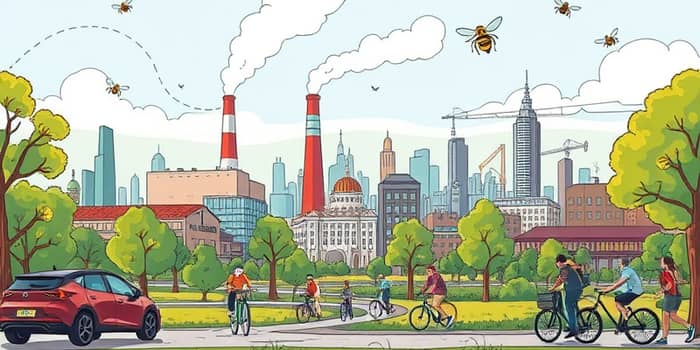
Every day, we make choices that seem personal, but their echoes reach far beyond our own lives.
When a factory pollutes the air or a neighbor plays loud music, the costs aren't just theirs alone.
These spillover effects, known as externalities, shape our communities and economies in profound ways.
Cost or benefit imposed on uninvolved third parties is at the heart of this concept, revealing how market prices often fail to tell the whole story.
This leads to inefficiencies where resources aren't used in the best way possible for everyone.
Understanding externalities isn't just academic; it's key to building a fairer, healthier society.
Defining the Core Concept
An externality occurs when an economic activity affects people who aren't directly involved.
These effects aren't reflected in market prices, creating a gap between private and social outcomes.
Private decisions fail to account for social costs or benefits, disrupting optimal resource allocation.
This violation of Pareto optimality means someone could be better off without harming others, but it doesn't happen.
By grasping this, we can start to address the hidden impacts of our actions.
Classifying Externalities
Externalities come in different forms, based on whether they're positive or negative and their source.
This classification helps us pinpoint where interventions might be needed most urgently.
Beyond these, pecuniary externalities involve price changes in competitive markets, but they aren't true market failures.
Positional externalities, like luxury goods demand, stem from relative consumption and status comparisons.
Recognizing these types empowers us to tailor solutions effectively.
Key Examples and Their Real-World Impacts
Negative externalities often dominate headlines, with severe consequences for public health and environment.
Pollution imposes health costs on communities, from industrial emissions to urban congestion.
Consider how factory waste in rivers can lead to long-term ecological damage.
Alcohol consumption creates external costs in healthcare and law enforcement, as noted by economists.
- Noise pollution from industry disturbs residential quality of life.
- Deforestation for products harms indigenous groups and accelerates climate change.
- Congestion in cities reduces efficiency and increases stress for all commuters.
Positive externalities, though less highlighted, offer immense societal benefits.
Vaccinations protect not just the individual but entire populations through herd immunity.
Electric vehicles reduce air pollution, benefiting everyone in cleaner urban spaces.
- Education fosters innovation and economic growth beyond personal gain.
- Community gardens enhance local well-being and social cohesion.
- Renewable energy adoption decreases reliance on fossil fuels globally.
These examples show why ignoring externalities can degrade our collective quality of life.
The Economic Mechanics Behind Externalities
In economic terms, externalities shift supply and demand curves away from social optima.
For negative externalities, the marginal private cost is lower than the marginal social cost.
This leads to overproduction, where market equilibrium exceeds the socially desirable level.
Deadweight loss results from inefficient resource allocation, causing waste and harm.
Positive externalities, in contrast, see marginal private benefit below marginal social benefit.
This results in underconsumption, where society misses out on beneficial goods and services.
Understanding these graphs helps visualize why markets fail without correction.
- Negative externality graphs show supply curves splitting into private and social costs.
- Positive externality graphs illustrate demand curves with similar splits.
- Market failure occurs when competitive equilibrium ignores these external effects.
This mechanical insight is crucial for designing effective policies.
Solutions to Internalize Externalities
To align private incentives with social welfare, various strategies can be employed.
Government interventions often play a key role in correcting these market failures.
Pigouvian taxes raise prices to marginal social cost, reducing harmful outputs.
Subsidies for positive activities, like education, boost consumption to optimal levels.
- Regulations set limits on pollution or protect endangered species.
- Consumption taxes target demerit goods, such as polluting products.
- Nudges encourage green choices through behavioral incentives.
Market-based solutions, grounded in the Coase theorem, offer alternative pathways.
If transaction costs are low and property rights clear, parties can negotiate efficiently.
For instance, a polluter might compensate affected neighbors, internalizing the cost.
Property rights and low transaction costs enable efficient negotiation, fostering private resolutions.
- Create pollution rights markets to trade emissions allowances.
- Use bribes or contracts between affected parties to settle disputes.
- Develop community agreements for shared resource management.
These approaches highlight the balance between public and private action.
Historical Insights and Theoretical Foundations
The study of externalities has deep roots in economic thought, guiding modern policy.
Arthur Pigou pioneered the use of taxes and subsidies to address spillover effects.
His work on factory and alcohol examples laid the groundwork for corrective measures.
Ronald Coase introduced the theorem emphasizing negotiation over state intervention when feasible.
Coase theorem emphasizes negotiation with clear property rights, reducing government reliance.
Barry Commoner highlighted environmental costs, pushing externalities into public discourse.
- Pigou's insights inform carbon taxes and education subsidies today.
- Coase's ideas shape pollution trading schemes and private settlements.
- Commoner's advocacy spurs grassroots environmental movements.
These historical perspectives enrich our understanding and application of solutions.
Practical Steps for Everyday Impact
You don't need to be an economist to make a difference regarding externalities.
Start by assessing the spillover effects of your daily choices, from commuting to consumption.
Support policies that internalize costs, such as advocating for green taxes or subsidies.
Advocate for policies that internalize social costs, driving systemic change.
Engage in community efforts, like carpooling or recycling, to reduce negative impacts.
Educate others about positive externalities, encouraging actions like vaccinations or energy savings.
- Choose products with lower environmental footprints to minimize harm.
- Participate in local clean-up events to address pollution directly.
- Volunteer for educational programs that boost societal benefits.
By taking these steps, you contribute to a more efficient and equitable world.
Externalities remind us that our interconnectedness demands responsibility and innovation.
Embrace this knowledge to inspire change, turning private decisions into public gains.
References
- https://en.wikipedia.org/wiki/Externality
- https://conceptually.org/concepts/externalities
- https://www.economicshelp.org/blog/glossary/externalities/
- https://www.carboncollective.co/sustainable-investing/externalities
- https://www.imf.org/external/pubs/ft/fandd/basics/38-externalities.htm
- https://www.youtube.com/watch?v=2DYntAGD3wg
- https://courses.ems.psu.edu/ebf200/node/144