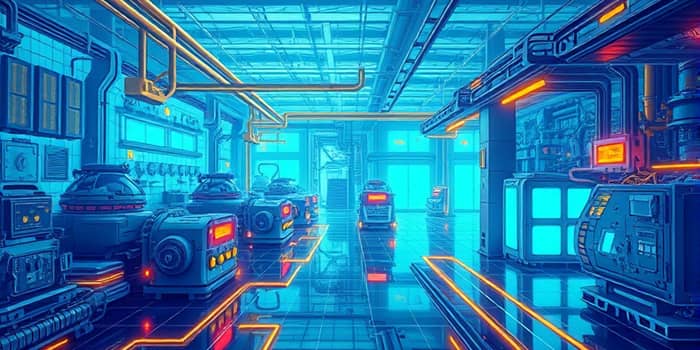
In an era of rapid digital transformation, industries worldwide are embracing dynamic digital representation to revolutionize operations and investment strategies.
Digital twins offer a powerful lens into physical assets, unlocking new opportunities for efficiency, innovation, and growth.
Understanding Digital Twins: Definitions and Taxonomy
A digital twin is a dynamic digital representation of a physical asset, continuously synchronized via real-time data from sensors, historical records, and analytical models. By mirroring status, behavior, and performance, these virtual counterparts enable organizations to anticipate challenges, optimize processes, and guide strategic investments.
Key characteristics of a robust digital twin include:
- Continuous data synchronization with IoT platforms, control systems, and enterprise databases.
- Simulation and “what-if” analysis to explore future scenarios and inform decisions.
- Closed-loop feedback where insights from the twin drive adjustments in physical operations.
Digital twin taxonomy often includes multiple layers:
- Component/Asset Twin – motors, turbines, or robots.
- System/Line Twin – production lines, substations, or HVAC systems.
- Process Twin – end-to-end workflows like maintenance or logistics.
- Facility/Plant Twin – entire factories, warehouses, or data centers.
- Network/Portfolio Twin – utility grids, building portfolios, or transportation networks.
- Organizational/Business Twin – simulating supply chains, financial models, and investment outcomes.
Core Components of the Digital Twin Technology Stack
Building and operating a digital twin demands a sophisticated technology stack that integrates connectivity, computation, and intelligence.
- IoT & edge connectivity – sensors and edge devices stream operational data, from temperature and vibration metrics to throughput and energy consumption.
- Cloud & high-performance computing – scalable storage and compute resources support large-scale simulations and real-time analytics, enabling cross-site collaboration.
- AI and advanced analytics – machine learning models drive predictive maintenance, anomaly detection, optimization, and forecasting at unprecedented speed.
- Industrial integration – seamless links to MES/SCADA, ERP, PLM, CAD/CAE, and building management systems for data sharing and orchestration.
- Physics-based simulation – multi-physics, discrete-event, and agent-based models represent structural, fluid, and logistical behavior.
- Visualization – immersive 3D/VR/AR interfaces for interactive monitoring, scenario testing, and stakeholder engagement.
- Data governance – standardized data models and secure APIs ensure interoperability and federated twin frameworks.
Market Trends and Financial Forecasts
The digital twin market has emerged as a compelling high-growth, high-ROI segment of industrial digitalization, drawing significant investment and executive attention.
Key adoption metrics further underscore the opportunity:
- 75% of businesses use digital twins in some capacity, with 60% of manufacturers prioritizing cost reduction through smart manufacturing.
- By 2027, 40% of large industrial firms will deploy digital twins to boost revenue and operational agility.
- 92% of organizations tracking ROI report returns above 10%, and nearly half exceed 20%.
Quantifiable Benefits and ROI Drivers
Concrete metrics illustrate the transformative impact of digital twins on industrial performance:
- 30–60% improvement in productivity when twins integrate IoT and AI.
- 20% reduction in material waste and 25% fewer quality issues.
- 5–7% monthly cost savings through optimized scheduling and bottleneck resolution.
- 30% operational cost savings and 50% shorter time-to-market for smart manufacturing projects.
- 3–5% increase in sales thanks to enhanced product-market fit and customization.
Across industries, McKinsey reports that digital twins can elevate capital and operational efficiency by 20–30% on major infrastructure initiatives.
Industrial and Infrastructure Use Cases
From factory floors to public utilities, digital twins are reshaping investment decisions and operational excellence.
In smart factories, production line twins detect real-time bottlenecks and optimize job sequencing. One major OEM leveraged twins to cut processing time by 4% and achieve a non-stop operation in air-conditioner manufacturing.
Automotive and aerospace manufacturers simulate complex assembly cells before physical changes, reducing rework and accelerating new model launches. Collaborative research efforts are extending twin frameworks to configurable manufacturing equipment.
At a cluster scale, utility grids and transportation networks benefit from federated twins that model interdependencies, forecast demand, and coordinate maintenance across geographies.
Economic and Financial Decision Frameworks
Industrial investors apply rigorous frameworks to prioritize digital twin initiatives. Discounted cash flow analyses incorporate twin-driven efficiency gains and risk-adjusted returns. Scenario-based budgeting uses simulation-driven insights to compare capex options and schedule capital deployment.
Governance models align stakeholder incentives, define data ownership, and set performance benchmarks to ensure transparent ROI tracking and continuous improvement.
Risks, Barriers, and Future Directions
Despite its promise, digital twin adoption faces hurdles: cybersecurity threats, regulatory compliance, and the complexity of integrating legacy systems.
Barriers include upfront investment costs, a skills gap in data science and systems integration, and the need for robust data standards to support federated twins across vendors.
Looking ahead, trends such as AI-driven autonomy, edge-centric twin deployments, and cross-industry standardization will propel digital twins toward mainstream industrial use. Federated, autonomous ecosystems will enable self-optimizing facilities and adaptive supply chains.
Conclusion
Digital twins stand at the forefront of industrial innovation, offering investors a powerful toolkit to enhance performance, manage risk, and unlock new value streams. By harnessing real-time data, advanced analytics, and immersive simulations, organizations can model the future of their assets and infrastructure with unprecedented clarity.
As markets mature and technology barriers fall, digital twins will redefine how industries invest, operate, and compete. The journey toward fully connected, self-optimizing ecosystems has begun, and the potential rewards are immense for those ready to embrace this transformative paradigm.
References
- https://www.simio.com/how-will-digital-twins-software-transform-your-business-in-2025/
- https://www.visualcapitalist.com/dp/charted-the-return-on-investment-of-digital-twins/
- https://research.aimultiple.com/digital-twin-applications/
- https://www.mckinsey.com/industries/public-sector/our-insights/digital-twins-boosting-roi-of-government-infrastructure-investments
- https://www.nvidia.com/en-us/use-cases/industrial-facility-digital-twins/
- https://www.weforum.org/stories/2024/06/digital-twins-and-industrial-clusters-are-about-to-change-the-face-of-manufacturing/
- https://article.murata.com/en-us/article/digital-twin-use-cases
- https://www.simio.com/digital-twin-manufacturing-applications-benefits-and-industry-insights/
- https://news.engin.umich.edu/2025/07/digital-twins-for-manufacturing-industry-collaborators-wanted/
- https://www.ibm.com/think/topics/digital-twin
- https://www.tavus.io/post/digital-twin-applications
- https://www.nist.gov/publications/economics-digital-twins-costs-benefits-and-economic-decision-making
- https://www.siemens.com/global/en/company/stories/industry/2025/digital-twin-for-industry.html
- https://www.sap.com/blogs/digital-twins-at-work