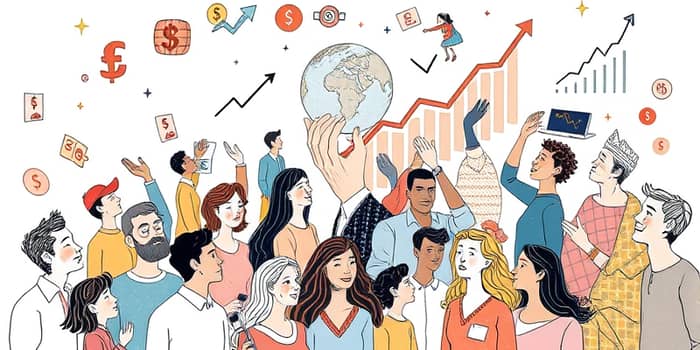
In a world where every economic decision is intertwined with human lives, understanding how population changes shape markets is not just insightful—it's essential for thriving in tomorrow's economy.
The silent forces of demographic shifts are rewriting the rules of global commerce, from labor dynamics to consumer spending, and grasping these trends can unlock unprecedented opportunities.
This article delves into the intricate dance between people and prosperity, offering practical insights to help you navigate and capitalize on these changes.
The Engine of Growth: Labor Force Dynamics
At the heart of economic vitality lies the labor force, and its composition is undergoing profound transformations.
Across most of Africa and Asia, the working-age population is increasing, fueling potential for rapid development and innovation.
In contrast, developed economies in Europe have seen negative growth rates for over a decade, signaling challenges ahead as fewer workers support aging societies.
This divergence creates a demographic dividend in emerging regions, where a surplus of young workers can accelerate growth if skills are nurtured effectively.
However, this window is fleeting, requiring timely investments in education and infrastructure to harness its full potential.
- Key regions with expanding labor forces include Asia and Latin America.
- Regions facing decline include Europe and parts of Advanced Asia.
- The demographic dividend offers a temporary boost but demands strategic planning.
Consumer Spending: From Population to Per Capita
A fundamental shift is underway in how consumption grows globally.
Until the early 2000s, population expansion drove more than half of all spending, but now, three-quarters of global consumption growth comes from individuals spending more per capita.
This reflects rising purchasing power and changing lifestyles, with Asia leading the charge by adding millions to the consumer class each year.
India, for instance, is expected to surpass China in new consumer additions, highlighting the region's dynamic economic ascent.
Historical data shows that while new consumer numbers are slowing, spending per person is accelerating, indicating a maturing market with deeper pockets.
- Consumer class growth is projected from 4 to 5 billion people by 2031.
- Asia contributes 81% of new consumers in 2024, with India and China at the forefront.
- Annual spending growth is now driven more by inflation and income gains than sheer numbers.
Generational Transitions in Spending
Age plays a critical role in shaping consumption patterns, with generational leadership shifting over time.
Generation X currently dominates spending in travel, healthcare, and education, but Millennials will surpass them by the early 2030s as they enter peak earning years.
Seniors are set to account for one-quarter of global consumption by 2050, double their share from 1997, driven by longer lifespans and falling birth rates.
This aging trend necessitates a focus on products and services tailored to older adults, from healthcare to leisure activities.
Regional nuances exist, such as Millennials already leading in Mexico, while Gen X will peak in Brazil around 2028.
Regional Waves of Demographic Change
Demographic shifts occur in distinct waves across the globe, creating varied economic landscapes.
First wave regions, including North America and Western Europe, already face declining working-age populations, with fertility rates as low as 1.2 children per woman.
Later wave regions, such as India and Nigeria, still have growing young populations but will see peaks in the coming decades, offering temporary growth opportunities.
This divergence means businesses must adapt strategies to local contexts, whether investing in aging societies or tapping into youthful markets.
- First wave regions: Advanced Asia, Central and Eastern Europe, North America.
- Later wave regions: Bangladesh, Brazil, Egypt, India, Indonesia.
- These regions account for 35% of global population but shifting economic contributions.
Structural Impacts on Productivity
As demographics evolve, they impose structural constraints on economic output, requiring innovations in productivity.
In Western Europe, labor intensity grew modestly, but aging reduced economic growth by 0.3% annually, highlighting the need for faster productivity gains.
Countries like Australia and Spain face similar challenges, where changing age mixes could slash GDP per capita growth unless offset by technological or policy interventions.
This underscores the importance of investing in automation, education, and flexible work arrangements to sustain prosperity.
- Examples: Western Europe saw 0.4% annual labor intensity growth but 0.3% drag from aging.
- Australia: Age mix decreased weekly hours, affecting GDP growth.
- Spain: Projected to lose 0.8% annual GDP per capita growth due to demographic shifts.
Emerging Market Opportunities
Amidst these changes, specific demographic groups are poised to drive substantial market growth.
Nine key groups will generate three-quarters of global urban consumption growth through 2030, with just three accounting for half, reshaping consumer landscapes.
Minority race and ethnicity groups are gaining economic influence, necessitating diverse product offerings and marketing strategies.
In North America, while the working-age population grows modestly, younger consumers face income pressures, leading to more cost-conscious behaviors.
This creates niches for value-driven brands and services that cater to evolving preferences.
- Top demographic groups: Seniors, Millennials, high-income households.
- Opportunities: Healthcare, education, ethical products for Gen Z.
- Challenges: Income inequality affecting spending patterns.
Navigating Demographic Decline
Some regions are already experiencing population contraction, presenting unique challenges and opportunities.
Countries like Japan, Italy, and Germany are projected to lose millions of consumers, shifting demand towards healthcare and retirement services.
Global population growth is expected to turn negative around 2028-2029, emphasizing the urgency for economies to adapt to shrinking bases.
This decline necessitates a focus on quality over quantity, with innovations in elder care and sustainable living becoming paramount.
Businesses can thrive by pivoting to serve aging populations with tailored solutions, from smart home technologies to personalized wellness programs.
- Countries with consumer class contraction: Japan, Italy, Germany.
- Global trend: Negative population growth imminent by late 2020s.
- Implications: Increased demand for leisure and healthcare offerings.
Practical Implications for Stakeholders
To leverage these demographic trends, individuals and organizations must take actionable steps.
For investors, focusing on regions with growing labor forces or aging populations can yield high returns in sectors like technology and healthcare.
Businesses should diversify product lines to cater to generational shifts, such as developing apps for Millennials or comfort goods for seniors.
Policy-makers need to foster education and immigration to mitigate skill shortages and support economic resilience.
By staying informed and adaptable, you can turn demographic challenges into profitable opportunities for growth.
Embrace data-driven strategies to anticipate market needs and build inclusive economies that benefit all age groups.
Remember, demographics are not destiny—they are a canvas for innovation and connection in an ever-changing world.
References
- https://blogs.worldbank.org/en/developmenttalk/what-do-demographic-changes-mean-for-labor-supply-
- https://www.mastercardservices.com/en/advisors/economic-consulting/insights/8-reasons-why-consumer-spending-patterns-change
- https://www.stlouisfed.org/open-vault/2022/dec/why-economists-study-demographic-change
- https://www.bcg.com/publications/2025/under-pressure-consumers-shift-their-spending
- https://www.mckinsey.com/mgi/our-research/dependency-and-depopulation-confronting-the-consequences-of-a-new-demographic-reality
- https://www.bostonfed.org/publications/current-policy-perspectives/2025/why-has-consumer-spending-remained-resilient.aspx
- https://www.materialplus.io/perspectives/demographics-the-key-to-effective-market-research
- https://www.conference-board.org/webcast/ondemand/US-Consumer-Demographic-Composition
- https://www.schroders.com/en-us/us/individual/insights/the-3d-reset-how-demographic-shifts-will-impact-global-economies-and-markets/
- https://www.weforum.org/stories/2025/09/generation-x-world-consumer-spending/
- https://guides.lib.uh.edu/business/demographics
- https://www.brookings.edu/articles/how-the-world-consumer-class-will-grow-from-4-billion-to-5-billion-people-by-2031/
- https://www.driveresearch.com/market-research-company-blog/market-demographics/
- https://www.mckinsey.com/featured-insights/urbanization/urban-world-the-global-consumers-to-watch
- https://economicdevelopment.extension.wisc.edu/articles/demographics-lifestyle-analysis/