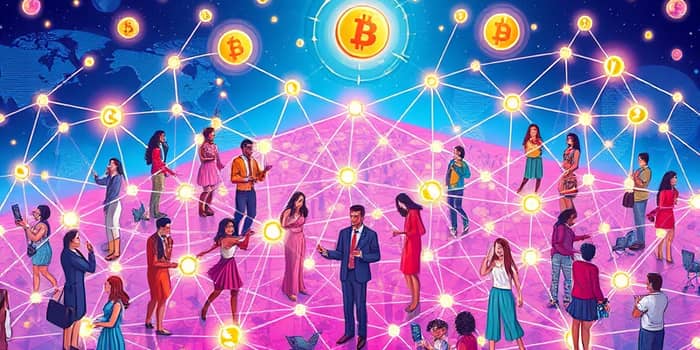
Decentralized Finance, or DeFi, represents a paradigm shift in the way we access, manage, and interact with financial services. By leveraging the transparency and tamper-resistance of public blockchains, DeFi promises to eliminate the need for traditional intermediaries, putting control back into the hands of individual users. This article delves into the core principles, technical building blocks, real-world applications, risks, and future prospects of this emerging digital ecosystem.
Whether you are curious about smart contracts, eager to explore new investment opportunities, or seeking to understand the risks of a borderless financial world, this guide provides a comprehensive overview. Read on to discover how DeFi is reshaping finance and how you can participate in this movement.
Core Definition and Value Proposition
At its heart, DeFi delivers financial instruments and services via smart contracts on programmable, permissionless blockchains. Unlike centralized finance, where banks or brokerages control custody and execution, DeFi protocols run autonomously, enabling users to transact peer-to-peer without intermediaries. Imagine sending money, trading assets, or securing a loan without a single institution taking custody of your funds.
DeFi’s umbrella encompasses lending, trading, payments, insurance, derivatives, and more—all implemented as open-source code. The overarching goal is to provide open, permissionless, global access to anyone with an internet connection, potentially lowering fees, accelerating settlement, and enhancing transparency.
By replacing human gatekeepers with self-executing programs on a blockchain, DeFi empowers users to retain custody via private keys. This shift fosters innovation, as developers worldwide can build new financial services without seeking permission or navigating complex licensing regimes.
How DeFi Works: Technical & Conceptual Building Blocks
DeFi’s foundation rests on public blockchains—distributed ledgers maintained by a network of computers. Platforms like Ethereum allow anyone to read the ledger and submit transactions, provided they pay network fees. These blockchains ensure immutability and consensus, so once a transaction is confirmed, it cannot be altered.
Smart contracts are the backbone of DeFi. These are pieces of code deployed on a blockchain that automatically execute predefined actions when conditions are met. For example, a lending protocol’s smart contract can disburse a loan once a borrower locks collateral, enforce interest accruals, and trigger liquidation if collateral value falls below a threshold.
Users interact with these contracts via decentralized applications (dApps), which serve as user-friendly interfaces. Through wallets controlled by private keys, individuals connect to dApps to lend, borrow, swap tokens, or participate in governance. However, with great power comes great responsibility: loss of a private key means irreversible loss of access.
Governance in DeFi often occurs through Decentralized Autonomous Organizations (DAOs). Token holders vote on protocol upgrades, fee structures, and risk parameters, ensuring that decision-making is distributed rather than centralized. This model aligns incentives between developers, investors, and users.
Key Use Cases and Product Categories
- Lending and borrowing: Supply assets to earn interest; borrowers post overcollateralized crypto collateral.
- Decentralized exchanges (DEXs): Trade tokens directly from wallets via automated market makers.
- Stablecoins: Cryptoassets pegged to fiat currencies, reducing volatility.
- Derivatives and synthetic assets: Speculate on prices and access tokenized versions of real-world assets.
- Payments and money transfers: Near real-time, cross-border transactions without banks.
- Yield-bearing savings: Earn returns through liquidity provision and algorithmic strategies.
- Insurance: Coverage against smart-contract failures or hacks via pooled funds.
- Crowdfunding and token sales: Decentralized capital raising through liquidity bootstrapping pools.
Risks and Challenges
While DeFi offers unprecedented opportunities, it also carries unique risks. Smart-contract vulnerabilities can lead to hacks or exploits, resulting in significant capital losses. The rapidly evolving codebase may harbor undiscovered bugs despite audits.
- Regulatory uncertainty: Jurisdictional differences and unclear guidelines could impact protocol operations.
- Market volatility: Rapid price swings in cryptoassets can trigger liquidations and losses.
- Custody risk: Users bear full responsibility for their private keys and wallet security.
- Oracle failures: Reliance on off-chain data feeds may introduce inaccuracies or manipulation.
Understanding these pitfalls is crucial before allocating significant capital to DeFi. Mitigation strategies include diversifying across protocols, using audited contracts, and employing hardware wallets to secure private keys.
Market Growth, Adoption, and Future Outlook
The DeFi market has experienced explosive but variably estimated growth. According to Precedence Research, the global market was valued at USD 21.04 billion in 2024, projected to soar to USD 1,558.15 billion by 2034 at a CAGR of 53.8%. Other firms forecast even higher expansions, reflecting diverse methodologies—some measure total value locked, others protocol revenues or market capitalization.
Regionally, North America commands the largest share, driven by high crypto adoption and supportive initiatives. The Asia-Pacific region follows closely, with burgeoning user bases and innovative DeFi projects. As infrastructure matures and regulations clarify, institutional participation may accelerate, further scaling the ecosystem.
Looking ahead, we can expect deeper integration between DeFi and traditional finance, increased interoperability across blockchains, and the emergence of more sophisticated derivatives, insurance solutions, and decentralized identity frameworks.
Conclusion
Decentralized Finance is more than a technological novelty—it heralds a future where financial services are accessible, transparent, and user-centric. By understanding the core concepts, technical architecture, use cases, and risks, individuals can navigate this dynamic landscape with confidence.
Whether you aim to optimize your crypto holdings, explore innovative yield strategies, or contribute to protocol governance, DeFi offers a gateway to a new financial frontier. Embrace the possibilities, educate yourself continuously, and participate responsibly in this evolving ecosystem.
References
- https://corporatefinanceinstitute.com/resources/cryptocurrency/decentralized-finance/
- https://www.researchnester.com/reports/decentralized-finance-market/5975
- https://en.wikipedia.org/wiki/Decentralized_finance
- https://www.precedenceresearch.com/decentralized-finance-market
- https://www.britannica.com/money/decentralized-finance-defi
- https://www.grandviewresearch.com/industry-analysis/decentralized-finance-market-report
- https://www.coinbase.com/learn/crypto-basics/what-is-defi
- https://www.insightaceanalytic.com/report/decentralized-finance-market/1607
- https://www.fidelity.com/learning-center/trading-investing/crypto/decentralized-finance-defined
- https://www.technavio.com/report/decentralized-finance-market-analysis
- https://www.nasaa.org/61141/informed-investor-decentralized-finance-defined/
- https://www.statista.com/outlook/fmo/digital-assets/defi/worldwide
- https://www.bis.org/publ/work1066.htm
- https://aws.amazon.com/marketplace/pp/prodview-pzyxqcijnvwmq
- https://www.bostonfed.org/publications/risk-and-policy-analysis/2022/decentralized-finance-defi-transformative-potential-and-associated-risks.aspx
- https://www.thebusinessresearchcompany.com/report/decentralized-finance-global-market-report