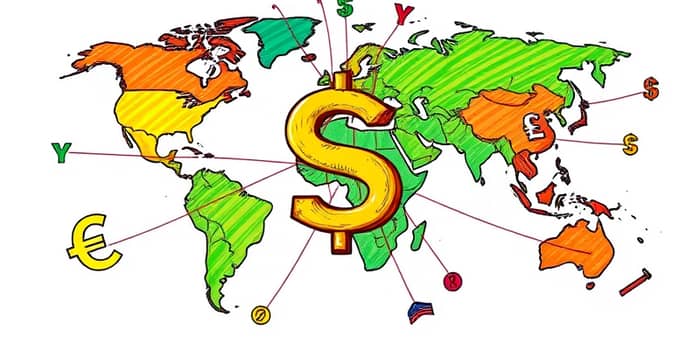
In the aftermath of a sharp 2025 depreciation, the U.S. dollar remains the dominant anchor of the global financial system. Yet structural shifts in trade, reserves, and investor behavior are prompting central banks, asset managers, and corporations to rethink their currency strategies as they navigate an evolving multi-polar environment.
From record FX turnover to subtle reserve rebalancing, this article explores how the dollar’s structural strength coexists with its price weakness, and why diversification strategies are increasingly vital.
1. The Dollar’s 2025 Performance: Weakness in Price, Strength in Structure
In the first half of 2025, the U.S. dollar (DXY index) fell 10.7 percent, marking its worst performance for that period in over fifty years. This decline was driven by a mix of domestic and global factors.
- Slower U.S. growth and revised GDP forecasts.
- Rising U.S. fiscal deficits and budget uncertainty.
- Policy ambiguity around trade and geopolitics.
- Shifting global capital flows beyond interest rates.
Despite rate cuts by the ECB and BoE, the Fed held steady, underscoring that growth and fiscal concerns have weighed more heavily than monetary policy alone.
2. The Dollar’s Structural Dominance in Global FX
The Bank for International Settlements reported record global FX turnover of $9.6 trillion per day in April 2025, up 28% since 2022. Remarkably, the U.S. dollar was on one side of 89.2% of all trades, reaffirming its central role.
All top ten currency pairs still feature the dollar, with rapid growth in USD/CNY, USD/CHF, and USD/HKD. Trading hubs such as London, New York, Singapore, and Hong Kong continue to reinforce deep liquidity for the greenback and the euro.
While FX swaps remain the largest instrument by volume, their share dipped as hedging needs and volatility trading surged elsewhere in the market.
3. Central Banks & Reserves: The Dollar’s Enduring Role
IMF data show the dollar’s share of global reserves at 56.3% in Q2 2025, down from 57.8% a quarter earlier. However, this decline largely reflects valuation effects from dollar depreciation, not active selling.
Once adjusted for valuation, the dollar’s reserve share is virtually unchanged, roughly three times that of the euro and far ahead of the yen, pound, and renminbi. Key reasons include:
- Unmatched depth and safety of U.S. Treasuries.
- Institutional depth and rule-of-law framework in U.S. markets.
- Fed’s ability to provide dollar swap lines during stress.
4. The Rise of the Renminbi (RMB) and Regionalization
The Chinese yuan’s share of global FX turnover reached 8.5% in April 2025, reflecting increased use in trade and investment within Asia and growth in offshore RMB markets, particularly Hong Kong.
Regionalization trends—driven by intra-Asian trade, bilateral currency agreements, and energy deals outside dollar invoicing—are reinforcing the yuan’s role and encouraging the use of other regional currencies such as the yen, won, rupee, and Singapore dollar.
5. Alternative Currencies: Euro, Yen, Pound, CAD
With the dollar in a period of relative weakness, investors and central banks are exploring alternatives more actively:
- Euro: Viewed as the “anti-dollar,” it appreciated from 1.04 to 1.14 USD/EUR in 2025 and remains cheap on PPP. Positive fiscal, political, and economic developments could drive it to 1.22 within a year.
- Japanese yen: Benefiting from safe-haven flows, policy shifts, and unwinding carry trades, the yen has seen a surge in trading volumes.
- British pound: Despite sterling’s decline in market share, it remains a key reserve currency, though vulnerable to UK-specific fiscal and political risks.
- Canadian dollar: Supported by strong fiscal fundamentals, a sound banking system, and reforms, the loonie could reach C$1.32 per USD as the dollar weakens.
6. Global Financial Stability & Currency Risks
The IMF’s October 2025 Global Financial Stability Report warns that, despite being the world’s most liquid market, FX remains vulnerable to funding cost spikes, widening spreads, and excess volatility. Structural vulnerabilities such as currency mismatches in emerging markets and concentrated dealer activity amplify risks.
Moreover, greater participation by non-bank financial institutions can increase fragility, with stress in FX markets spilling over into bond, equity markets, and broader financial conditions.
7. Investment Implications of Dollar Weakness
According to RBC Global Asset Management’s Summer 2025 Outlook, the dollar is in a multi-year decline accelerated by multiple factors, including trade regionalization and increased non-dollar energy invoicing. They forecast above-consensus returns for the euro, yen, pound, and Canadian dollar, along with emerging-market currencies.
Key asset-class impacts include:
- U.S. earnings benefit from a weaker dollar as foreign income translates into more USD.
- Emerging-market debt burdens ease with dollar depreciation.
- Precious metals often rally as the dollar weakens.
In this complex environment, investors and policymakers must blend strategic diversification with vigilance to capture opportunities while managing currency risks. As the dollar’s price moves and its structural dominance endures, a nuanced approach will drive success in a truly global financial arena.
References
- https://www.tastyfx.com/news/despite-2025-pullback-dollar-still-anchors-the-global-forex-market/
- https://www.weforum.org/stories/2025/10/dollar-still-dominates-forex-trading-2025-finance-news/
- https://institutional.rbcgam.com/en/us/research-insights/article/currency-markets-gio-summer-2025_i/detail
- https://www.imf.org/en/publications/gfsr/issues/2025/10/14/global-financial-stability-report-october-2025
- https://www.federalreserve.gov/econres/notes/feds-notes/the-international-role-of-the-u-s-dollar-2025-edition-20250718.html
- https://am.jpmorgan.com/us/en/asset-management/adv/insights/market-insights/market-updates/on-the-minds-of-investors/where-is-the-us-dollar-headed-in-2025/
- https://unctad.org/publication/trade-and-development-report-2025
- https://tradingeconomics.com/forecast/currency