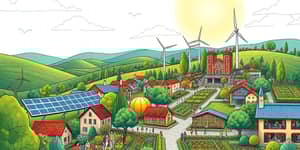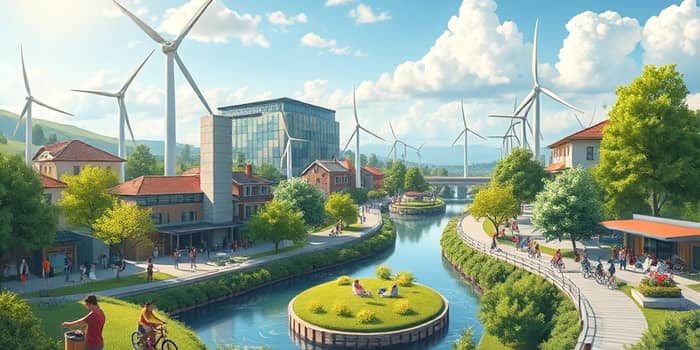
“Waste Not, Want Not” has echoed through generations, urging us to cherish resources. Today, this proverb defines the restorative and regenerative by design vision of the circular economy. By moving beyond the traditional take-make-dispose model, we can build systems that decouple economic activity from finite resources while benefitting business, society, and nature.
Core Principles of Circular Design
The circular economy rests on three interwoven pillars. First, products must be designed to last using high-quality materials and optimized for disassembly. No material is waste; every component becomes an input for a new cycle. Second, value is preserved through sharing, leasing, repairing, refurbishing, and recycling—extending lifecycles at their highest value.
Finally, a circular system must nurture nature. By choosing renewable, non-toxic materials and practices, businesses can restore ecosystems, rebuild soil health, and enhance biodiversity, closing the loop between production and regeneration.
- Design out waste and pollution
- Keep products and materials in use
- Regenerate natural systems
Environmental and Economic Advantages
Shifting to a circular model dramatically reduces environmental impact. Studies show that 80% of a product’s footprint is determined at the design phase, making early decisions vital. By replacing virgin material inputs with recycled content, the circular economy can reduce extraction demand by up to 32% and achieve 70% material savings compared to linear processes. Remarkably, this approach could halve CO2 emissions by 2030 relative to 2018 levels.
On the economic front, circular industries are outpacing traditional sectors. Circular-native businesses have grown twice as fast since 2020, and the global circular market is projected to reach $578.09 billion by 2026. Companies report up to 25% savings on material costs and stand to save $640 billion in disposal expenses by 2050.
- Environmental benefits: reduced extraction, lower emissions, restored ecosystems
- Economic gains: material cost cuts, new revenue streams, market growth
- Social resilience: more jobs, community equity, supply chain security
Social Impact and Business Resilience
A circular economy fuels employment and equity. Repair and recycling are labor-intensive activities, creating thousands of durable jobs while supporting underserved communities. In the EU alone, circular practices could generate 700,000 new positions in repair and recycling, boosting GDP by 0.5%.
Businesses also gain resilience. By relying on recycled inputs and modular designs, companies are less vulnerable to raw material scarcity and price volatility. They comply with tightening regulations, improve their reputation, and drive innovation in processes and services. Consumers benefit too, enjoying durable goods, repair options, and flexible access models that increase disposable income.
Key Metrics at a Glance
EU Policy and Implementation Context
The European Union is pioneering policies to accelerate circularity. The forthcoming Circular Economy Act will mandate higher collection rates, improve recycled material uptake, and enforce recycled-content targets in products. Extended Producer Responsibility rules are expanding, shifting disposal costs from taxpayers to manufacturers and incentivizing better design.
Despite these advances, recycling alone cannot achieve circularity. Hazardous waste in the EU has risen by 31.1% since 2010. NGOs emphasize that true transformation requires prevention, repair, and reuse to reduce resource extraction at the source.
Trends and Future Outlook for 2026
As we approach 2026, investment in circular ventures is poised to accelerate. Falling interest rates will lower capital costs, while digital tools like asset passports, AI-driven sorting, and advanced sensors will streamline reuse and recycling. The refurbished electronics market is booming, demonstrating consumer appetite for high-quality, sustainable alternatives.
Collaboration is key. Shared reuse infrastructure across industries—ranging from packaging loops to repair hubs—will expand. Material scarcity and climate risk will further drive innovation in longer-lasting products and closed-loop business models.
Challenges and Call to Action
Transitioning at scale presents hurdles. Regulatory harmonization across regions, scaling sorting capacity, and shifting consumer mindsets all require coordinated effort. Yet, every stakeholder—from designers and manufacturers to policymakers and consumers—can take concrete steps to turn the circular vision into reality.
- Assess material flows and prioritize design improvements
- Implement take-back schemes and repair networks
- Adopt renewable, non-toxic materials in product lines
- Engage suppliers and customers in closed-loop initiatives
- Monitor progress using standardized circularity metrics
By embracing these actions, businesses can unlock innovation, reduce risks, and cultivate a future where waste is reimagined as opportunity. The circular economy is not a distant ideal—it is a practical pathway to prosperity, resilience, and environmental harmony.
References
- https://youmatter.world/en/definition/definitions-circular-economy-meaning-definition-benefits-barriers/
- https://www.interlakemecalux.com/blog/circular-economy
- https://www.sage.com/en-gb/blog/the-circular-economy-in-2026-and-beyond-manufacturing/
- https://www.okonrecycling.com/consumer-recycling-initiatives/learn-about-recycling/what-is-circular-economy/
- https://www.statista.com/statistics/1337519/circular-economy-market-revenue/
- https://www.europarl.europa.eu/topics/en/article/20151201STO05603/circular-economy-definition-importance-and-benefits
- https://www.circle-economy.com/cgr
- https://greenly.earth/en-us/blog/company-guide/circular-economy-definition-and-principles
- https://www.reuseabox.co.uk/circular-economy-trends-for-2026-every-business-should-know/
- https://www.milliken.com/en-us/blogs/circular-economy-sustainability
- https://www.tomra.com/news-and-media/news/2025/circular-technology-trends-in-2026-turning-preparation-to-action
- https://www.ellenmacarthurfoundation.org/topics/circular-economy-introduction/overview
- https://www.thebusinessresearchcompany.com/report/circular-economy-global-market-report
- https://fsc.org/en/blog/what-is-circular-economy