In an era defined by rapid technological breakthroughs, leaders across sectors face a pivotal question: how can we transform disruptions into profitable opportunities? This article explores key innovations reshaping industries, uncovers market-specific challenges, and offers pragmatic strategies to thrive amid change.
By harnessing tailored tools, investing wisely, and reinforcing digital trust, organizations can chart a path to sustainable growth. Read on to discover how to turn waves of disruption into catalysts for competitive advantage.
Understanding the Convergence of Exponential Shifts
Today’s business landscape is being remade by three foundational technology shifts: generative AI, quantum computing, and spatial computing. Each offers unique capabilities—from automating complex workflows to creating immersive virtual collaborations. When combined, they produce a force multiplier effect that can accelerate innovation and disrupt entrenched players.
Strategic foresight is no longer optional for executives who wish to stay ahead. Anticipating emerging trends and aligning resources with disruptive forces is the first step toward long-term resilience.
The Three Pillars of Disruption
To capitalize on industry shifts, it is essential to understand the core attributes of each transformative technology.
Manufacturing and Industry 4.0: Seizing Operational Excellence
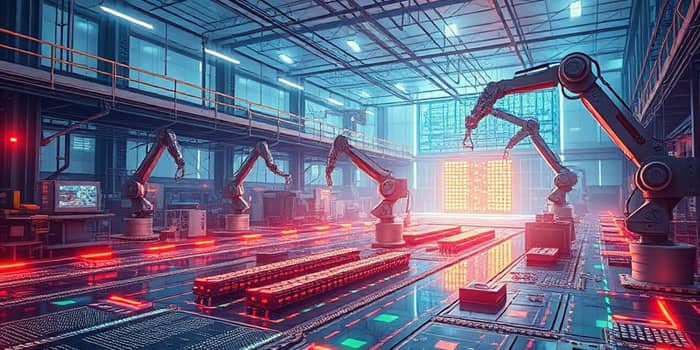
For manufacturing leaders, the integration of AI and automation is imperative. Physical AI—autonomous robots capable of sorting, transporting, and installing components—promises to revolutionize shop floors. Meanwhile, investments in small modular reactors and semiconductor capacity are set to redefine energy and chip production.
- 80% of executives plan to allocate 20% or more of budgets to new technology.
- 22% of manufacturers will deploy autonomous robots within two years.
- $500 billion committed to US chipmaking expansion by 2032.
Despite a temporary downturn in construction spending and policy uncertainty, these commitments signal a robust long-term trajectory. Manufacturers who move beyond generic AI adoption will unlock predictive maintenance, optimize supply chain flows, and elevate worker safety.
Navigating Market-Specific Disruptions
Disruptions manifest differently across markets. From memory-chip shortages to shifting smartphone demand, each sector demands tailored responses.
In semiconductors, a prolonged DRAM shortage is driving year-on-year growth below historical norms, forcing device makers to adapt production schedules and explore alternative materials. Smartphone vendors, especially low-margin ones, face potential market contractions up to 5.2%; they must pivot to value-added services or regional niches.
The PC market encounters a “perfect storm”—memory scarcity, Windows 10 end-of-life upgrades, and AI marketing hype—leading to projected price hikes of 15–20%. Companies that can bundle AI-enabled features with support services will differentiate themselves and mitigate volume declines.
Strengthening Supply Chain Resilience and Cybersecurity
Recent years have witnessed a 61% surge in cyber-attacks targeting logistics networks. As physical and digital infrastructures converge, supply chain vulnerabilities represent a systemic risk.
Organizations must prioritize digital trust through robust cybersecurity frameworks. Key measures include continuous authentication, behavioral biometrics, and end-to-end encryption. Record M&A activity—such as Palo Alto Networks’ $25 billion acquisition of CyberArk—underscores the commercial value of advanced identity solutions.
Strategic Imperatives for Leadership
To thrive amid disruption, leaders should embrace five strategic imperatives:
- Continuously scan the horizon for emerging agentic AI use cases.
- Anticipate how quantum computing will reshape risk analysis and decision-making.
- Embrace spatial computing to redefine teams and collaboration.
- Forge partnerships with startups to accelerate innovation cycles.
- Invest in digital trust and cybersecurity as strategic assets.
By executing on these directives, organizations can move from reactive firefighting to proactive value creation, positioning themselves as leaders rather than followers.
Real-World Success Stories: From Vision to Value
Leading enterprises are already reaping benefits. Volkswagen’s collaboration on quantum algorithms has accelerated battery research, compressing months of experimentation into hours. BMW’s digital twin factories have reduced downtime by enabling remote teams to identify bottlenecks and reconfigure lines in real time.
In the legal sector, bespoke AI platforms draft and review contracts in seconds, liberating attorneys for high-value work. Retailers harness generative AI to design personalized products on-demand, boosting customer engagement and reducing inventory waste.
Conclusion
The convergence of generative AI, quantum computing, and spatial computing marks a watershed in industrial evolution. Companies that embed these technologies into their core operations—reinforcing their supply chains and securing digital trust—will emerge as the winners in a disrupted landscape.
Remember: preparing for future market shifts is not merely a strategic choice but a business imperative. By capitalizing on industry disruptions today, organizations can build a resilient, innovative, and profitable tomorrow.
References
- https://www.burrus.com/emerging-technologies-2026-business/
- https://www.deloitte.com/us/en/insights/industry/manufacturing-industrial-products/manufacturing-industry-outlook.html
- https://www.corumgroup.com/insights/2026-top-10-disruptive-tech-trends
- https://www.idc.com/resource-center/blog/global-memory-shortage-crisis-market-analysis-and-the-potential-impact-on-the-smartphone-and-pc-markets-in-2026/
- https://www.lseg.com/en/insights/ftse-russell/the-us-markets-take-on-ai-disruption
- https://www.slalom.com/us/en/insights/manufacturing-outlook-2026
- https://www.everstream.ai/articles/are-you-prepared-for-the-supply-chain-disruptions-of-2026/