For decades, Gross Domestic Product (GDP) has stood as the primary gauge of economic success.
Yet, this reliance on a single number often masks the deeper realities of human progress and planetary health.
We must question whether economic output alone defines true prosperity, prompting a shift toward more holistic measures.
The Hidden Flaws of GDP
GDP measures total market-based output but overlooks critical aspects of well-being.
It fails to account for uneven income distribution and regional disparities, which can distort national economic narratives.
For instance, from 2001 to 2021, U.S. GDP rose by 45.4%, but growth was uneven.
San Francisco surged by 87.4%, while New Orleans contracted by 5.2%, highlighting stark imbalances.
Other significant shortcomings include the exclusion of non-market activities and environmental costs.
Unpaid work like childcare and volunteering, along with subsistence farming, are omitted from calculations.
This understates economies with high informal sectors and ignores the value of community and family care.
Environmental degradation, such as pollution and resource depletion, is not deducted from GDP figures.
This means that activities harming our planet are often counted as economic gains, not losses.
- GDP ignores the costs of crime, family breakdown, and climate change destabilization.
- It undervalues the data economy, where free exchanges like personal data for services are overlooked.
- Technological innovations, such as self-booking flights, can be seen as economic shrinkage rather than progress.
- Underground markets and product quality improvements are also excluded from measurements.
- Leisure time and inequality, both vertical and horizontal, are not captured in GDP data.
Historically, GDP was developed by Simon Kuznets post-Great Depression and modified by Keynes.
Criticism dates back to 1968 when Robert Kennedy noted it measures everything except that which makes life worthwhile.
Exploring Alternative Indicators
To address GDP's limitations, various alternative metrics have emerged.
These indicators adjust GDP or measure multi-dimensional well-being, including social and environmental factors.
These alternatives help redefine prosperity by incorporating sustainability and human well-being into economic analysis.
They challenge the notion that growth alone leads to better lives.
- Green GDP adjusts for environmental and social costs, promoting eco-friendly policies.
- Ecological Footprint measures human demand on nature, encouraging resource conservation.
- Happy Planet Index and Well-Being Index focus on life satisfaction and health outcomes.
- STAR rating systems assess job quality and inclusion for underrepresented groups.
By using such metrics, we can move beyond narrow economic indicators and foster more inclusive progress.
Real-World Applications and Policy Shifts
Governments and cities are increasingly adopting alternative metrics to guide policy.
States like Hawaii and Vermont use GPI to inform sustainable development strategies.
Cities such as San Francisco report public metrics to adjust investments and convene stakeholders.
New Zealand's national framework integrates well-being into all policy decisions, setting a global example.
- Businesses are aligning with these shifts through B Corps and worker-owned cooperatives.
- Initiatives like the Cleveland Model promote green jobs and fair pay, enhancing community resilience.
- Global pushes, such as the Sarkozy-Stiglitz Commission, critique GDP and advocate for standardized beyond-GDP metrics.
- Calls for UN-led committees aim to expand multilateral cooperation on new economic measures.
Organizations like LISEP emphasize that GDP is designed for a bygone era and urge rethinking metrics for working Americans' well-being.
NEF views GDP as a means to an end, not an end in itself, promoting growth that prioritizes people and planet.
These applications show how alternative indicators can drive meaningful and sustainable change in economies.
Future Directions and Challenges
As we look ahead, the evolution of economic measurement faces both opportunities and obstacles.
Historical critiques from figures like Kennedy have paved the way for modern reforms, but challenges remain.
For example, global GDP has doubled since 1970, yet resource use has tripled, highlighting sustainability issues.
GPI and other indicators often face subjectivity, limiting cross-comparisons and requiring mixed suites with GDP.
- Future efforts should focus on comprehensive wealth metrics over flow indicators like GDP.
- Centering youth and underrepresented groups in economic assessments is crucial for equity.
- EU initiatives aim to develop comparable environmental and social indicators for better policy-making.
- Expanding data collection on non-market activities can improve the accuracy of alternative metrics.
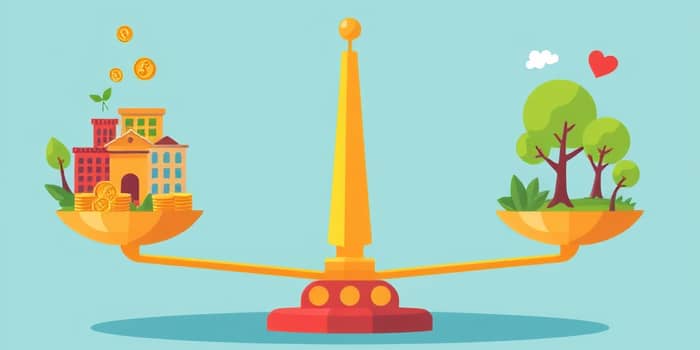
These directions promise to redefine prosperity by balancing economic growth with ecological health.
They inspire a vision where policies are informed by holistic well-being, not just output numbers.
Conclusion: Embracing a Holistic Vision
Moving beyond GDP is not just an academic exercise; it's a practical imperative for our times.
By adopting alternative metrics, we can create economies that truly serve people and the planet.
This shift requires courage and collaboration from governments, businesses, and communities alike.
Let's commit to measuring what matters, ensuring that future generations inherit a world of balance and prosperity.
- Start by advocating for local GPI or HDI reports in your community.
- Support businesses that prioritize social and environmental accountability.
- Engage in policy discussions to promote beyond-GDP metrics at national levels.
- Educate others on the limitations of GDP and the value of holistic indicators.
Together, we can build a future where economic health is defined by well-being, sustainability, and equity for all.
References
- https://www.lisep.org/content/gdp-poor-measure-of-nations-economic-health-says-ludwig-institute-report
- https://sustainableconsumption.usdn.org/initiatives-list/alternative-economic-indicators
- https://corporatefinanceinstitute.com/resources/economics/gross-domestic-product-limitations/
- https://www.stlouisfed.org/open-vault/2023/apr/three-other-ways-to-measure-economic-health-beyond-gdp
- https://www.worldfinance.com/strategy/why-gdp-is-no-longer-the-most-effective-measure-of-economic-success
- https://www.thebeyondlab.org/article/whats-next-on-beyond-gdp-2
- https://www.globalpolicyjournal.com/blog/05/08/2025/alternative-conceptual-framework-gdp-measuring-well-being-interview-james-k-boyce
- https://unu.edu/cpr/report/beyond-gdp-and-multidimensional-vulnerability-index
- https://fscj.pressbooks.pub/macroeconomics/chapter/limitations-of-real-gdp/
- https://www.oecd.org/en/topics/policy-issues/well-being-and-beyond-gdp.html
- https://courses.lumenlearning.com/hccs-macroeconomics-3/chapter/shortcomings-of-gross-domestic-product/
- https://www.c40knowledgehub.org/s/article/Beyond-GDP-How-your-city-can-use-alternative-measures-of-social-environmental-and-economic-progress
- https://joint-research-centre.ec.europa.eu/projects-and-activities/beyond-gdp-delivering-sustainable-and-inclusive-wellbeing_en